
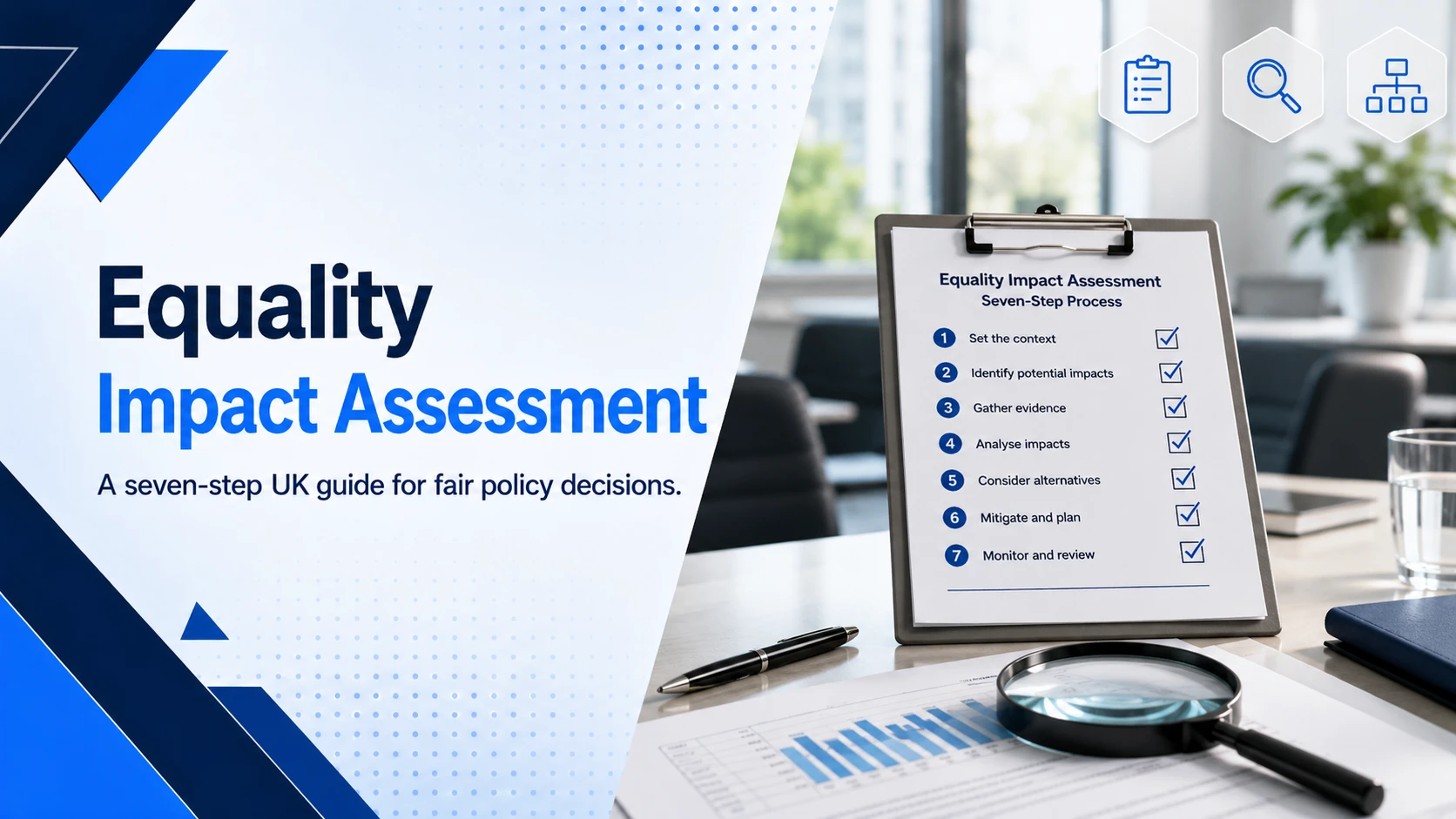
An equality impact assessment, or EIA, is the document that shows you considered the equality consequences of a decision before you took it. UK public bodies use them constantly: when a council changes its waste collection schedule, when an NHS trust restructures a service, when a university revises its admissions policy. They are also used by housing associations, charities and an increasing number of private employers who want a defensible record of how they made their decisions.
This guide explains when you need an EIA, what it should contain, the process for doing one well, and the mistakes that turn an EIA into a paperwork exercise rather than a useful tool.
When you need to do one
EIAs sit underneath the Public Sector Equality Duty, set out in section 149 of the Equality Act 2010. The duty requires public authorities to have 'due regard' to the need to eliminate discrimination, advance equality of opportunity and foster good relations when exercising their functions. An EIA is the most established and credible way of evidencing that you did so.
You should consider an EIA whenever you are making a decision that affects how people use a service or experience an organisation. Typical triggers include a new policy, a significant change to an existing policy, a restructure, a budget reduction that will affect service provision, a major procurement, and a strategy or plan that sets direction for several years. Routine operational decisions don't usually need a full EIA but should still be considered through an equality lens.
The duty itself, and the contexts where EIAs are commonly used, are covered more fully in our guide to the Public Sector Equality Duty.
Is an EIA legally required?
This is the most common question and the answer matters. An equality impact assessment is not, in itself, a legal requirement under the Equality Act in England. The legal duty is to have 'due regard' to the three aims set out in section 149. An EIA is the practical tool through which most public bodies demonstrate they had that due regard.
The position differs by nation. In Scotland, the specific duties under regulations attached to the Act require public authorities to assess and review new and revised policies and practices against the three needs of the duty, use evidence, act on the results and publish the assessment. In Wales, public bodies must assess the likely impact of proposed and reviewed policies on PSED compliance, and publish reports where a substantial impact is detected. In Northern Ireland the equivalent duty arises under Section 75 of the Northern Ireland Act 1998 rather than the Equality Act 2010.
For private organisations, an EIA is never required by equality law but is increasingly expected by funders, regulators and partners as evidence of good practice. It's also a useful management tool: it forces a structured pause before a significant decision.
Who should be involved
The temptation is to assign the EIA to one person, usually whoever drew the short straw in the policy team. This is the single biggest reason EIAs end up as paperwork. They work when the people closest to the decision and the people closest to the affected groups both contribute.
A workable model is a small assessment group: the policy or service lead who is proposing the change, an equality lead or HR contact who knows the legal framework, a representative from operations who understands what implementation will actually look like, and — crucially — input from people with relevant lived experience. For a council policy change that lived experience might come through resident consultation; for an employer it might come through staff networks or employee resource groups.
Sign-off should sit with the decision-maker, not the assessor. The decision-maker is the person who is accountable under the duty, and they need to see, understand and engage with the assessment before the decision is taken.
The seven-step process

A good EIA follows a recognisable structure. The names vary but the content is consistent across the Equality and Human Rights Commission guidance, gov.uk guidance for public authorities, and the various sector-specific frameworks.
Step 1: Scoping
Describe the proposal clearly, in plain English. What is being changed? Why? When? Who will be affected and how? The scoping section is where many EIAs collapse — if the proposal can't be described in two paragraphs of ordinary language, the EIA won't work either.
Step 2: Evidence gathering
What data do you already have about who uses the service, who works in the relevant team, who lives in the relevant area? What national or regional data is available? What consultation has already taken place, and what does it tell you? Reference the data, don't just claim it. If you don't have data, say so and explain how you'll address the gap.
Step 3: Analysis
For each of the nine protected characteristics, ask: how will this decision affect people who share this characteristic? The honest answer is sometimes 'no differential impact' and that's fine if you can show why. More often there is some differential impact, and the analysis is about identifying it precisely. A change to library opening hours might reduce access for older residents who don't use online services. A change to a uniform policy might affect people whose faith requires particular dress. A change to flexible working might reduce options for people with caring responsibilities or chronic health conditions.
Step 4: Mitigation
Where you've identified negative impact, what are you going to do about it? Mitigation might mean redesigning the proposal, providing alternative provision for the affected group, phasing the change, communicating differently, or accepting some impact and explaining why it's justified and proportionate. Document the reasoning.
Step 5: Sign-off
The decision-maker reviews the assessment and either approves the proposal (with whatever mitigation has been built in), asks for revisions, or rejects it. This step is what makes the EIA evidence of due regard — it must happen before the decision is taken, not after.
Step 6: Publication
Public sector EIAs should generally be published. In Scotland and Wales there are specific requirements; in England the position is looser but the EHRC strongly recommends publication. Publishing the assessment makes it useful to others, makes it auditable, and signals good practice.
Step 7: Review
EIAs aren't one-off documents. If the proposal changes during implementation, the EIA should be updated. If unanticipated impacts emerge, the EIA should be revisited. Set a review date.
A worked example

Hollowmoor District Council is consulting on changing its garden waste collection from weekly to fortnightly to reduce costs.
Scoping: The change affects all households that currently use garden waste collection. The council estimates 22,000 households. The aim is to save £180,000 a year, with the saving redirected to social care.
Evidence: The council has data on which households opt into garden waste collection (it's a paid service). Cross-referenced with Council Tax data, this gives a profile of the user base by age, household type and area deprivation level. The council also has feedback from the last consultation on waste services, three years earlier.
Analysis: Older residents are over-represented among garden waste users. Some have mobility limitations and store waste in containers they can't easily move. Larger families and households with growing children are also over-represented; smaller, flatted properties are under-represented. The fortnightly schedule has a particular impact on the summer months when garden waste volumes are highest.
Mitigation: The council proposes (a) maintaining weekly collection from May to August when waste volume is highest; (b) offering free wheeled bins to households where the resident or a member has a physical disability that makes container handling difficult; (c) running a communication campaign focused on older residents using community channels, not just the website; (d) extending the consultation period by two weeks to allow more responses from groups under-represented in the first round.
Sign-off: The Cabinet Member for Environment reviews the assessment, agrees the mitigations, and approves the change with the revised summer-weekly arrangement.
Publication: The assessment is published on the council's website alongside the cabinet decision.
Review: A review is scheduled for nine months after implementation to check actual impacts and adjust if needed.
The decision is the same as the original proposal in most respects, but it is now defensible, transparent and adjusted where the analysis suggested adjustment was justified.
Common mistakes
Several patterns turn EIAs from a useful tool into a tick-box exercise.
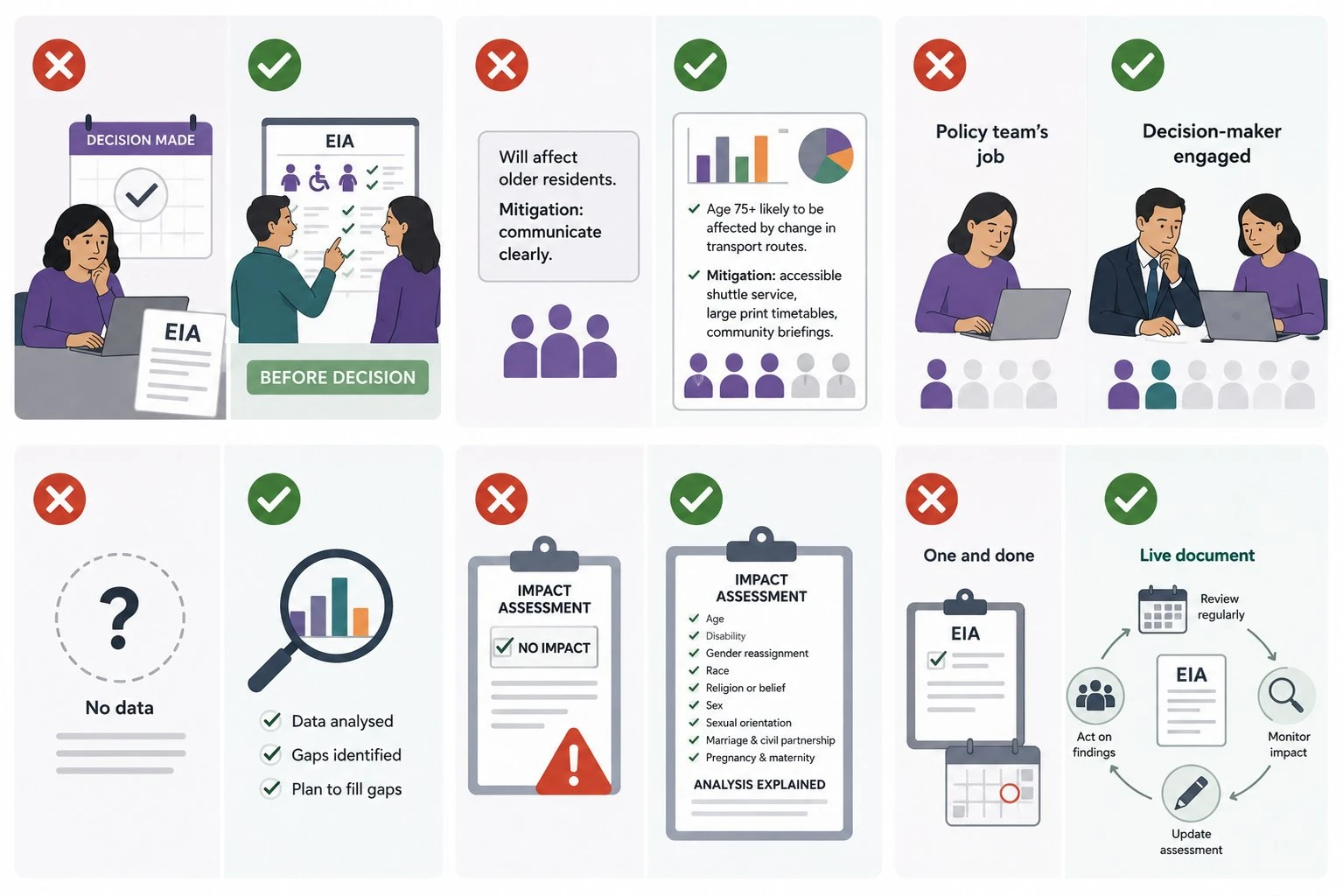
Doing the EIA after the decision
The legal duty is to have due regard before and at the time of the decision, not afterwards. An EIA that exists only as retrospective justification doesn't satisfy the duty and is vulnerable to challenge.
Generic statements that could apply to anything
'Will affect older residents — mitigation: communicate clearly' is not an EIA, it's a placeholder. Specific assessments cite specific data and describe specific actions.
Treating it as the policy team's responsibility
EIAs work when the decision-maker engages. If the decision-maker only sees the EIA at sign-off and signs without reading it, the duty hasn't really been discharged.
Skipping the evidence step
EIAs that don't reference data are weaker, both legally and practically. If the data isn't available, the EIA should say so and describe how the gap will be filled.
Treating 'no impact' as the answer to everything
If the honest answer is 'no differential impact', explain why. If the assessment finds no impact across nine characteristics for a major service change, it's probably wrong.
Reviewing and updating
EIAs are described as 'live documents' for a reason. Significant changes during implementation should trigger a review. Unexpected impacts identified after implementation should be addressed in an updated assessment. Set a review date — six months or a year is typical — and stick to it.
Some specific duties in Scotland and Wales include explicit publication and review requirements; in England these are good practice rather than mandatory but the EHRC's expectation is that meaningful assessments are reviewed.
Frequently asked questions
What is an equality impact assessment?
An equality impact assessment, or EIA, is a structured analysis of how a proposed decision or policy will affect people with different protected characteristics. It is the most common way that public authorities demonstrate compliance with the Public Sector Equality Duty.
Is an EIA legally required?
An EIA is not directly required by the Equality Act in England, but the underlying duty to have due regard to equality is, and an EIA is the established tool for demonstrating that you've had it. In Scotland and Wales the specific duties impose stronger requirements to assess, publish and review.
When should an EIA be carried out?
Before and during the decision-making process, not afterwards. The aim is to inform the decision, not to justify it once made. If an EIA is being written to support a decision that's already been taken, the legal duty has probably already been failed.
Who should do the EIA?
A small group involving the policy or service lead, an equality or HR contact, an operations representative, and input from people with relevant lived experience. Sign-off should sit with the decision-maker.
What sections should an EIA include?
At minimum: a clear scoping description, evidence and data, analysis of impact across the nine protected characteristics, mitigation actions where impact is negative, sign-off, publication arrangements and a review date.
Should an EIA be published?
Generally yes, particularly in the public sector. Scotland and Wales have specific publication duties. In England publication is good practice and strongly recommended.
Equality impact assessments are part of a wider compliance framework that includes the Public Sector Equality Duty, the protected characteristics listed in the Equality Act, and an organisation's general equality and diversity policy. If you'd like your team trained to carry out EIAs confidently and to a defensible standard, our Equality, Diversity & Inclusion Training course covers the process in detail with current case-law context.
Related guides
- The Public Sector Equality Duty: a UK guide
- The Nine Protected Characteristics Under the Equality Act 2010
- Equality Act 2010: The Complete UK Guide
Train your team to carry out equality impact assessments confidently and to a defensible standard.
Explore the Equality, Diversity & Inclusion course →
Mark writes about equality, diversity & inclusion, workplace compliance and accredited online training for Equality, Diversity & Inclusion Training, part of Online CPD Academy.