
An equality and diversity policy is a written statement of how an organisation treats people fairly, prevents discrimination, and values difference. It is the document that sets expectations for staff and managers, explains how to raise concerns, and provides the framework for everything from recruitment through to disciplinary action.
This guide explains what should go into one, what's changed in the law since 2024, and gives you a template structure to adapt. It's relevant whether you're a small business writing your first policy, a charity updating an old one, or an HR manager who's inherited a policy that hasn't been touched since 2018.
Is an equality and diversity policy legally required?
In England, Scotland and Wales an equality and diversity policy is not itself legally required. What the law requires is compliance with the Equality Act 2010 — that you don't discriminate, harass or victimise people because of a protected characteristic, that you make reasonable adjustments for disabled people, that you take active steps to prevent sexual harassment, and (if you're a public body) that you have due regard to the Public Sector Equality Duty.
A policy is the most common way of evidencing that you take those duties seriously and have a coherent approach to them. The Equality and Human Rights Commission recommends that every organisation has one. Employment tribunals routinely look at whether an employer had a policy, whether it was communicated to staff, and whether it was followed when assessing claims.
For organisations with 250 or more employees, gender pay gap reporting is a separate statutory requirement under the Equality Act 2010 (Gender Pay Gap Information) Regulations 2017. That obligation isn't the policy itself but the policy should reference it.
What to include
A workable equality and diversity policy covers ten areas. You can re-order them, but if any are missing the policy has gaps.
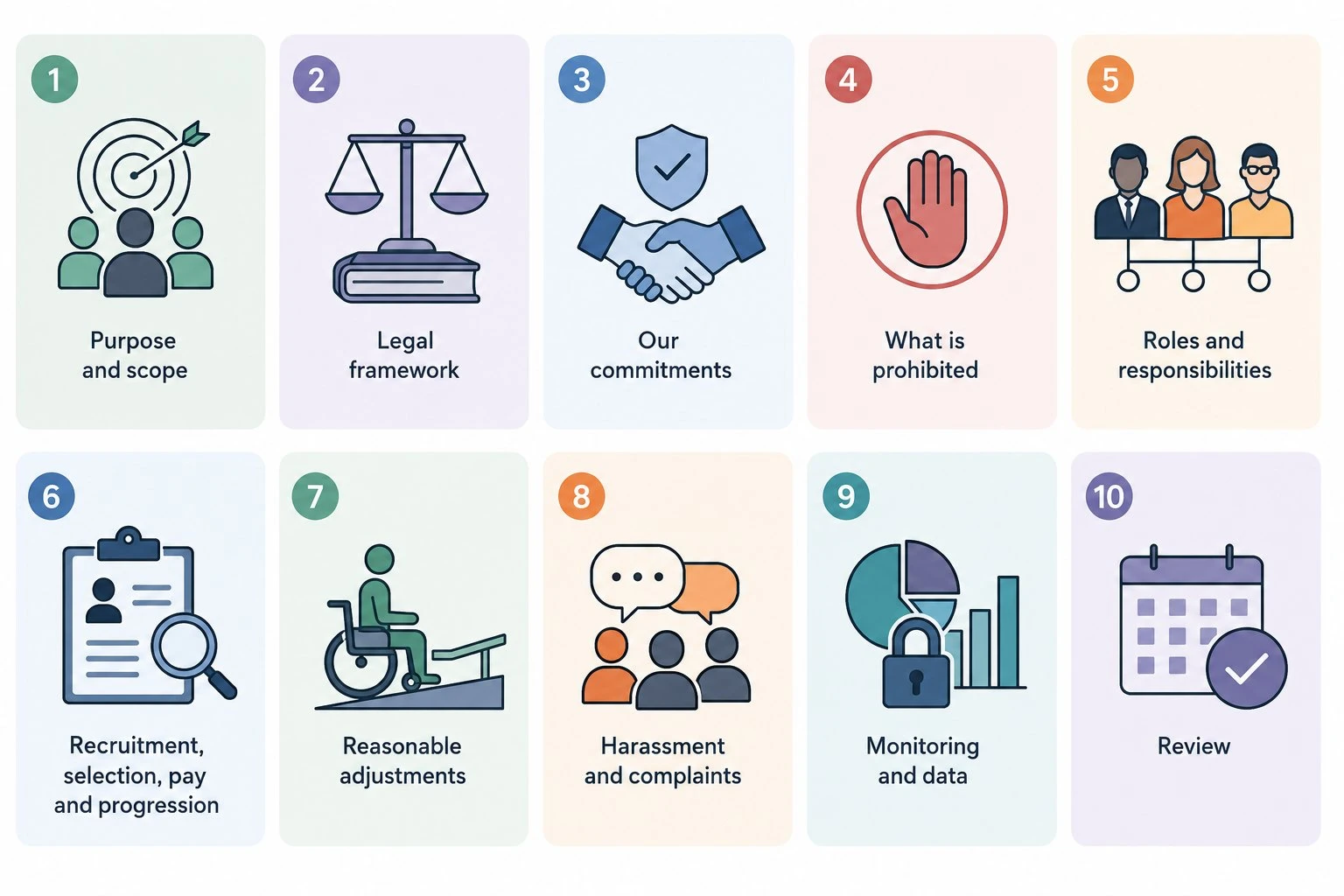
1. Purpose and scope
What the policy is for and who it applies to. Scope usually covers employees, workers, contractors, volunteers, agency staff and job applicants. Some organisations also extend the policy explicitly to customers, service users and the public — useful both for legal cover and for cultural clarity.
2. Legal framework
A short reference to the Equality Act 2010, the nine protected characteristics, the duty to make reasonable adjustments, and the prohibitions on direct discrimination, indirect discrimination, harassment and victimisation. Public sector employers should also reference the Public Sector Equality Duty.
3. The organisation's commitments
What the organisation actually commits to do. This isn't a place for vague aspirations. Specific commitments work better: 'we will publish our gender pay gap annually', 'we will offer reasonable adjustments at recruitment and during employment', 'we will train all managers on inclusive recruitment', 'we will provide mandatory equality training during induction and refresh it every two years'.
4. What is prohibited
Direct and indirect discrimination, harassment (including sexual harassment and third-party harassment), victimisation, and bullying. State the consequences plainly.
5. Roles and responsibilities
What managers are expected to do (model the policy, respond to concerns, accommodate reasonable adjustments), what HR is expected to do (advise, investigate, monitor), what every employee is expected to do (read and follow the policy, raise concerns). The board or senior leadership should be named as accountable.
6. Recruitment, selection, pay and progression
Fair adverts, fair selection criteria, blind shortlisting where practicable, structured interviews, pay decisions based on objective criteria, promotion based on capability. This section is the part of the policy with the most legal exposure.
7. Reasonable adjustments
A clear statement that the organisation will make reasonable adjustments for disabled employees and job applicants, how to request them, and the process for assessing and providing them. Reference our fuller guide to reasonable adjustments under the Equality Act.
8. Harassment and complaints
How to report harassment or discrimination, including the option to raise concerns informally and the formal grievance route. The Worker Protection Act 2023 has reshaped what good practice looks like here — see below.
9. Monitoring and data
What equality monitoring data the organisation collects, why, the lawful basis under UK GDPR (equality monitoring data is special category data under Article 9 and needs an explicit condition for processing), and how the data is protected.
10. Review
A commitment to review the policy regularly — annually is the usual standard — and to update it after material legal changes or significant organisational change.
Sample template wording
The structure below is a starting point. Replace bracketed text and adapt to your sector and size.
Purpose and scope
[Organisation name] is committed to providing equal opportunities and to a workplace free from unlawful discrimination, harassment and victimisation. This policy applies to all employees, workers, contractors, volunteers, agency staff and job applicants, and to the services we provide to our customers and the public.
Legal framework
This policy is informed by the Equality Act 2010, which prohibits discrimination on the grounds of nine protected characteristics: age, disability, gender reassignment, marriage and civil partnership, pregnancy and maternity, race, religion or belief, sex, and sexual orientation. [If applicable: We are also subject to the Public Sector Equality Duty under section 149 of the Act.] We also recognise our duties under the Worker Protection (Amendment of Equality Act 2010) Act 2023 to prevent sexual harassment, and we are reviewing our practices in advance of further changes taking effect in October 2026 under the Employment Rights Act 2025.
Our commitments
We will: provide equality, fairness and respect for all staff; make reasonable adjustments for disabled employees and applicants; provide training on equality and diversity at induction and as part of ongoing development; investigate complaints of discrimination, harassment and victimisation; review pay annually and publish our gender pay gap data [if 250+ employees]; monitor the diversity of our workforce and act on what the data shows; and review this policy annually.
What is prohibited
Direct discrimination, indirect discrimination, harassment (including sexual harassment and harassment by third parties), victimisation, and bullying. Breach of this policy will be treated as a serious disciplinary matter, up to and including dismissal.
Responsibilities
[Senior named role] is responsible for the implementation of this policy. All managers are responsible for modelling its expectations and responding to concerns. All employees are responsible for treating colleagues, customers and the public fairly and for raising concerns through the appropriate route.
Reasonable adjustments
We will make reasonable adjustments for disabled employees and job applicants. Requests can be made to [named contact] at any point and will be discussed openly. We do not require a formal diagnosis before considering an adjustment.
Raising concerns
Anyone affected by behaviour that falls below the standards in this policy can raise it informally with their manager, with [HR contact], or formally under our grievance procedure. Where the matter involves harassment or potential criminal conduct, the formal route is usually appropriate.
Monitoring
We collect equality monitoring data on a voluntary, anonymised basis to track whether our practices are working as intended. The lawful basis under UK GDPR is [substantial public interest condition, with appropriate policy document in place / explicit consent / other applicable Schedule 1 condition]. Monitoring data is held separately from personnel records.
Review
This policy will be reviewed annually and updated whenever material legal or organisational changes occur.
Adapt the language and add detail relevant to your sector and size. A care provider will want explicit reference to the Care Act 2014; a school will reference statutory equality duties in education; a public body will reference the PSED and equality objectives.
What's changed since 2024
Two developments are reshaping what counts as a good policy. Both should be reflected in any policy written or revised from late 2024 onwards.
Section 40A of the Equality Act, inserted by the Worker Protection (Amendment of Equality Act 2010) Act 2023, came into force on 26 October 2024. It places an active duty on employers to take reasonable steps to prevent sexual harassment of their workers. Tribunals can uplift discrimination compensation by up to 25% where the duty hasn't been met. A policy from before October 2024 is unlikely to address this duty explicitly.
The Employment Rights Act 2025 raises the bar further from October 2026. The standard becomes 'all reasonable steps', not just 'reasonable steps', and the duty extends to third-party harassment — harassment by customers, contractors, members of the public — across all protected characteristics, not just sex. Policies will need to be reviewed in advance of October 2026 to reflect this.
Recruitment, selection and pay
This section deserves more space than most policies give it because it's where most discrimination cases originate.
For recruitment: write job descriptions in plain English, list essential and desirable criteria separately, advertise in at least two channels to reach a wider audience, train shortlisters in inclusive practice, and use structured interviews with the same questions for every candidate. Make reasonable adjustments at every stage from application to interview to assessment.
For pay: review pay decisions against objective criteria, run a regular audit by protected characteristic, and address any unexplained differentials. Equal pay claims under the Equality Act compare like work, work rated as equivalent, or work of equal value between men and women specifically; but the same principle of objective justification applies across all protected characteristics for any other pay difference.
For progression: training opportunities should be open and known, succession planning should be transparent, and high-potential or talent schemes should be assessed for whether they reproduce the existing demographic mix of senior roles.
Embedding the policy
A written policy is the foundation, not the building. Training, monitoring and routine reinforcement are what make it real.
Training should be mandatory at induction, refreshed periodically, and tailored to role — managers need more detail on their specific responsibilities, including the duty to make reasonable adjustments and to prevent harassment.
Monitoring should be regular, voluntary and anonymised, with results reviewed at leadership level and acted on where patterns emerge.
Reinforcement happens in the small day-to-day decisions. A policy that says 'we welcome applications from candidates with disabilities' followed by an inaccessible interview venue is doing harm. The signal is the action, not the document.
Data protection and monitoring
Equality monitoring data — ethnicity, religion, sexual orientation, disability, gender identity — is 'special category data' under Article 9 of the UK GDPR. You need an Article 9 condition for processing, usually either explicit consent or the substantial public interest condition with an appropriate policy document in place. The Information Commissioner's Office publishes guidance on the substantial public interest conditions.
Practically, this means: collect voluntarily, explain why you're collecting, separate the monitoring data from personnel records, restrict access, and don't use individual responses in management decisions.
Policies most templates miss
Three areas are increasingly expected in modern UK policies and are missing from most older templates.
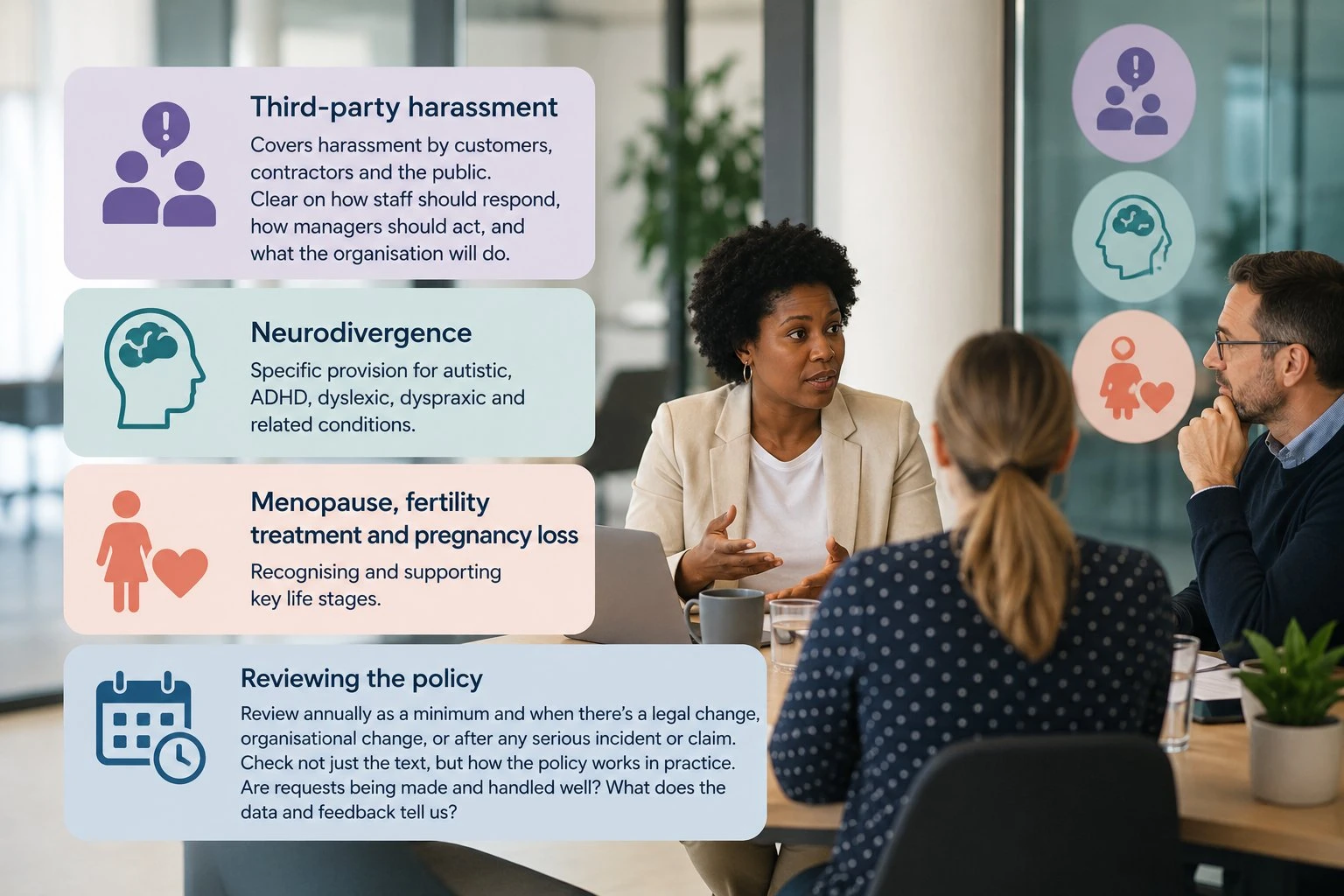
Third-party harassment
Following the Employment Rights Act 2025, the harassment section needs to address harassment by customers, contractors and members of the public, not just colleague-on-colleague. Policies should describe how staff should respond, how managers should act, and what the organisation will do.
Neurodivergence
Specific provision for neurodivergent staff — autism, ADHD, dyslexia, dyspraxia and related conditions — is increasingly expected. Reference our guide to neurodiversity in the workplace for context.
Menopause, fertility treatment and pregnancy loss
All three are increasingly addressed in mainstream policies, partly because case law in these areas has been developing and partly because organisations have realised that not addressing them causes good people to leave.
Reviewing the policy
Review annually as a minimum. Trigger an additional review whenever there's a material legal change (the October 2024 section 40A duty was one such trigger; the October 2026 ERA 2025 changes will be another), whenever there's a significant organisational change (merger, restructure, new geographic operations), and after any serious incident or tribunal claim.
The review should look at the policy text, but also at whether the policy is working in practice. Are reasonable adjustment requests being made? How are they being handled? What does the monitoring data show? Are complaints being raised, and what's happening to them?
Frequently asked questions
Is an equality and diversity policy legally required?
In England, Scotland and Wales, an EDI policy is not directly required by the Equality Act 2010. However, the Act creates duties that a policy is the most practical way of meeting, and the EHRC recommends that every organisation has one.
What should be in an equality and diversity policy?
Purpose and scope, legal framework, the organisation's specific commitments, what is prohibited, roles and responsibilities, recruitment and pay, reasonable adjustments, harassment and complaints procedures, monitoring and data, and review arrangements.
How often should I review the policy?
Annually as a minimum, with additional reviews triggered by significant legal changes (such as the 2024 section 40A duty and the 2026 Employment Rights Act changes), major organisational change, or after a serious incident or claim.
Do I need a separate harassment policy?
Not necessarily. Many organisations integrate harassment into their equality and diversity policy; others have a separate, more detailed harassment and bullying policy. The choice often depends on size — larger employers tend to have separate policies for clearer signalling.
Can I collect diversity data on my staff?
Yes, but carefully. Equality monitoring data is special category data under UK GDPR. You need an explicit Article 9 condition (usually explicit consent or substantial public interest), the data should be voluntary, anonymised in use, and stored separately from personnel records.
What size of business needs an EDI policy?
Any size. The legal duties under the Equality Act apply to all employers regardless of headcount. Small employers might have a shorter, simpler policy, but the absence of one is increasingly noticed by customers, funders and prospective employees.
An equality and diversity policy works best as part of a wider framework that includes the Equality Act 2010 it sits under, the workplace framing of equality, diversity and inclusion, and (for public bodies) the Public Sector Equality Duty. To get your staff trained on the policy and the duties it reflects — including the October 2024 and October 2026 legal changes — our Equality, Diversity & Inclusion Training course covers everything in one programme.
Related guides
- Equality and Diversity in Health and Social Care: A UK Guide
- Equality Act 2010: The Complete UK Guide
- The Nine Protected Characteristics Under the Equality Act 2010
Get your team trained on your equality and diversity policy and the duties it reflects.
View course →
Mark writes about equality, diversity and inclusion, UK workplace law and accredited online training for Equality, Diversity & Inclusion Training, part of Online CPD Academy.