

The question ‘why does diversity matter?’ gets answered in three styles. The first is moral — it’s the right thing to do. The second is legal — there are statutory duties that require it. The third is the business case — diverse organisations make better decisions and earn more money. All three matter, but they don’t carry equal weight, and the third one is more contested than most articles admit.
This is a UK-focused look at all three, with current evidence and an honest engagement with the disputes around the business case. The aim is to give you arguments you can actually use, not slogans that fall apart under scrutiny.
The moral case
The moral case is the most durable one because it doesn’t depend on outcomes. It rests on the idea that people deserve fair treatment because they are people — not because fair treatment produces measurable benefits, and not only because the law requires it. A workplace that excludes capable people from progression because of their race, sex or disability is doing harm even if its profits hold up.
The moral case is also the foundation that the other arguments sit on. A purely business-case framing — ‘diversity matters because it’s profitable’ — collapses the moment the data is challenged or a recession changes the calculus. The legal case is more solid but is reactive: it tells you what to avoid, not what to aspire to. The moral case sets the direction.
In UK public discourse the moral case is sometimes called the social justice argument, sometimes the dignity argument, and sometimes (with a longer history) the equal worth argument. All three point to the same thing: people are not interchangeable resources to be optimised, they are members of a shared society whose treatment by employers and institutions reflects on the rest of us.
The legal case
The legal case is concrete. The Equality Act 2010 makes it unlawful to discriminate, harass or victimise people on the grounds of nine protected characteristics. Employers have specific duties to make reasonable adjustments for disabled people and, since October 2024 under section 40A, to take active steps to prevent sexual harassment. Public sector employers carry the additional Public Sector Equality Duty under section 149.
Getting this wrong is expensive in three currencies. The first is money: discrimination compensation is uncapped in employment tribunals and tribunals can uplift awards by up to 25% where the sexual harassment prevention duty has been breached. The second is time: discrimination claims take months and tie up senior people. The third is reputation: tribunal judgments are public, and the cases that go to media attract reputational damage that outlives any settlement.
Looking forward, the Employment Rights Act 2025 raises the bar further from October 2026. The standard for preventing sexual harassment moves from ‘reasonable steps’ to ‘all reasonable steps’. Third-party harassment — by customers, contractors or members of the public — becomes a basis for employer liability across every protected characteristic, not just sex. The legal pressure on UK employers to take equality and diversity seriously is increasing, not loosening.
The fuller treatment of the legal framework is in our guide to the Equality Act 2010.
The business case — the UK evidence

The business case has been made in many ways, with varying degrees of rigour. The most reliable UK-specific evidence comes from a small number of long-running reviews and surveys.
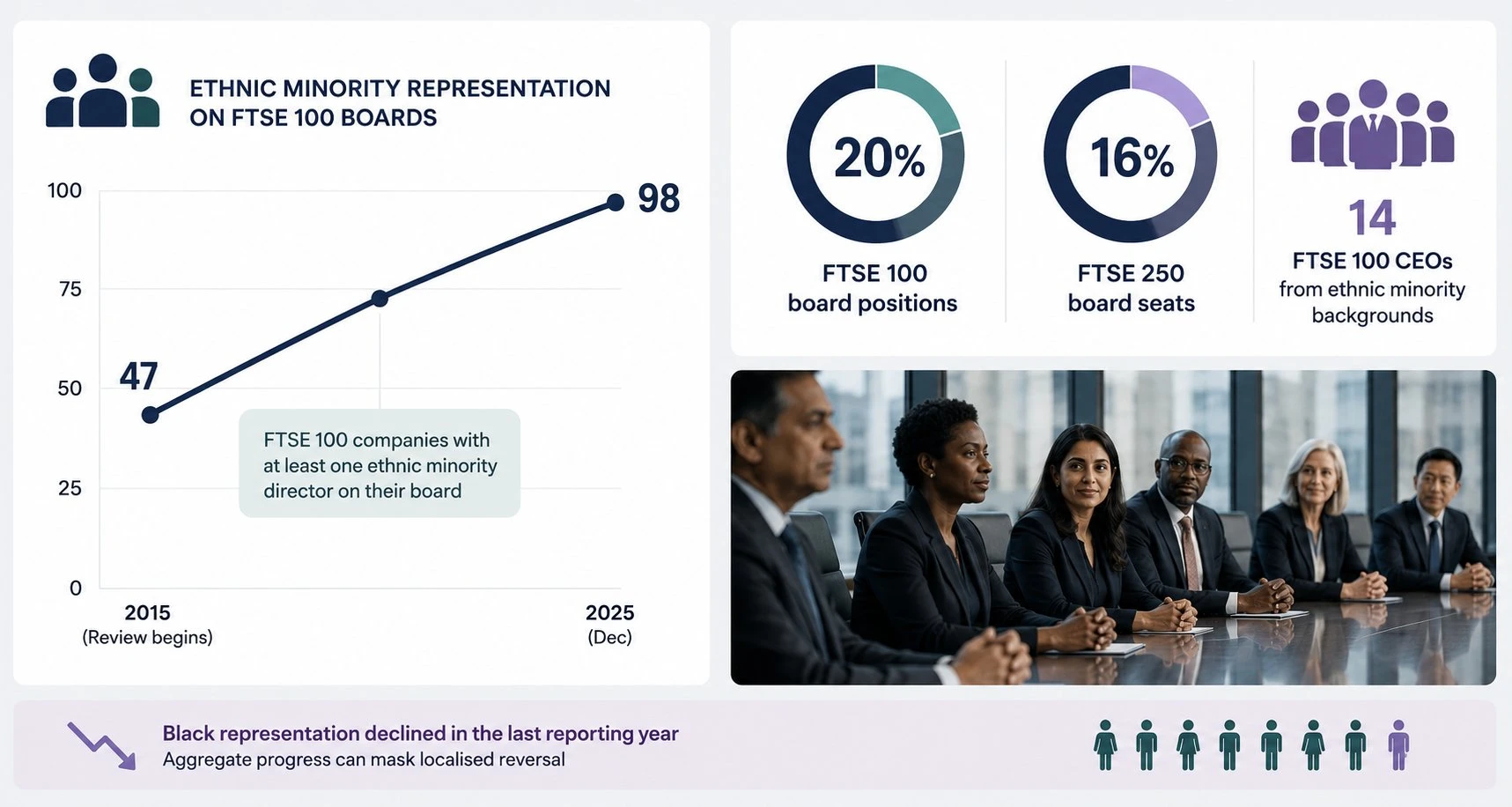
The Parker Review tracks ethnic minority representation on FTSE 350 boards. Its most recent report, published in March 2026, found that 98 of the FTSE 100 companies had at least one ethnic minority director on their board as of December 2025, up from 47 when the Review began in 2015. Ethnic minorities held 20% of FTSE 100 board positions and 16% of FTSE 250 board seats. Fourteen FTSE 100 CEOs are from ethnic minority backgrounds. The Review documents that black representation specifically declined in the last reporting year — a reminder that aggregate progress can mask localised reversal.
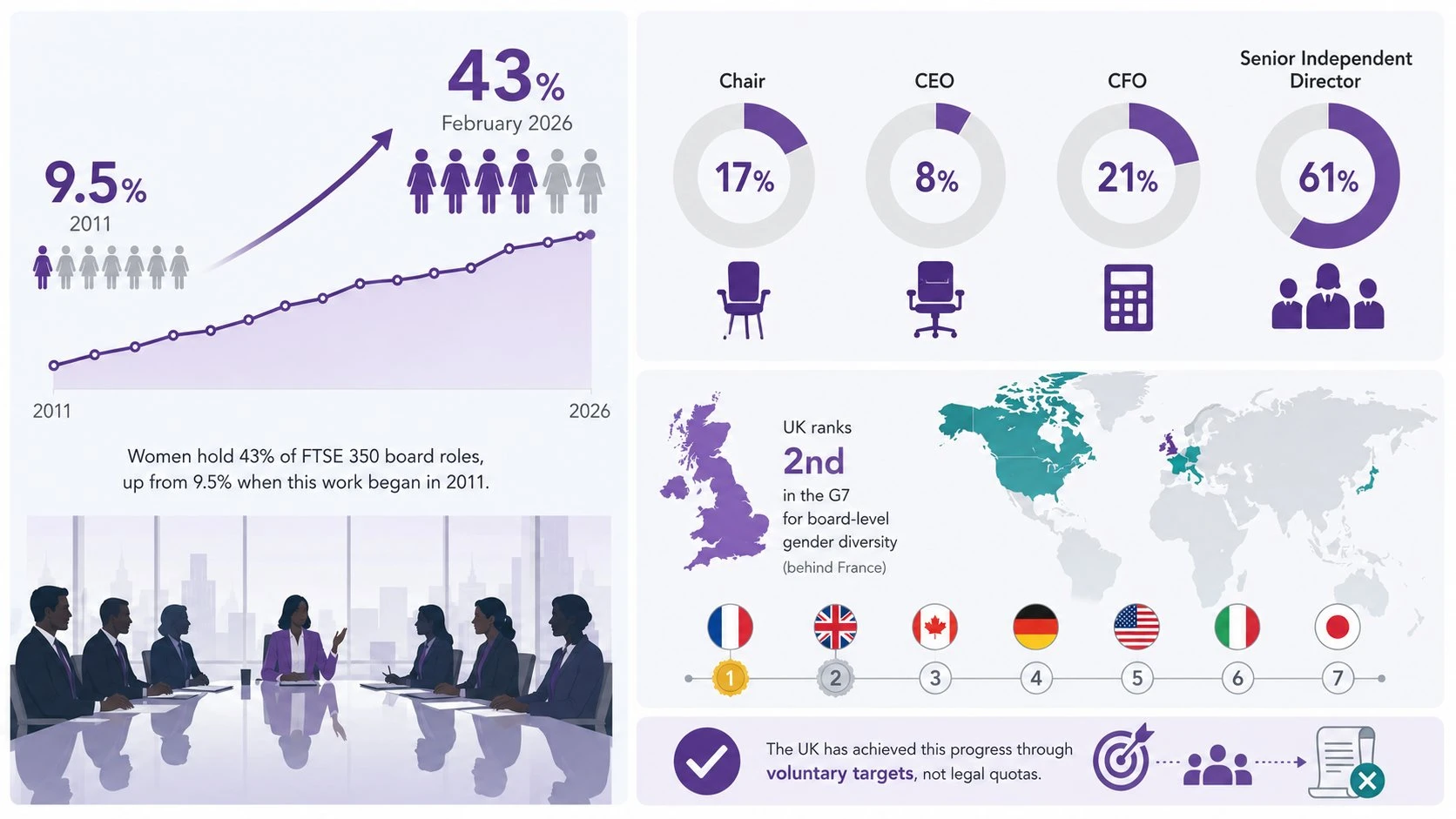
The FTSE Women Leaders Review covers gender. Its February 2026 report found that women hold 43% of FTSE 350 board roles, up from 9.5% when this work began in 2011. Progress has been uneven across the four most senior roles: women hold 17% of Chair positions, 8% of CEO roles, 21% of CFO roles, and 61% of Senior Independent Director roles in the FTSE 350. The UK ranks second in the G7 (behind France) for board-level gender diversity, and has achieved this through voluntary targets rather than legal quotas.
The CIPD’s 2025 ‘Resetting EDI and Reaffirming Inclusion’ report documents a more mixed picture across the wider UK economy: many organisations recommitted to EDI work after the US backlash of late 2024 and early 2025, while others repositioned or renamed their programmes. The report finds that 66% of UK workers say the acceptance and inclusion of employees from all backgrounds is important to them when looking for a job.

What these UK studies establish is real but modest: more diverse organisations attract a wider talent pool, and senior leadership in the UK has become meaningfully more diverse over the last fifteen years. What they don’t establish — and don’t claim to establish — is direct causal evidence that diversity by itself produces higher profits.
Where the business case is contested
For a long time the most-cited evidence for the financial business case has been a series of reports by McKinsey & Company — ‘Why Diversity Matters’ (2015), ‘Delivering Through Diversity’ (2018), ‘Diversity Wins’ (2020) and ‘Diversity Matters Even More’ (2023). These reports found, broadly, that companies in the top quartile for ethnic and gender diversity in leadership were more likely to outperform peers on profitability.
These reports have been challenged. In March 2024, accounting academics Jeremiah Green and John Hand published a paper in Econ Journal Watch that attempted to replicate the McKinsey findings using S&P 500 data. They were unable to find a statistically significant relationship between executive ethnic diversity and various measures of financial performance, including EBIT margin, sales growth, return on assets and total shareholder return. They also noted that McKinsey’s methodology measured financial performance over years leading up to the year when diversity was measured, which complicates any causal interpretation.
McKinsey has acknowledged the methodological critique, stood by its conclusions, and emphasised that its findings demonstrate correlation rather than causation. The honest position is that the financial business case is not as settled as the most-quoted statistics suggest. There is real evidence that organisations taking diversity seriously do better on talent attraction, retention and decision quality. There is contested evidence that diversity in leadership directly produces higher profits.
This nuance matters because business-case framing that overstates the evidence is fragile. The first economic downturn that affects a high-diversity company can be cited as a counter-example. Honest framing — the evidence on talent and decision quality is solid; the direct profit case is real but contested — holds up better and signals that the speaker actually understands the literature.
The societal case
Diversity matters at a level beyond individual organisations. A society where talent is wasted because some groups can’t access opportunity is poorer than a society where talent finds its level. A society where public services are designed without input from the people who use them serves those people worse. A society where some groups are systematically over- or under-represented in institutions of power has lower trust and weaker cohesion.
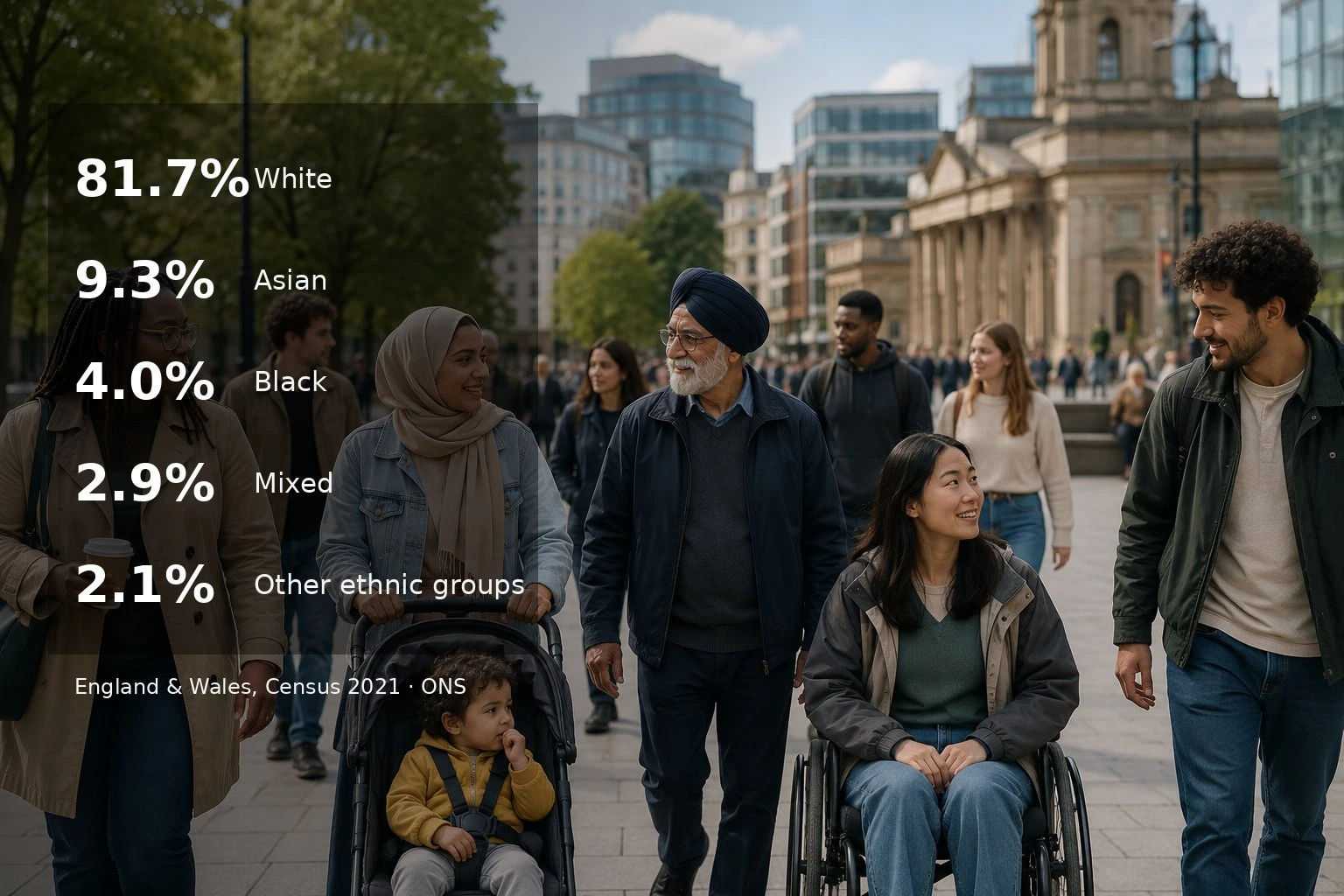
The Office for National Statistics’ 2021 Census recorded that 81.7% of the population of England and Wales identified as White, 9.3% as Asian, 4.0% as Black, 2.9% as Mixed, and 2.1% as Other ethnic groups. ONS projections published in 2026 anticipate continued demographic change driven mainly by net migration. UK institutions — boards, governments, courts, professions, media — that don’t reflect this demographic reality at senior levels lose legitimacy with the population they serve.
Cohesion and trust are not abstractions. They show up in how willing people are to support public services through their taxes, in how willing they are to engage with the institutions of public life, and in how stable democratic systems are over time. The societal case for diversity is the case that these things matter.
Common counter-arguments
A few counter-arguments come up often enough to deserve direct engagement.
‘Hiring should be based purely on merit.’ This is correct, and equality law agrees. The Equality Act prohibits ‘positive discrimination’ — preferring a candidate purely because of a protected characteristic. What it permits, under sections 158 and 159, is ‘positive action’: proportionate measures to enable people from under-represented groups to overcome disadvantage. The two are routinely confused. Positive action is about widening the pool of qualified candidates and removing barriers; positive discrimination is about picking the lower-qualified person, and is unlawful.
‘The business case has been overstated.’ As discussed above, the strongest version of the financial case is contested. Better arguments are available — talent attraction, retention, decision quality, legal risk, reputation, and the moral and legal cases that don’t depend on financial outperformance.
‘Diversity programmes can themselves create resentment.’ Poorly implemented programmes — token gestures, ill-judged communications, training that lectures rather than develops understanding — do create resentment. Well-implemented programmes tend not to. The lesson is that quality of implementation matters; the lesson is not that the underlying aims are wrong.
‘Quotas would be simpler and more effective.’ This is a position with some intellectual force but it isn’t UK law. The UK approach is voluntary targets backed by transparency requirements (gender pay gap reporting, the Parker Review, the FTSE Women Leaders Review). The argument for quotas is that they produce faster change; the argument against is that they politicise appointments and can produce backlash. UK policy has so far favoured voluntary mechanisms.
What diversity actually means
This page treats diversity as ‘difference of identity, background, perspective and experience present in a group’. The deeper question — what kinds of difference, and how do you actually measure them? — is unpacked in our guide to what diversity means, which covers the main dimensions in more detail.
How to realise the benefits
The benefits don’t appear automatically. Organisations that get value from diversity tend to do five things consistently.
They embed equality and diversity into core business processes rather than treating it as a separate workstream. Recruitment, performance, promotion, pay — all designed with equality considerations built in.
They have a workplace equality and diversity policy that is actually followed, not just published.
They invest in inclusion as actively as in diversity. Bringing diverse people in is one thing; building a culture that retains them is the harder and more important thing. Our piece on equality, diversity and inclusion covers the framework.
They measure, and they act on what the measurement shows. Gender pay gap data, ethnicity pay gap data (voluntary but increasingly expected), staff survey data broken down by protected characteristic.
They train people genuinely and regularly. Equality and diversity training that is treated as a tick-box exercise produces tick-box results. Training that is treated as serious professional development tends to change behaviour.
Frequently asked questions
Why does diversity matter at work?
For four overlapping reasons: it’s right to treat people fairly (the moral case); equality law requires it (the legal case); diverse teams attract a wider talent pool, retain people for longer, and tend to make better decisions (the talent and decision-quality case); and organisations that don’t reflect the society they serve lose legitimacy over time (the societal case).
Does diversity actually improve business performance?
The evidence on talent attraction, retention and decision quality is solid. The evidence on direct financial outperformance is real but more contested than the most-quoted statistics suggest. A 2024 paper by Green and Hand could not replicate the well-known McKinsey findings on diversity and profitability using S&P 500 data. McKinsey stands by its findings while emphasising correlation rather than causation.
Is the business case for diversity proven?
The strongest version is not. The weaker version — that organisations taking diversity seriously do better on talent and decision quality — is well supported. Honest framing reflects both.
What are the benefits of diversity beyond business?
A wider talent pool, better representation of the population in institutions, stronger public trust, more inclusive public service design, and a society where capability isn’t wasted because of who someone is.
What’s the moral case for diversity?
That fair treatment of people is owed to them as people, not because it produces measurable benefits. It’s the durable foundation that the other arguments sit on.
What do recent UK studies say about diversity?
The Parker Review (March 2026) tracks rising ethnic minority representation on FTSE 350 boards. The FTSE Women Leaders Review (February 2026) tracks gender representation at FTSE 350 board and leadership levels, reporting 43% women on boards. The CIPD’s 2025 ‘Resetting EDI’ report documents a mixed picture across the wider UK economy.
Diversity is one half of the standard UK workplace framing. The other half is equality, and the relationship between them is set out in our equality and diversity guide. The legal framework that underpins all of this is the Equality Act 2010. If you’d like to embed all of it as practice in your organisation, our Equality, Diversity & Inclusion Training course delivers it as a single programme.
Related guides
- Equality Act 2010: The Complete UK Guide
- The Nine Protected Characteristics Under the Equality Act 2010
- Equality and Diversity: A UK Guide
Give every team member the understanding and confidence to support a fair, inclusive workplace.
Explore the Equality, Diversity & Inclusion course →
Mark writes about equality, diversity & inclusion, workplace compliance and accredited online training for Equality, Diversity & Inclusion Training, part of Online CPD Academy.