
Equality and equity are two of the most frequently confused terms in workplace conversations about fairness. They sound similar. They’re often used interchangeably. And yet they describe different things, and using them precisely matters — both for clear thinking and for understanding what UK law actually requires.
This guide sets out what each term means, where the distinction matters in practice, and why the UK has stayed with ‘equality’ as its primary legal term while building equity-style mechanisms into the law.
Equality and equity: side-by-side definitions
Equality is the principle that people are treated fairly, without unjustified disadvantage because of who they are. In its strongest sense, it’s about giving people the same starting point: the same rules, the same access, the same opportunities.
Equity is the principle of giving people what they each need to reach a comparable outcome. It recognises that people start from different places — different bodies, different circumstances, different barriers — and that genuine fairness sometimes means treating them differently to get them to the same destination.
A workplace example. Two employees both want to apply for a promotion that requires a written test. Equality says: give them both the same test, the same time, the same conditions. Equity says: give them both the same test and the same time, but recognise that one of them is dyslexic and provide extra time, a quiet room and screen-reading software — so that the test measures her ability to do the job, not her ability to read the test.
These aren’t competing principles. They’re answers to slightly different questions. Equality is about how the rules apply; equity is about whether the rules produce fair access. UK law uses ‘equality’ as the umbrella term, but builds equity into the rules through specific mechanisms such as the duty to make reasonable adjustments.
The illustration problem
The most familiar visual for explaining equality vs equity shows three people of different heights trying to watch a baseball game over a fence. In the ‘equality’ panel, all three get the same height of crate to stand on — so the tall person sees easily, the medium person can just see over, and the short person sees nothing. In the ‘equity’ panel, each gets a crate sized to their need, and all three see equally.
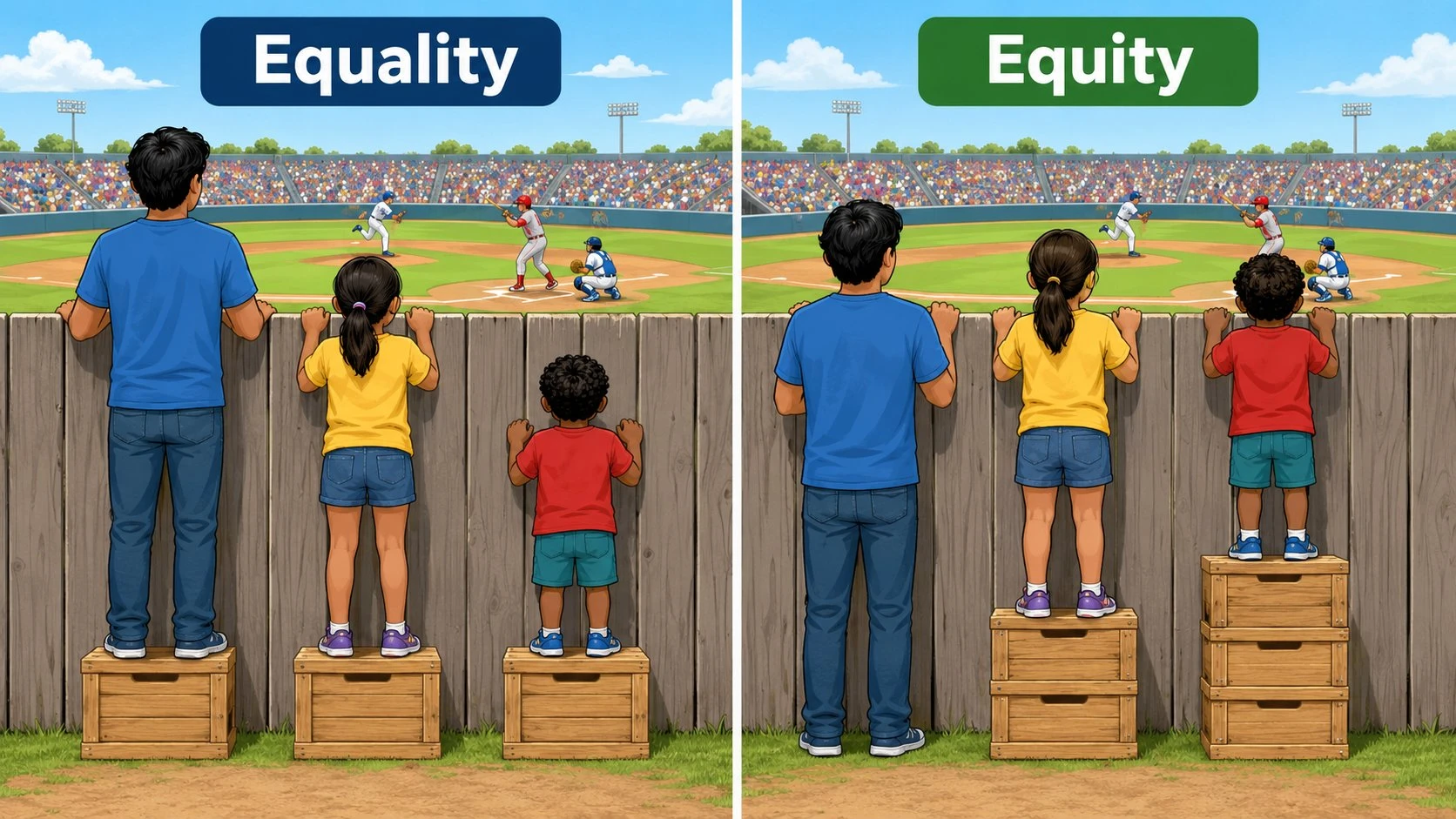
The image makes a real point — equal inputs don’t always produce equal outcomes — but it has problems as a teaching tool. The baseball framing is American and feels foreign in a UK context. The fence is a fixed obstacle rather than something that could be redesigned (which the more recent ‘justice’ panel of the illustration tries to address by removing the fence entirely). And it suggests the choice is binary, when in practice equality and equity are layered approaches that work together.
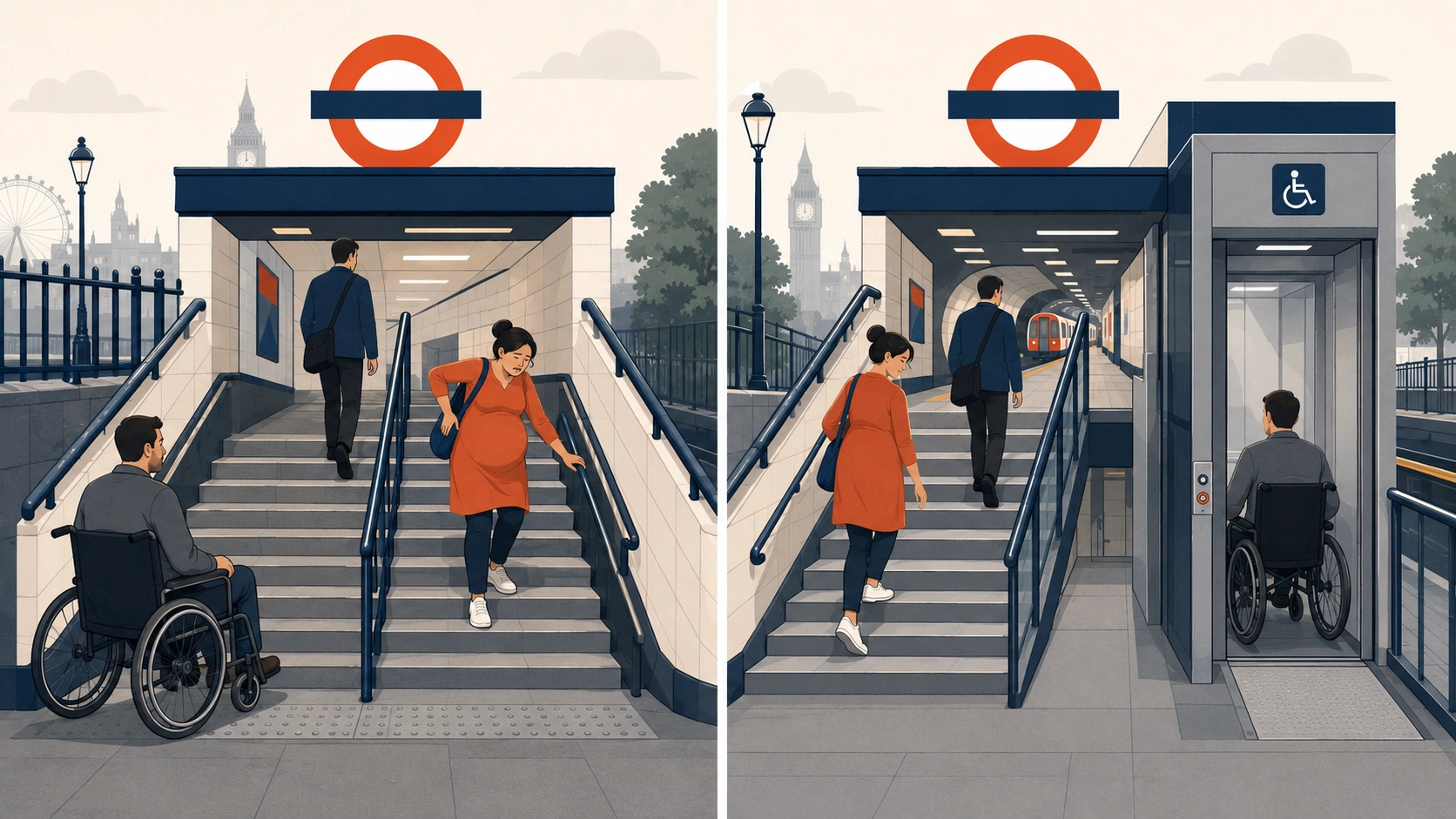
A UK-appropriate equivalent: three commuters trying to reach a tube station platform. One walks down the stairs easily. One uses the stairs with difficulty because she’s pregnant. One can’t use the stairs at all because he uses a wheelchair. Equality of access means all three should be able to reach the platform. Equality of facility — giving them all stairs — fails the second two. Equity provides a lift. Justice rebuilds the station so the lift is the main route and the stairs are an alternative.
Equality vs equity at work
The distinction shows up in several common workplace scenarios.
Recruitment and selection
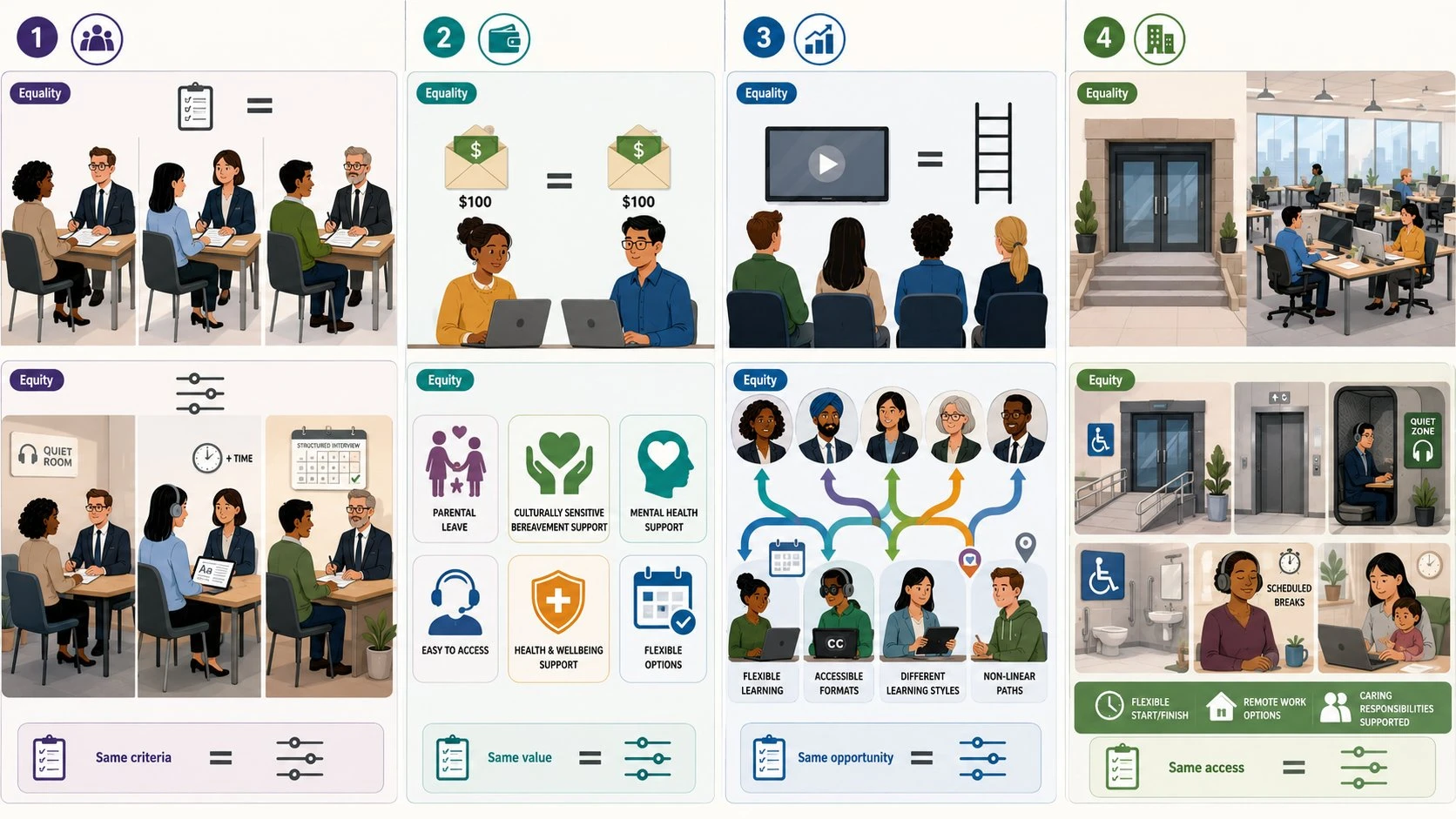
Equality says every candidate gets the same job advert, the same application form, the same interview process. Equity says the process is designed so that candidates with different access needs can demonstrate their actual ability — quiet rooms for autistic candidates, extended time for dyslexic candidates, scheduled rather than ambush interviews for people with chronic conditions that affect concentration. Both can be true at once: the criteria and questions are the same; the conditions are adjusted to the candidate.
Pay and benefits
Equality says employees doing the same work get the same pay. The Equality Act 2010 makes this enforceable specifically between men and women under the equal pay provisions, and more broadly across other protected characteristics through the wider discrimination prohibitions. Equity considerations show up in how benefits are designed — parental leave that covers both parents equally, bereavement leave that recognises different cultural and family practices, mental health support that doesn’t require disclosure to access.
Training and progression
Equality says all employees have access to the same training programmes and promotion routes. Equity asks whether the programmes work for everyone — whether progression routes assume linear careers (which disadvantage people with caring responsibilities), whether ‘high potential’ schemes reproduce the existing demographic mix of senior management, whether training is accessible to people with different learning styles or sensory needs.
The physical workplace
Equality says everyone can come to the office. Equity asks what ‘come to the office’ means for someone with mobility limitations (lifts, ramps, accessible toilets), for someone who is autistic and finds open-plan environments overwhelming (quiet zones, headphones, scheduled breaks), for someone with caring responsibilities (flexible start and finish times, remote-working options).
Equality vs equity in education and healthcare
Outside the workplace the distinction shapes how public services are designed.
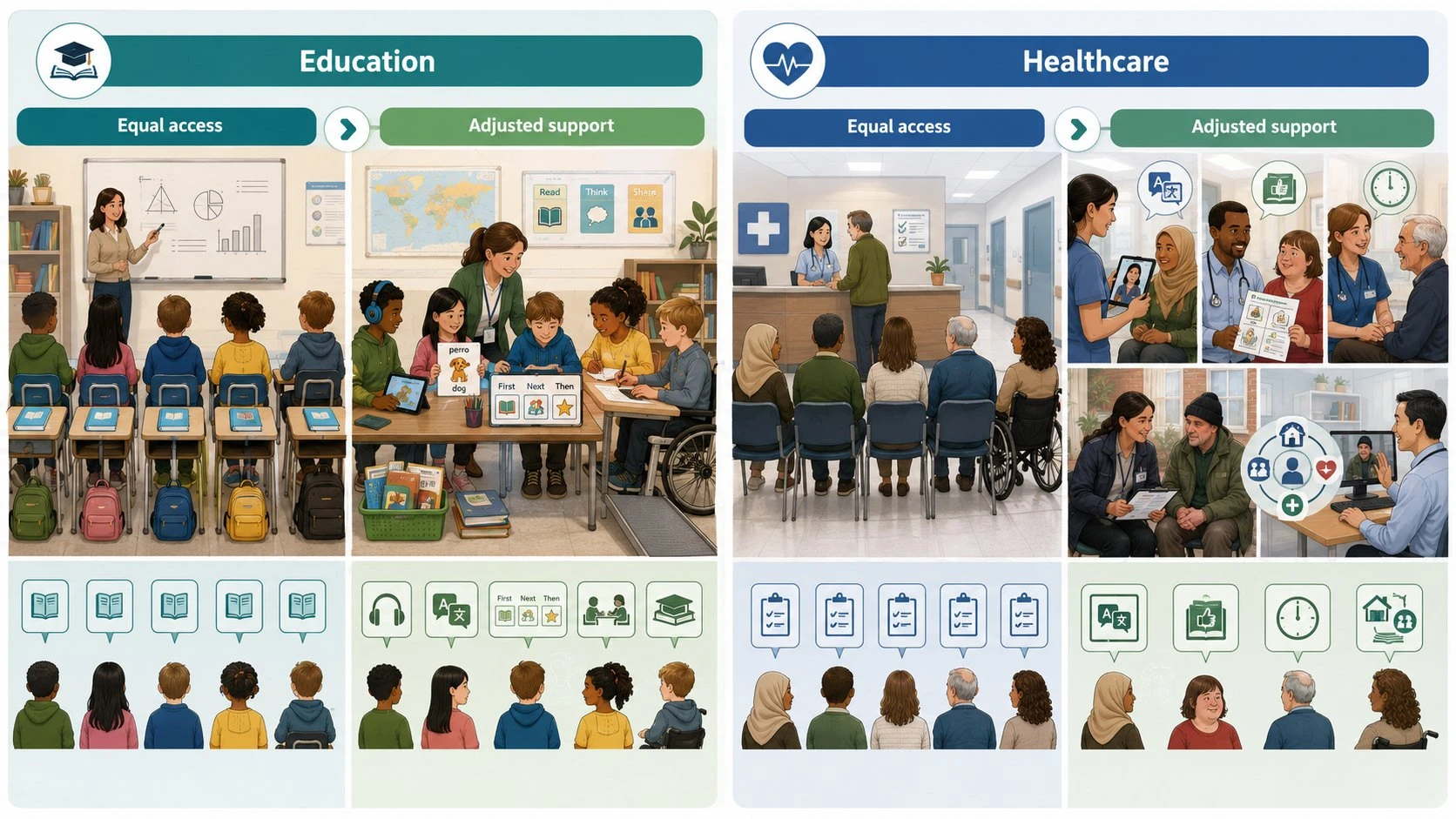
In education, equality means every child has the right to schooling. Equity means provision is adjusted for special educational needs, for English as an additional language, for pupils from disadvantaged backgrounds (pupil premium funding is essentially an equity intervention), and for disabled students. The Special Educational Needs and Disability legislation works on equity principles built into a broader equality framework.
In healthcare, equality means everyone can register with a GP and access NHS services. Equity means provision is adjusted for people who need adjustments — interpreters for people whose first language isn’t English, accessible information for people with learning disabilities, longer appointments for patients with complex needs, outreach services for groups that don’t access conventional provision. The NHS Constitution and the Public Sector Equality Duty both push in this direction.
When equality is the right answer; when equity is
The two aren’t always in tension, but they sometimes recommend different actions.
Equality is the right primary answer where the difference between people isn’t relevant to what’s being decided. Voting rights, the right to a fair trial, the right to access public services — these are equality questions. Treating people differently here would be wrong.
Equity is the right primary answer where the difference between people is relevant and the rules would otherwise disadvantage some groups without justification. Adjustments for disability are an equity intervention written into UK law as a duty. Adjustments for pregnancy are another. Adjustments for caring responsibilities (through the right to request flexible working) are a third.
In most workplace contexts you’re operating across both. Same job, same criteria, same expectations of capability — that’s the equality floor. Different supports, different adjustments, different routes to demonstrating capability — that’s the equity overlay. A workplace that gets only the first is legalistic and missing real talent. A workplace that gets only the second is open to challenge for inconsistent treatment of like cases.
How this fits into EDI
UK workplace practice usually sits under the ‘equality, diversity and inclusion’ (EDI) umbrella. The American equivalent is DEI — ‘diversity, equity and inclusion’ — which substitutes equity for equality and puts diversity first.
The choice of letter isn’t accidental. EDI emphasises that fair treatment is a baseline obligation; equity is built into the rules rather than serving as the headline. DEI emphasises that giving people what they specifically need is the active principle, with equality treated as too thin a concept.
Both framings are defensible. UK practice has stayed with EDI, partly because it maps more directly onto the Equality Act and partly because ‘equity’ in UK English has a different primary meaning (in finance and law). We unpack this in more detail in our guide to equality, diversity and inclusion.
For deeper definitions of the two underlying terms separately, see our guides to what equality means and what diversity means.
Positive action vs positive discrimination
The distinction between equality and equity opens onto a related UK legal distinction that gets routinely confused: positive action versus positive discrimination.
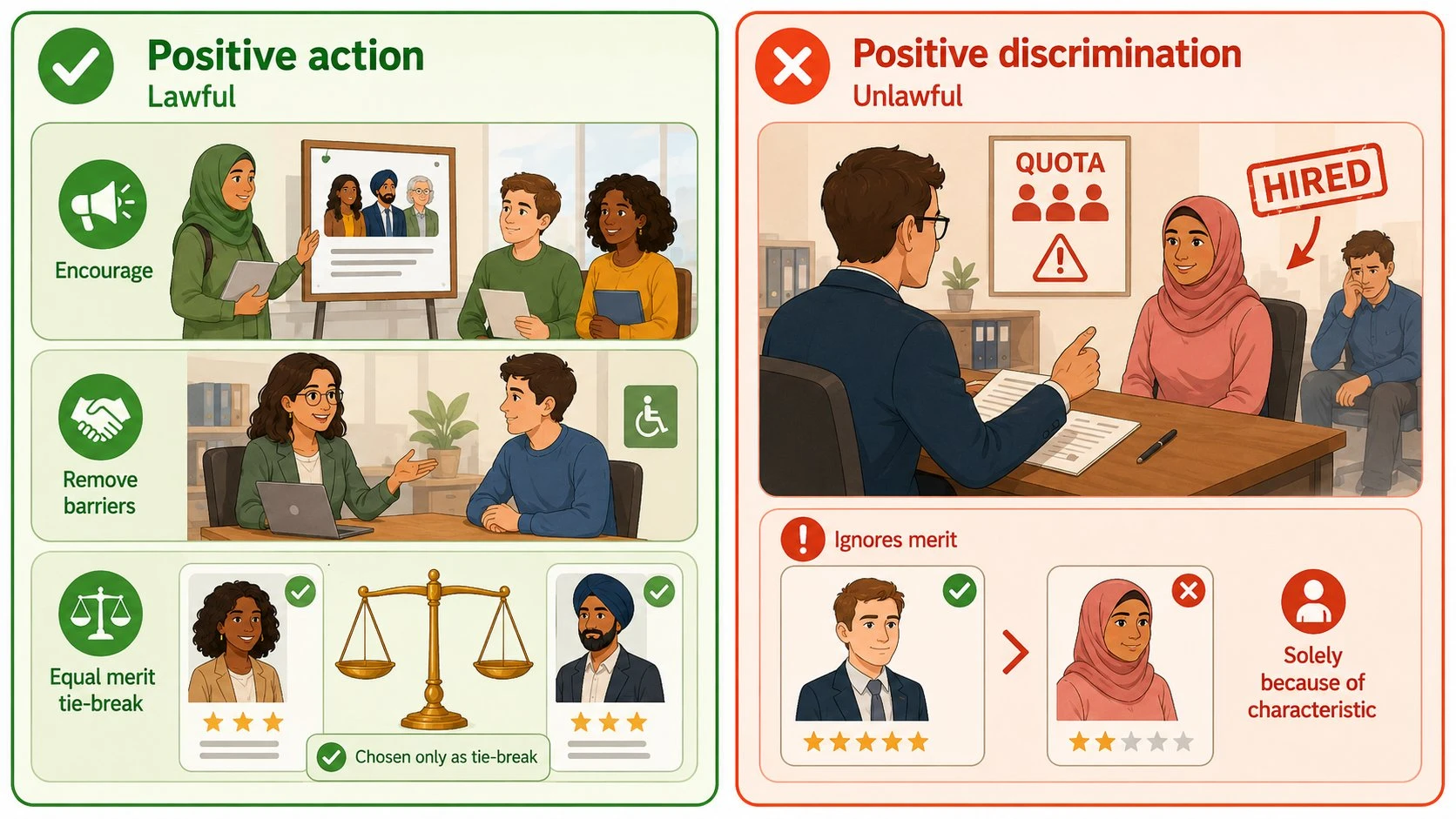
Positive action, set out in sections 158 and 159 of the Equality Act, is lawful. It permits employers and service providers to take proportionate measures to enable people who share a protected characteristic to overcome a disadvantage, meet different needs, or participate in an activity where their participation is disproportionately low. Examples include targeted advertising to encourage applications from under-represented groups, mentoring schemes for women, work experience programmes for ethnic minority students, or — under section 159 specifically — using protected characteristics as a tie-breaker between equally qualified candidates.
Positive discrimination is unlawful. It would mean preferring a candidate or treating someone more favourably solely because of a protected characteristic, without regard to capability. Quotas requiring a certain number of women or ethnic minority hires, regardless of whether the candidates can do the job, would be positive discrimination.
The line is genuinely fine in some cases, and section 159 in particular requires careful application. The tie-breaker provision only applies where the candidates are of equal merit; the section can’t be used to prefer a less-qualified candidate over a more-qualified one. The action must be a proportionate means of achieving a legitimate aim.
This matters because the public discussion of ‘diversity hiring’ often blurs these categories. Lawful positive action — widening the pool, removing barriers, encouraging applications, tipping the balance between genuinely equal candidates — is sometimes attacked as ‘discrimination’. Unlawful positive discrimination — picking the less qualified person — is sometimes defended as ‘positive action’. The Equality Act draws a clear line. Employers and HR teams need to know which side of it they’re standing on.
Frequently asked questions
What is the difference between equality and equity?
Equality is the principle of treating people fairly, often by giving them the same starting point. Equity is the principle of giving people what they each need to reach a comparable outcome. The two work together: equality is the baseline; equity is how the rules are adjusted to make the baseline meaningful for people who’d otherwise face barriers.
Is equity the same as equality?
No. They overlap, but the questions they answer are different. Equality asks whether the rules are the same; equity asks whether the rules give everyone fair access.
What’s an example of equity vs equality at work?
Equality is giving every candidate the same job test under the same conditions. Equity is giving every candidate the same test, while providing the screen-reading software, extra time or quiet room that a dyslexic, autistic or anxious candidate needs to demonstrate their actual ability.
Is positive discrimination legal in the UK?
No. The Equality Act prohibits preferring someone solely because of a protected characteristic. What is lawful is ‘positive action’ — proportionate measures to overcome disadvantage, meet different needs, or increase participation where it’s disproportionately low. Section 159 specifically permits using a protected characteristic as a tie-breaker between equally qualified candidates, in limited circumstances.
Why does the UK use ‘EDI’ rather than ‘DEI’?
UK workplace practice has stayed with the ‘equality’ framing partly because it maps directly onto the Equality Act 2010, and partly because ‘equity’ in UK English has a different primary meaning in finance and law. The American ‘DEI’ framing — diversity, equity and inclusion — describes a similar set of ideas but emphasises equity rather than equality as the active principle of fair treatment.
The distinction between equality and equity sits inside the wider framework of UK equality and diversity practice. Both ideas are present in UK law, with equality as the named principle and equity built into the rules through mechanisms like reasonable adjustments and the duties on public bodies. To get your team comfortable with the legal framework and how it applies in practice, our Equality and Diversity Training course covers it in depth.
Related guides
- Equality and Diversity in Health and Social Care: A UK Guide
- Equality Act 2010: The Complete UK Guide
- The Nine Protected Characteristics Under the Equality Act 2010
Get your team comfortable with the Equality Act 2010 and how it works in practice.
Explore the Equality, Diversity & Inclusion course →
Mark writes about equality, diversity and inclusion, workplace compliance and accredited online training for Equality, Diversity & Inclusion Training, part of Online CPD Academy.