

The Equality Act 2010 protects people from discrimination on the basis of nine specific characteristics. These nine — listed in section 4 of the Act — are the foundation of UK equality law in Britain. Every claim of unlawful discrimination at work, in services, in education or in housing rests on showing that less favourable treatment was related to one of them.
This guide takes each of the nine in turn, sets out the statutory definition, explains who is covered, and notes the practical implications. It also covers what the Equality Act protects against, the four main types of discrimination, and what’s not a protected characteristic — a question that comes up more often than the protected ones.
The nine at a glance
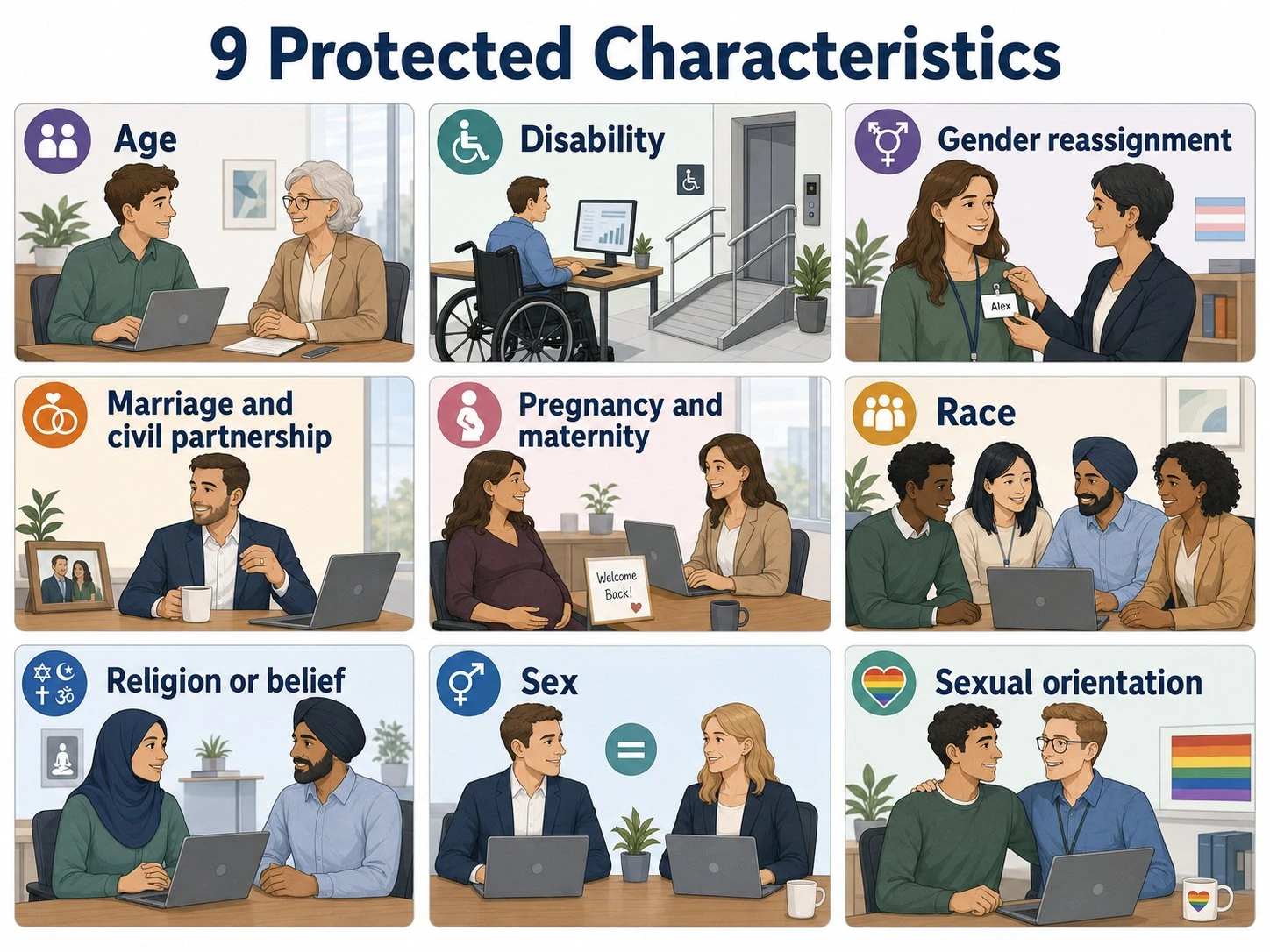
The protected characteristics, set out in section 4 of the Equality Act 2010, are:
Age, disability, gender reassignment, marriage and civil partnership, pregnancy and maternity, race, religion or belief, sex, and sexual orientation.
Each gets its own definition in sections 5–12 of the Act. The protections apply across employment, services and public functions, education, premises and associations, with some specific differences between contexts.
Age
Age is defined in section 5 as covering an age group — for example, ‘32 year olds’ or ‘people aged 18 to 30’. Both younger and older people are protected; the characteristic applies to all ages, not just to the elderly.
Direct age discrimination is unique among the protected characteristics in that it can be objectively justified — an employer can lawfully treat people of different ages differently if doing so is a proportionate means of achieving a legitimate aim. Mandatory retirement ages, for example, are not automatically unlawful but require justification. This is different from the other characteristics, where direct discrimination is essentially never justifiable.
Common examples of age discrimination include rejecting younger candidates as ‘lacking experience’ for roles where the actual job doesn’t require long experience; rejecting older candidates as ‘too set in their ways’; using language in job adverts that signals an age preference (‘young, dynamic team’); offering training or development opportunities preferentially to younger staff.
Disability
Disability is defined in section 6 of the Equality Act as a physical or mental impairment that has a substantial and long-term adverse effect on a person’s ability to carry out normal day-to-day activities. Each element of the definition matters.
Physical or mental impairment
Both are covered. Mental health conditions, learning disabilities, and neurodivergent conditions are within scope alongside physical conditions.
Substantial
More than minor or trivial. The threshold is comparatively low — small effects can be substantial if they’re regularly present.
Long-term
The impairment has lasted, or is likely to last, at least 12 months, or is expected to last for the rest of the person’s life. Recurring conditions where the effect is likely to come back also count, even if any single episode is shorter.
Normal day-to-day activities
Interpreted broadly — work-related tasks count, alongside the more obviously general ones.
Schedule 1 of the Act treats certain conditions as disabilities from the point of diagnosis, without needing to meet the standard tests: cancer, HIV infection, multiple sclerosis, and severe sight impairment (‘blindness’ as certified by an ophthalmologist).
The disability characteristic also carries the duty to make reasonable adjustments — a unique feature of UK disability law that requires duty-holders to make positive changes to remove disadvantage.
A person doesn’t need a formal diagnosis to be protected. ACAS guidance and case law are both clear that what matters is the practical effect, not the paperwork.
Gender reassignment
Gender reassignment is defined in section 7 as applying to a person who is proposing to undergo, is undergoing or has undergone a process for the purpose of reassigning their sex by changing physiological or other attributes of sex. The legal definition is not dependent on medical intervention; social transition can be enough.
The Supreme Court’s ruling in For Women Scotland Ltd v The Scottish Ministers [2025] UKSC 16, handed down on 16 April 2025, clarified that the gender reassignment characteristic is the route by which transgender people are protected under the Act, regardless of whether they hold a Gender Recognition Certificate. The ruling addressed how ‘sex’ is interpreted under the Act (see the ‘sex’ section below); it did not weaken protection from discrimination on grounds of gender reassignment. Transgender people remain fully protected from direct and indirect discrimination, harassment and victimisation on those grounds.
The Equality and Human Rights Commission has issued interim guidance on the practical implications and is updating its statutory codes of practice.
Common examples of gender reassignment discrimination include refusing to use a transgender employee’s preferred name; outing a transgender colleague without consent; treating a job applicant less favourably after discovering they’re transgender; harassment connected to gender identity.
Marriage and civil partnership
Marriage and civil partnership is defined in section 8. It protects people who are married or in a civil partnership from less favourable treatment because of that status. It doesn’t protect single people, divorced people, widowed people, or people in cohabiting relationships.
The protection is narrower than for the other characteristics. It applies primarily in employment contexts. It also doesn’t apply to all the discrimination types — for example, the Public Sector Equality Duty doesn’t require public authorities to advance equality of opportunity or foster good relations on this characteristic, only to eliminate discrimination.
Practical examples are relatively uncommon but include refusing to consider job applicants because they’re married, or treating married employees less favourably than unmarried colleagues without justification.
Pregnancy and maternity
Pregnancy and maternity protection is set out in section 18 (for employment) and section 17 (for non-work contexts). It protects pregnant women from less favourable treatment connected to their pregnancy or a pregnancy-related illness during the pregnancy period; and women on maternity leave from less favourable treatment connected to taking that leave.
An important technical point: pregnancy and maternity discrimination uses ‘unfavourable treatment’ rather than ‘less favourable treatment’ — meaning there’s no need to compare with how someone else has been treated. The treatment just has to be unfavourable on its own terms. This is different from most other discrimination claims and reflects the unique vulnerability of pregnancy.
The protection covers the pregnancy itself, pregnancy-related illness, taking maternity leave, breastfeeding (in the non-work context), and a ‘protected period’ that extends beyond the immediate event.
Common examples include declining to interview a visibly pregnant candidate; passing over a woman on maternity leave for a promotion; managing her out shortly after she returns; failing to consider her for redundancy with the same protections as colleagues.
Race
Race is defined in section 9 as including colour, nationality, and ethnic or national origins. The protection is broad — broader than colloquial usage of ‘race’ might suggest.
UK case law has confirmed that several specific groups are racial groups under the Act: Sikhs and Jews have both been treated as ethnic groups (notwithstanding that they are also religious groups), and so have Romani Gypsies and Irish Travellers. The protection of nationality covers British nationals as well as foreign nationals.
Race discrimination claims can be brought on the basis of direct discrimination, indirect discrimination, harassment and victimisation. Harassment connected to race — including ‘banter’ that’s racially charged — is unlawful regardless of whether it’s directed at a particular individual.
The aggregate scale of race discrimination in UK workplaces is significant. The Office for National Statistics’ ethnicity facts and figures service documents persistent ethnicity employment gaps, ethnicity pay gaps and disparities in promotion rates that are hard to explain without reference to race discrimination operating directly or indirectly.
Religion or belief
Religion or belief is defined in section 10. The ‘religion’ limb covers any religion and a lack of religion. The ‘belief’ limb covers any religious or philosophical belief, and the lack of any such belief.
The belief limb is wider than is sometimes appreciated. To be protected, a belief must meet a legal threshold known as the ‘Grainger criteria’ from Grainger plc v Nicholson [2010]: it must be genuinely held; be a belief and not just an opinion or viewpoint; concern a weighty and substantial aspect of human life; attain a certain level of cogency, seriousness, cohesion and importance; and be worthy of respect in a democratic society, not incompatible with human dignity and not in conflict with the fundamental rights of others.
Beliefs that have been protected include ethical veganism, climate change beliefs, certain forms of pacifism, gender-critical beliefs, and Scottish independence. Beliefs that haven’t met the threshold include support for a specific political party (in some cases) and certain narrow ideological views.
The protection includes the right to manifest belief — wearing religious dress or symbols, observing prayer times, taking time off for religious festivals — subject to proportionate limitations that the employer can justify.
Sex
Sex is defined in section 11 as ‘a reference to a man or to a woman’, with ‘man’ meaning a male of any age and ‘woman’ meaning a female of any age.
The Supreme Court ruled in For Women Scotland Ltd v The Scottish Ministers [2025] UKSC 16 on 16 April 2025 that ‘sex’, ‘man’ and ‘woman’ in the Equality Act mean biological sex. A Gender Recognition Certificate issued under the Gender Recognition Act 2004 does not change a person’s legal sex for the purposes of the Equality Act. This was a unanimous ruling by five Supreme Court justices and takes immediate effect.
The practical implications continue to be worked through. The Equality and Human Rights Commission published interim guidance shortly after the ruling and is updating its full statutory codes of practice. The House of Commons Library briefing on the ruling summarises the legal position.
The ruling did not remove or weaken protection for transgender people — they remain fully protected under the gender reassignment characteristic. It addressed which characteristic applies in which situation, not whether transgender people are protected.
Sex discrimination otherwise covers the familiar territory: less favourable treatment of women (or men) because of their sex; sexual harassment; equal pay between men and women doing equal work; pregnancy-related issues that overlap with the pregnancy and maternity characteristic.
Sexual orientation
Sexual orientation is defined in section 12 as orientation towards persons of the same sex (lesbian and gay), the opposite sex (heterosexual), or both sexes (bisexual). The Act protects all sexual orientations equally.
The protection covers direct and indirect discrimination, harassment and victimisation. Coming-out at work, being out at work, partnering arrangements, parental leave for same-sex couples, and harassment connected to sexual orientation are all within scope.
Specific exceptions exist for certain religious organisations in narrow circumstances, but the general framework is broad protection.
What the Equality Act protects against
The Act prohibits four main types of conduct in relation to the protected characteristics.
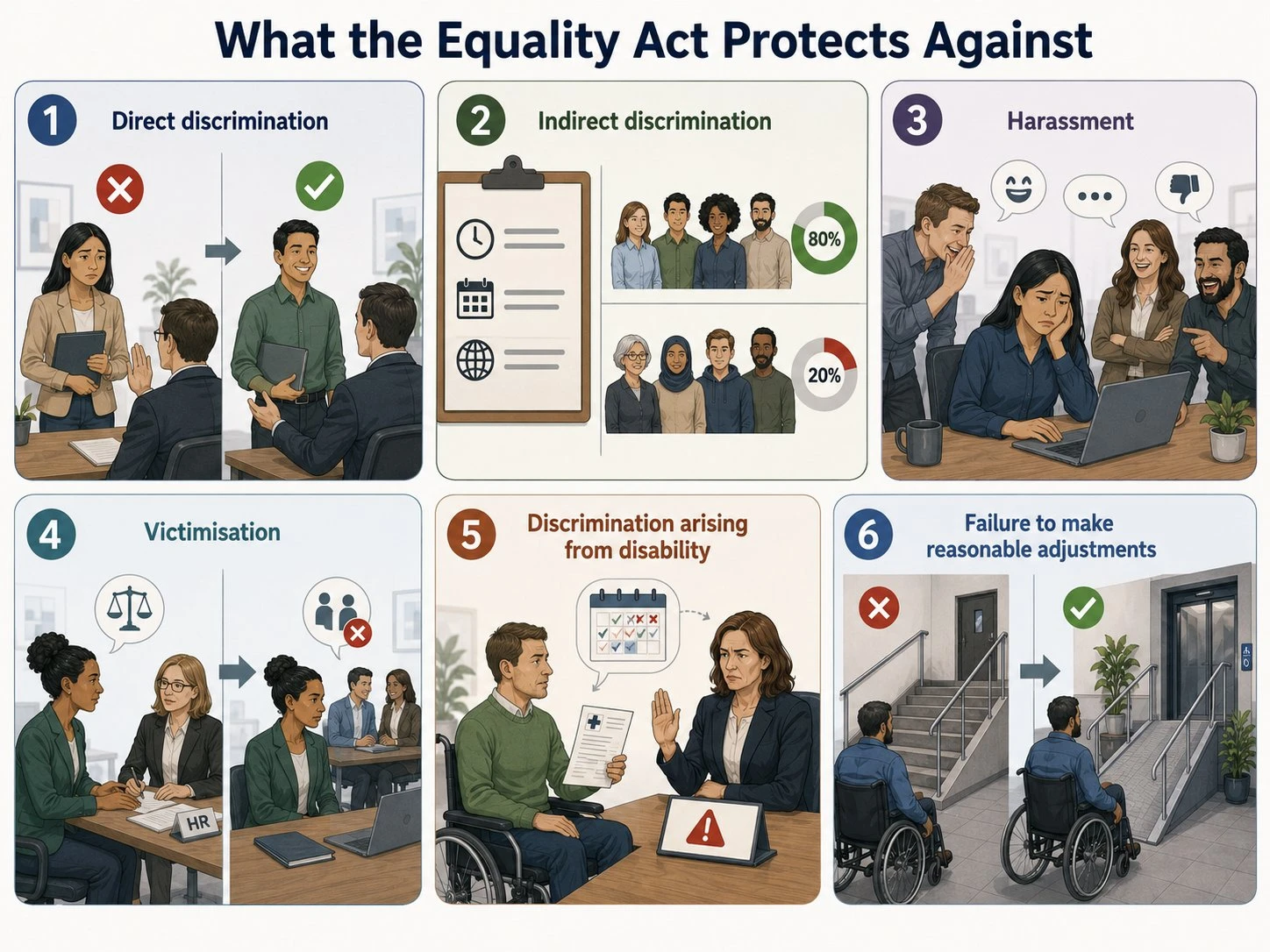
Direct discrimination — treating someone less favourably than others because of a protected characteristic. With the limited exception of age, direct discrimination is generally unjustifiable in law.
Indirect discrimination — applying a provision, criterion or practice (PCP) that is neutral on its face but puts people sharing a protected characteristic at a particular disadvantage, where the employer can’t justify it as a proportionate means of achieving a legitimate aim.
Harassment — unwanted conduct related to a protected characteristic that has the purpose or effect of violating someone’s dignity, or creating an intimidating, hostile, degrading, humiliating or offensive environment.
Victimisation — treating someone less favourably because they’ve made a complaint of discrimination, supported one, or done other ‘protected acts’ under the Act.
For disability specifically, the Act adds two further forms: discrimination arising from disability (under section 15), and failure to make reasonable adjustments. The ACAS guidance on discrimination covers the categories in workplace context.
The full treatment is in our guide to the Equality Act 2010.
Combined and intersectional discrimination
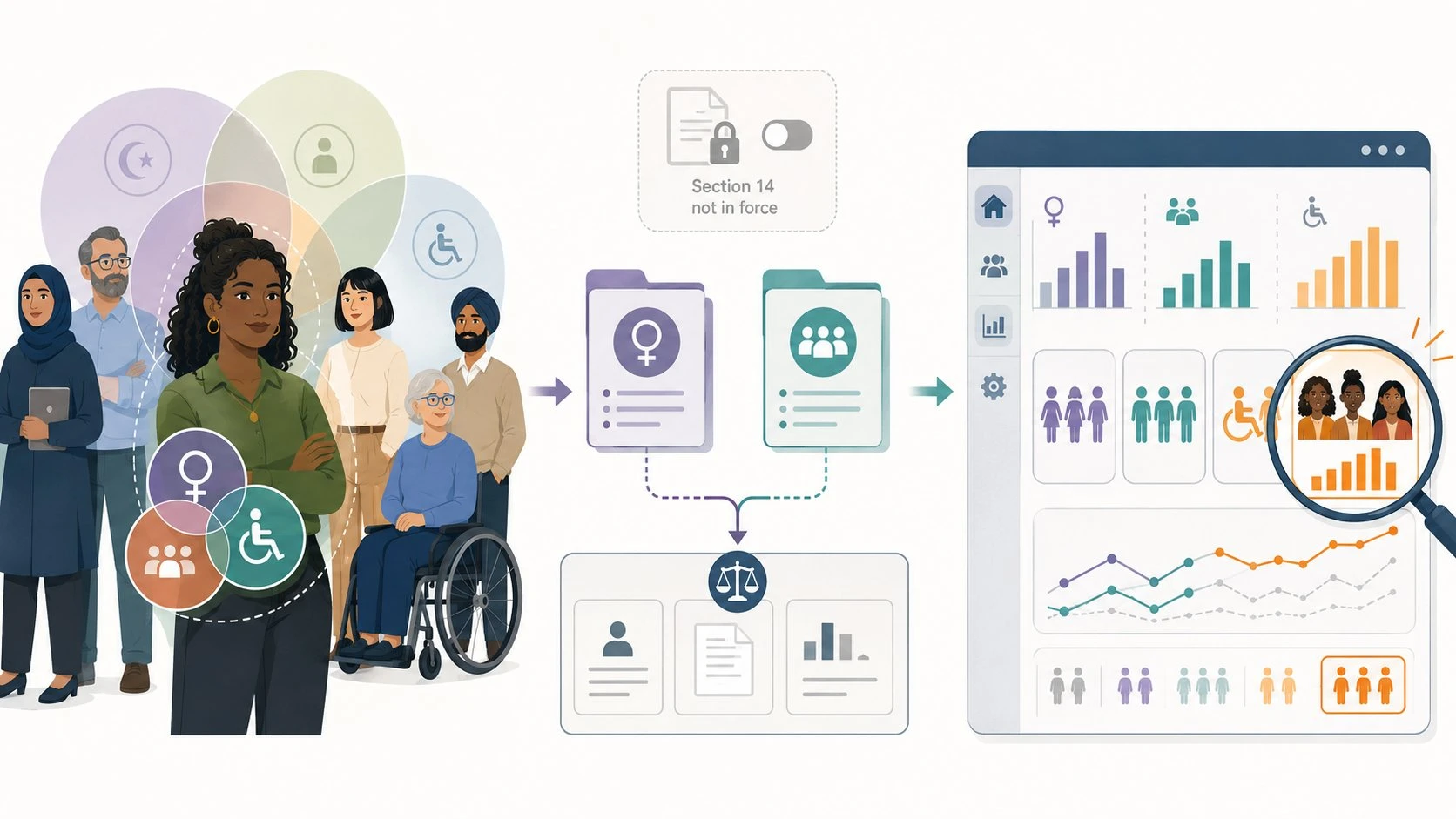
Section 14 of the Act provided for ‘combined discrimination’ — claims based on two characteristics together — but this section has never been brought into force. In practice, claims are usually brought on each characteristic separately, with the tribunal able to consider how multiple characteristics intersect when assessing the evidence.
The concept of intersectionality — the recognition that protected characteristics combine in individual lives rather than acting independently — has nonetheless influenced how cases are argued and how employers approach their data analysis. Reporting that combines characteristics (for example, looking at pay gaps for women of colour as a distinct group rather than for women and ethnic minorities separately) is becoming more common.
What is not a protected characteristic
A surprising number of attributes that people might assume are protected are not, in fact, protected characteristics under the Equality Act. Understanding the boundary matters.
Socio-economic status
Is not protected. Section 1 of the Act would have created a ‘socio-economic duty’ on public bodies, but it has never been commenced in England. Wales has brought it into force separately under devolved legislation, and Scotland under the Fairer Scotland Duty.
Political opinion
Is not generally protected, except in Northern Ireland (under separate NI legislation). Membership of a political party, holding particular political views, or political activity outside work are not protected characteristics under the Equality Act in Britain.
Accent or regional origin
Isn’t directly protected, though discrimination on the basis of accent might amount to indirect discrimination on grounds of race or nationality in some cases.
Weight or appearance
Isn’t protected, except where they connect to a protected characteristic (severe obesity that meets the disability definition, for example).
Caste is not currently a protected characteristic in itself, though caste-related discrimination might fall within the race characteristic in some cases.
Trade union membership is protected under separate legislation — the Trade Union and Labour Relations (Consolidation) Act 1992 — rather than under the Equality Act.
Frequently asked questions
What are the nine protected characteristics?
Age, disability, gender reassignment, marriage and civil partnership, pregnancy and maternity, race, religion or belief, sex, and sexual orientation. They are listed in section 4 of the Equality Act 2010.
How is disability defined under the Equality Act?
A physical or mental impairment that has a substantial and long-term adverse effect on a person’s ability to carry out normal day-to-day activities. ‘Long-term’ generally means lasting or likely to last 12 months or more. Cancer, HIV infection, multiple sclerosis and severe sight impairment are treated as disabilities from the point of diagnosis.
What counts as a long-term impairment?
One that has lasted or is likely to last at least 12 months, or to last for the rest of the person’s life. Recurring conditions where the effect is likely to come back also count.
Does the Equality Act protect transgender people?
Yes, through the gender reassignment characteristic. Following the Supreme Court ruling in April 2025, ‘sex’ under the Act means biological sex, but transgender people are protected from discrimination through the separate characteristic of gender reassignment regardless of whether they hold a Gender Recognition Certificate.
Is socio-economic status a protected characteristic?
No, not directly under the Equality Act in England. Wales and Scotland have brought equivalent duties into force separately. Section 1 of the Equality Act, which would have created a socio-economic duty in England, has never been commenced.
What are ‘deemed disabilities’?
Conditions treated as disabilities from the point of diagnosis without needing to satisfy the standard tests: cancer, HIV infection, multiple sclerosis, and severe sight impairment (‘blindness’ as certified by an ophthalmologist), set out in Schedule 1 of the Act.
What is combined discrimination?
A claim based on two protected characteristics together — for example, treatment of a person specifically because they are a Black woman, rather than for being either Black or a woman alone. Section 14 of the Equality Act provided for this but has never been commenced. In practice, tribunals consider how characteristics intersect when looking at evidence in single-characteristic claims.
The nine protected characteristics are the foundation of UK equality law and underpin every other topic in this cluster — from the Equality Act 2010 as a whole, to the duty to make reasonable adjustments, to the Public Sector Equality Duty. To make sure your team understands each of the nine confidently and in current legal context, our Equality, Diversity & Inclusion Training course covers them in depth.
Related guides
- Equality Act 2010: The Complete UK Guide
- Reasonable adjustments under the Equality Act
- Equality and Diversity in Health and Social Care: A UK Guide
Make sure your whole team understands each of the nine protected characteristics in current legal context.
Explore the Equality, Diversity & Inclusion course →
Mark writes about equality, diversity and inclusion, UK workplace law and accredited online training for Equality, Diversity & Inclusion Training, part of Online CPD Academy.