
The Equality Act 2010 is the principal piece of UK discrimination law. It governs how employers treat employees, how service providers treat customers, how schools treat pupils, how landlords treat tenants, and how public authorities exercise their public functions. Every claim of unlawful discrimination at work in Britain rests on it, every workplace equality policy refers to it, and every change in UK equality practice over the last fifteen years has had to be reconciled with it.
This guide explains what the Act actually does — its origins, who it covers, the characteristics it protects, the types of discrimination it prohibits, the duties it creates — and what’s changed since 2024 with the Worker Protection Act, the Supreme Court ruling on sex, and the Employment Rights Act 2025.
Why the Equality Act was introduced
For most of the second half of the twentieth century, UK equality law developed in patches. The Equal Pay Act 1970 introduced equal pay for men and women. The Sex Discrimination Act 1975 prohibited sex discrimination more broadly. The Race Relations Act 1976 covered race. The Disability Discrimination Act 1995 covered disability. Sexual orientation regulations came in 2003, religion or belief regulations the same year, age regulations in 2006.
Each piece of legislation used slightly different concepts, different definitions, different enforcement routes and different exemptions. The result was a body of law that protected most of the same people from most of the same things, but did so through nine or ten separate statutes and dozens of statutory instruments, with frequent inconsistencies between them.
The Equality Act 2010 consolidated this body of law into a single statute. According to the Equality and Human Rights Commission, it brought together over 116 separate pieces of legislation. It harmonised the definitions, simplified the routes to enforcement, and extended some protections that had previously applied unevenly across the characteristics.
The Act doesn’t apply in Northern Ireland. Equivalent protections there come from a series of NI-specific orders and from Section 75 of the Northern Ireland Act 1998.
When it came into force
The Equality Act 2010 received Royal Assent on 8 April 2010 and was largely commenced on 1 October 2010. Some provisions came in later — the public sector equality duty in April 2011, the age provisions for services in October 2012 — and a handful have never been commenced (most notably section 1, the socio-economic duty for England, and section 14, on combined discrimination).
The Act applies in England, Scotland and Wales. As above, Northern Ireland has its own framework.
Who the Act applies to
The Act has broad scope. It covers:
Employers — at every stage from recruitment to dismissal and beyond. The Act protects workers, employees, applicants, agency workers, contractors providing personal services, and (in some respects) former employees.
Service providers and public functions — any organisation providing services or carrying out public functions, from shops and restaurants to GP surgeries, banks, transport providers and government departments.
Education providers — schools, further education colleges, universities, and other education and training providers.
Premises — landlords, estate agents, accommodation providers.
Associations — clubs and similar bodies with at least 25 members where membership is selective.
Public authorities exercising public functions — additionally subject to the Public Sector Equality Duty.
The Act protects everyone in Britain. A common misunderstanding is that it only protects minority groups; in fact it protects every person from discrimination on any of the nine protected characteristics, including majority groups. A White man can bring a race discrimination claim if treated less favourably because he’s White; a Christian can bring a religion or belief claim; a man can bring a sex discrimination claim. The numbers of such claims are usually smaller because the patterns of discrimination in UK society are unequal, but the protection is the same.
The nine protected characteristics
The Act protects nine characteristics, listed in section 4. Each is defined in sections 5–12:
- Age (section 5): Covers all ages.
- Disability (section 6): A physical or mental impairment with a substantial and long-term adverse effect on day-to-day activities.
- Gender reassignment (section 7): Protects people undergoing or having undergone gender reassignment.
- Marriage and civil partnership (section 8): Protects married people and civil partners (not single, divorced, widowed or cohabiting people).
- Pregnancy and maternity (section 18 for employment, section 17 for non-work): Protects pregnant women and women on maternity leave.
- Race (section 9): Covers colour, nationality, and ethnic or national origins.
- Religion or belief (section 10): Covers any religion or any religious or philosophical belief, including the lack of any.
- Sex (section 11): Following the Supreme Court ruling of April 2025, refers to biological sex.
- Sexual orientation (section 12): Covers orientation towards persons of the same sex, the opposite sex, or both.
We cover each of these in detail in our guide to the nine protected characteristics, including the recent case law on sex and gender reassignment.
The four main types of discrimination
The Act prohibits four main types of conduct in relation to the protected characteristics, supplemented for disability by two additional forms.
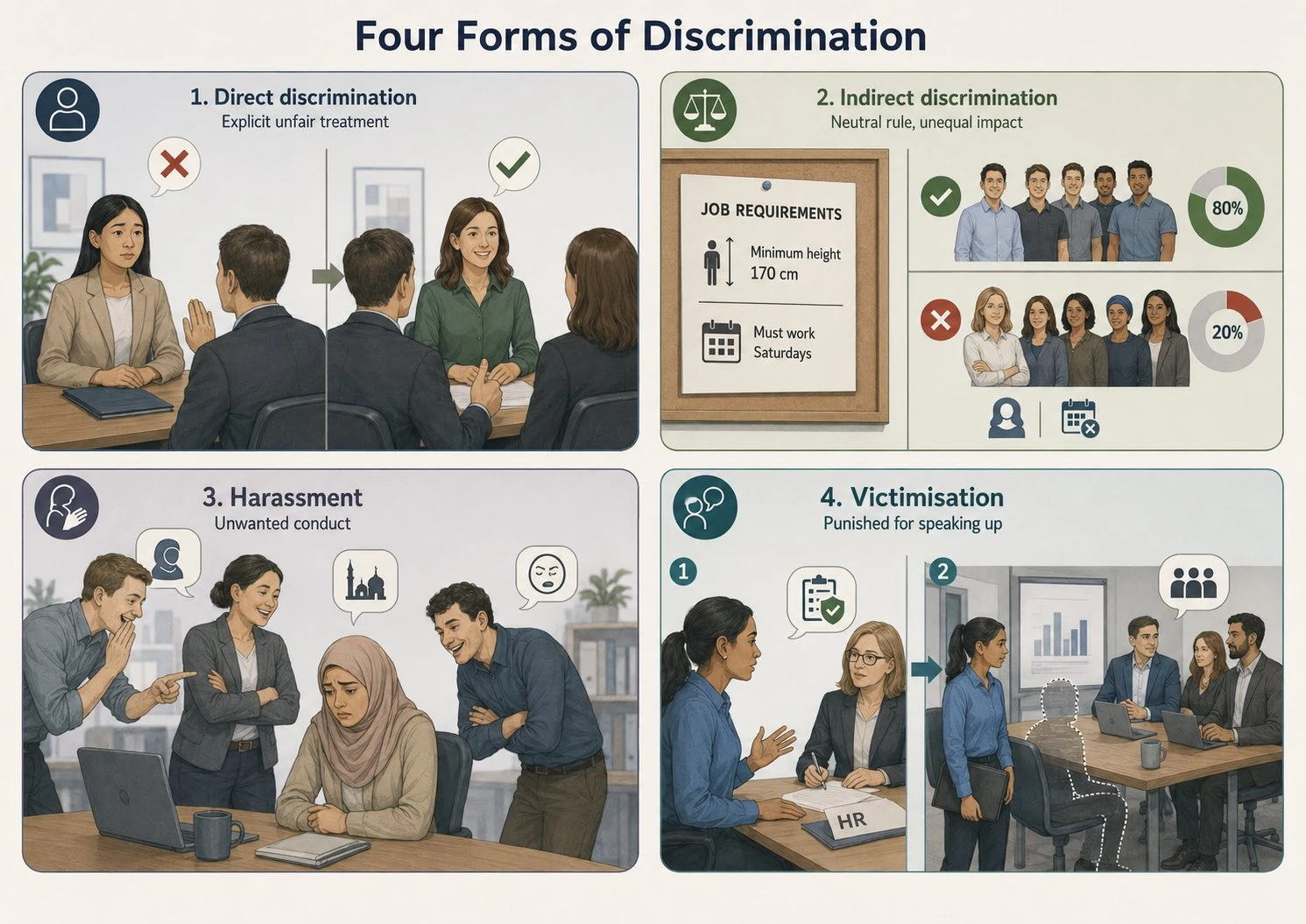
Direct discrimination — treating someone less favourably than others because of a protected characteristic. The clearest cases are explicit: refusing to hire someone because they’re Asian, dismissing someone because they’re gay, paying a woman less than a man for the same work. With the limited exception of age (where direct discrimination can be objectively justified as a proportionate means of achieving a legitimate aim), direct discrimination is essentially never justifiable.
Indirect discrimination — applying a provision, criterion or practice that is neutral on its face but puts people sharing a protected characteristic at a particular disadvantage compared to others. The classic example is a requirement that’s not actually necessary for the job and disproportionately affects one group: a ‘minimum height’ requirement that affects more women than men, a requirement to work Saturdays that affects Jewish and Seventh-day Adventist applicants, a requirement for several years of unbroken UK experience that affects recent migrants. Indirect discrimination can be justified if the employer can show the requirement is a proportionate means of achieving a legitimate aim.
Harassment — unwanted conduct related to a protected characteristic that has the purpose or effect of violating someone’s dignity, or creating an intimidating, hostile, degrading, humiliating or offensive environment. The ‘purpose or effect’ language matters: the harasser doesn’t have to have intended harm if the effect was harmful and reasonable. Sexual harassment is a specific form under section 26(2).
Victimisation — treating someone less favourably because they’ve made a complaint of discrimination, supported one, or done some other ‘protected act’ under the Act. Protection from victimisation is what makes the rest of the regime workable: without it, complaining about discrimination would carry an unacceptable personal cost.
For disability specifically, the Act adds:
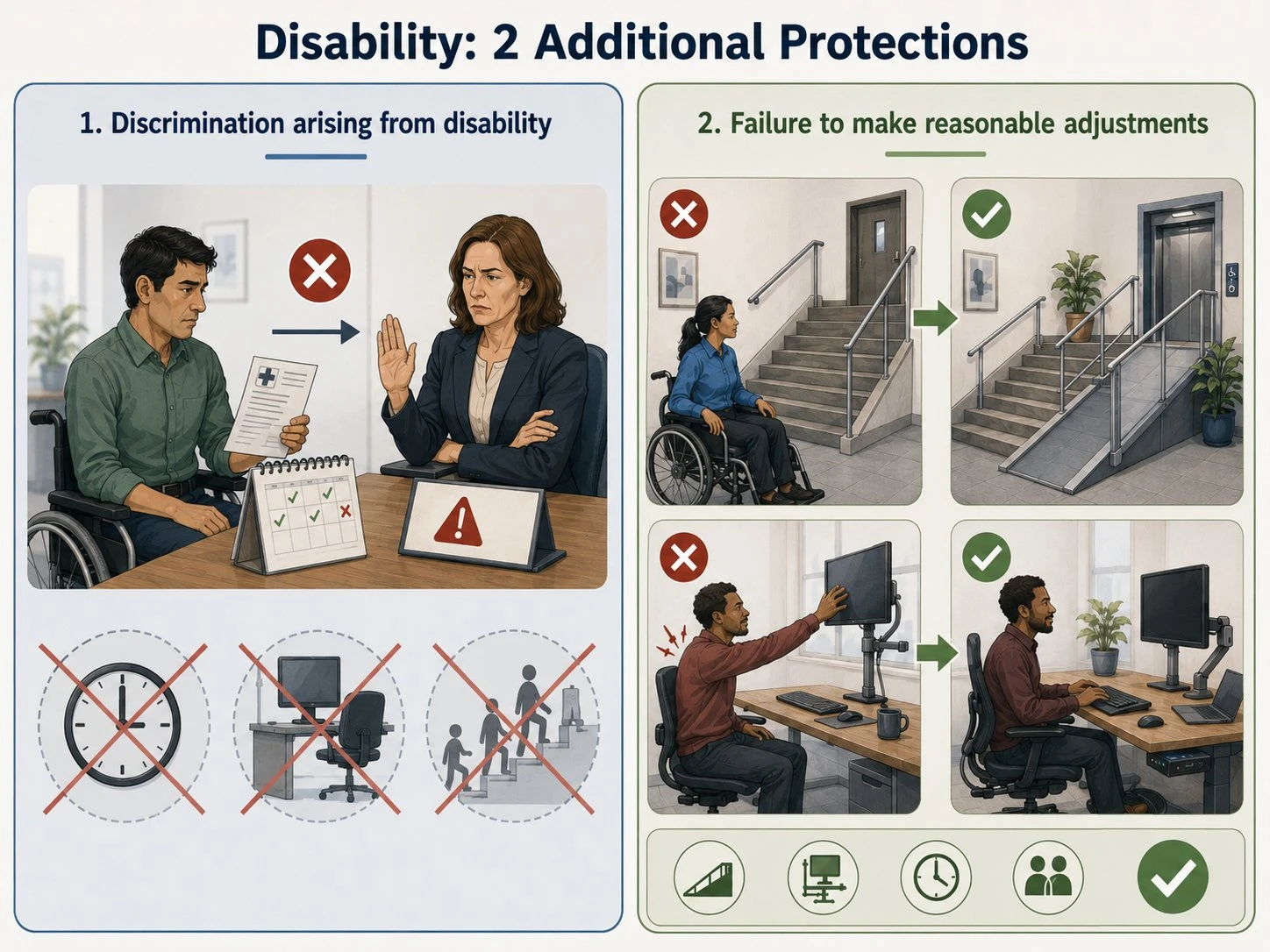
Discrimination arising from disability (section 15) — treating someone unfavourably because of something arising in consequence of their disability, where the employer can’t justify the treatment as a proportionate means of achieving a legitimate aim. Dismissing an employee for absence rates connected to their disability, without considering reasonable adjustments, is the most common example.
Failure to make reasonable adjustments (sections 20–22) — failing to take reasonable steps to remove substantial disadvantage faced by a disabled person. This duty is unique to disability and is covered in detail in our guide to reasonable adjustments.
The Public Sector Equality Duty
Section 149 of the Act creates a duty on public authorities — and on private organisations exercising public functions — to have due regard to three aims: eliminating discrimination, advancing equality of opportunity, and fostering good relations.
This duty applies on top of the prohibitions on discrimination, not instead of them. A council still can’t discriminate; it now also has to actively consider equality when making policy and operational decisions. The duty is enforceable through judicial review, and a substantial body of case law — including R (Brown) v Secretary of State for Work and Pensions [2008] EWHC 3158, Bracking v Secretary of State for Work and Pensions [2013] EWCA Civ 1345, and others — has shaped what ‘due regard’ means in practice.
We cover the duty in detail, including the case law and the specific duties that apply in England, Scotland and Wales, in our guide to the Public Sector Equality Duty.
Recent and upcoming changes
Three developments since 2023 have reshaped UK equality practice. Any current understanding of the Equality Act has to take account of them.
The Worker Protection Act 2023 — section 40A
The Worker Protection (Amendment of Equality Act 2010) Act 2023 inserted section 40A into the Equality Act. The provision came into force on 26 October 2024. It creates an active duty on employers to take reasonable steps to prevent sexual harassment of their workers in the course of their employment.
This is a shift from the previous position. Before October 2024, an employer could be liable for sexual harassment of an employee by a colleague, but the duty was essentially reactive — to respond to incidents. Section 40A makes the duty proactive: employers must take reasonable steps to prevent harassment in the first place. What ‘reasonable steps’ looks like in practice will vary by sector and risk, but typically includes risk assessment, policy review, training, and clear reporting routes.
The bite of the duty is in the remedy. Where an employee succeeds in a sexual harassment claim and the tribunal finds that the employer didn’t take reasonable steps to prevent the harassment, the tribunal can uplift the discrimination compensation by up to 25%. Given that discrimination awards are uncapped, the financial exposure is significant.
The Equality and Human Rights Commission has powers to investigate employers’ compliance with section 40A and to take enforcement action where the duty is breached.
The Supreme Court ruling on sex
On 16 April 2025, the UK Supreme Court handed down its judgment in For Women Scotland Ltd v The Scottish Ministers [2025] UKSC 16. The court ruled unanimously that the terms ‘sex’, ‘man’ and ‘woman’ in the Equality Act 2010 mean biological sex. A Gender Recognition Certificate issued under the Gender Recognition Act 2004 does not change a person’s legal sex for the purposes of the Equality Act.
The court was clear that the ruling did not weaken protection from discrimination on grounds of gender reassignment. Transgender people remain fully protected under the separate protected characteristic of gender reassignment, regardless of whether they hold a GRC. What the ruling addressed was which characteristic applies in which legal situation, not whether transgender people are protected.
The Equality and Human Rights Commission issued interim guidance in April 2025 and has been updating its statutory codes of practice to reflect the ruling. The practical implications — particularly for single-sex services, single-sex spaces and the application of various exceptions in the Act — continue to be worked through.
The full ruling is available on the Supreme Court website; the House of Commons Library has published a research briefing on the judgment summarising the legal position and the implications.
The Employment Rights Act 2025
The Employment Rights Act 2025 makes substantial further amendments to the Equality Act that take effect from October 2026. Two are particularly relevant.
First, the standard for preventing sexual harassment is raised from ‘reasonable steps’ to ‘all reasonable steps’. The change of one word raises the bar materially: an employer can no longer defend a claim simply by showing it took proportionate steps; it now has to show it took every reasonable step.
Second, employer liability for third-party harassment is reintroduced. Until 2013, employers could be liable for harassment of their workers by third parties — customers, contractors, members of the public — in certain circumstances. That provision was repealed. The 2025 Act reintroduces third-party liability and extends it across all protected characteristics, not just sex. From October 2026, an employer will be liable for third-party harassment of a worker unless it took all reasonable steps to prevent it.
This is a major change for sectors with high public contact — retail, hospitality, healthcare, transport, customer service. Policy review, training and physical workplace design will all need to reflect it. ACAS guidance on the new framework is being developed.
Enforcement
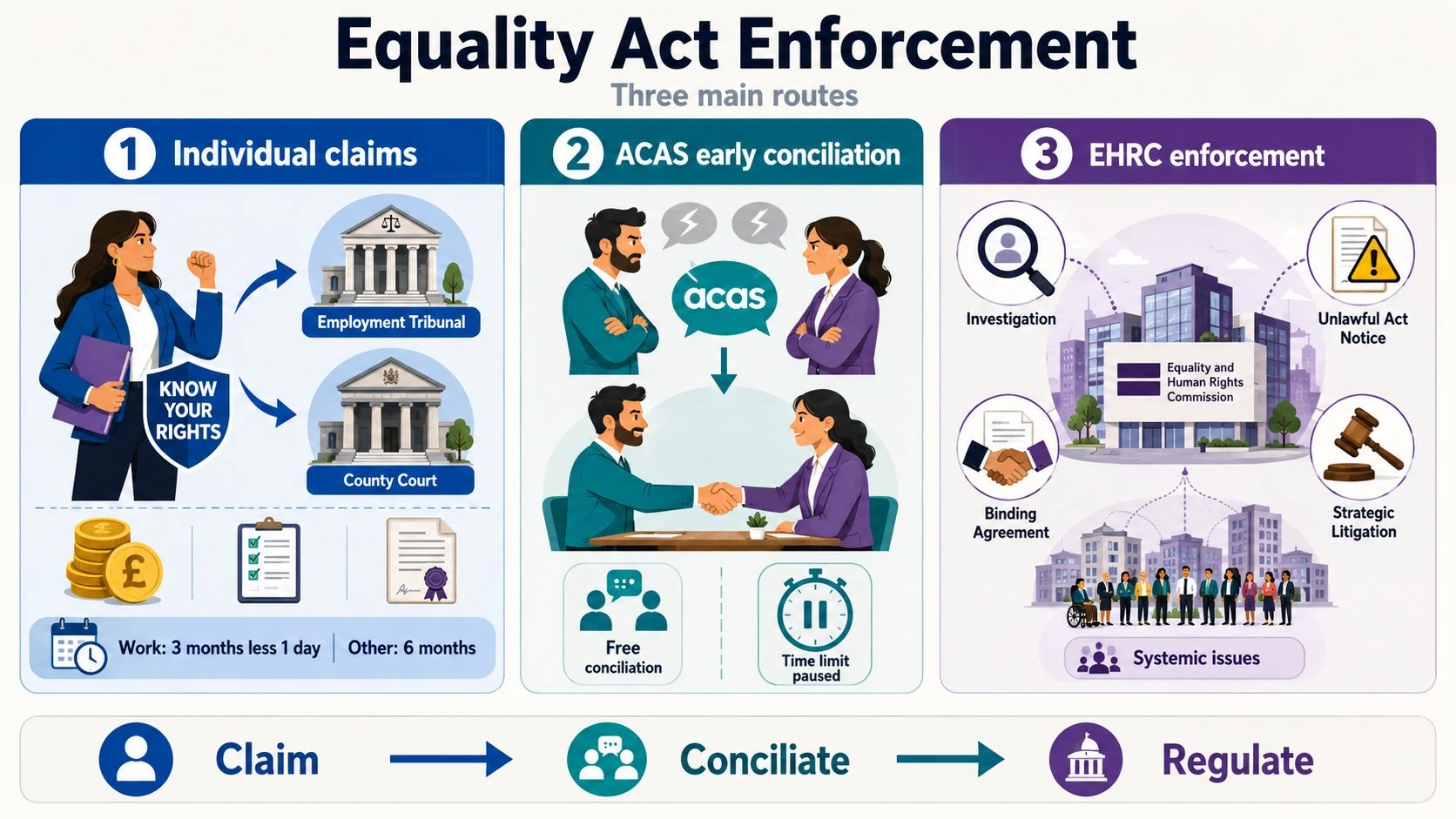
The Equality Act is enforced through three main routes.
Individual claims
A person who believes they’ve been discriminated against, harassed or victimised can bring a claim — in the Employment Tribunal for work-related matters, or in the County Court for matters relating to services, education, housing or public functions. Tribunals can award uncapped compensation (covering financial loss and injury to feelings), make recommendations, and issue declarations of unlawful conduct.
Time limits are short. For employment claims, three months less one day from the act of discrimination is the standard limit, extended where appropriate by ACAS early conciliation. For other claims, six months is more common.
ACAS early conciliation
Before bringing an employment claim, the prospective claimant must notify ACAS, which offers a free conciliation service to try to resolve the matter without litigation. The time spent on conciliation pauses the tribunal time limit.
EHRC enforcement
The Equality and Human Rights Commission has a range of regulatory powers, including conducting formal investigations, issuing unlawful act notices, entering into binding agreements with organisations, and bringing strategic litigation in its own name. The EHRC tends to focus on systemic issues rather than individual cases, but its work shapes how the Act is interpreted.
Common myths about the Equality Act
A few misconceptions come up regularly.
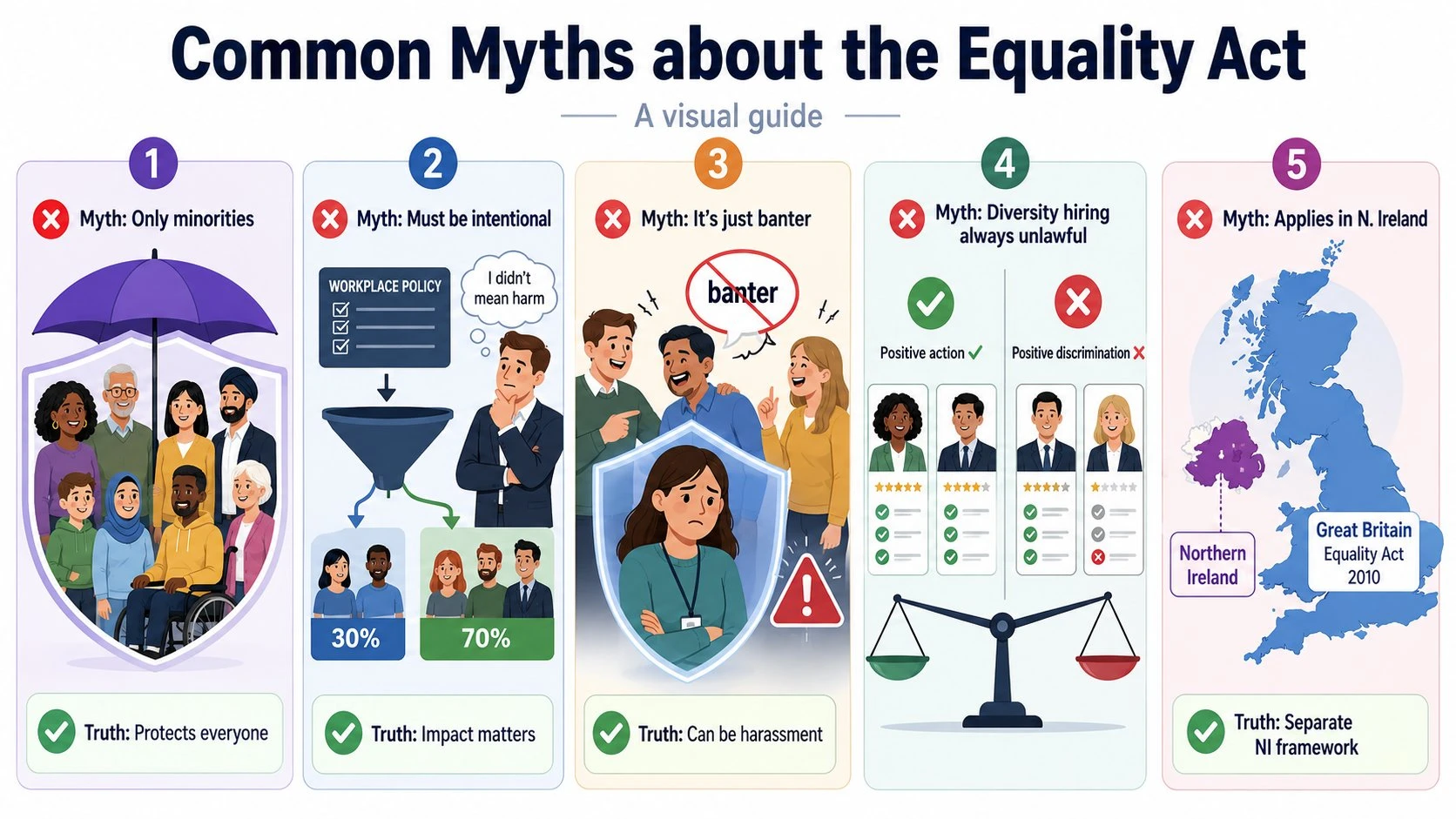
‘The Equality Act only protects minority groups.’ It protects everyone in Britain on each of the nine characteristics. A man can bring a sex discrimination claim; a White person can bring a race discrimination claim; a non-disabled person can’t bring a reasonable adjustments claim (that one is disability-specific), but the broader discrimination protections apply across the board.
‘Discrimination has to be intentional to count.’ It doesn’t. The Act doesn’t require malice or intent. A policy can be indirectly discriminatory even if the employer never thought about its differential impact.
‘Banter isn’t harassment.’ Conduct can be harassment under the Act regardless of how the perpetrator frames it. The legal test is whether the conduct was unwanted, related to a protected characteristic, and had the purpose or effect of creating a hostile environment for the recipient.
‘You can’t ask for diversity in hiring without breaking the law.’ Positive action under sections 158 and 159 is lawful — proportionate measures to enable underrepresented groups to overcome disadvantage, including using a protected characteristic as a tie-breaker between equally qualified candidates. Positive discrimination — preferring a less-qualified person purely because of a protected characteristic — is unlawful. The line is genuinely fine but real. Our piece on equality vs equity covers the distinction in more detail.
‘The Equality Act applies in Northern Ireland.’ It doesn’t. Northern Ireland has its own framework, mainly under Section 75 of the Northern Ireland Act 1998 and a series of NI-specific anti-discrimination orders.
Where to read the Act and get help
The Equality Act 2010 itself is available in full on the Government’s legislation website. The EHRC’s statutory codes of practice for employment, services and public functions, and equal pay, are the most useful interpretive guides for organisations. The ACAS website is the best practical resource for employment-specific guidance.
For individuals affected by discrimination, the Equality Advisory and Support Service (EASS) provides free advice. Citizens Advice can help with the legal route and pre-tribunal options. Trade unions support members through workplace discrimination cases.
Frequently asked questions
What is the Equality Act 2010?
The Equality Act 2010 prohibits discrimination, harassment and victimisation on the grounds of nine protected characteristics — age, disability, gender reassignment, marriage and civil partnership, pregnancy and maternity, race, religion or belief, sex, and sexual orientation. It applies in employment, services, education, premises and associations, and imposes a Public Sector Equality Duty on public authorities.
When did the Equality Act 2010 come into force?
The Act was largely commenced on 1 October 2010. Some provisions came in later, and a few have never been commenced.
Who does the Equality Act 2010 apply to?
Employers, service providers, education providers, landlords, associations of 25+ members, and public authorities exercising public functions. The protections apply to everyone in Britain on each of the nine protected characteristics.
What are the nine protected characteristics?
Age, disability, gender reassignment, marriage and civil partnership, pregnancy and maternity, race, religion or belief, sex, and sexual orientation.
What are the main types of discrimination under the Equality Act 2010?
Direct discrimination, indirect discrimination, harassment and victimisation. For disability specifically, the Act adds discrimination arising from disability and failure to make reasonable adjustments.
What did the Supreme Court rule about sex in 2025?
The Supreme Court ruled in April 2025 that ‘sex’ in the Equality Act means biological sex, and that a Gender Recognition Certificate does not change a person’s legal sex for the purposes of the Act. Transgender people remain fully protected under the separate characteristic of gender reassignment.
Does the Equality Act 2010 apply in Northern Ireland?
No. Northern Ireland has its own equality framework, mainly under Section 75 of the Northern Ireland Act 1998 and a series of NI-specific anti-discrimination orders.
Where can I read the Equality Act 2010?
The full text is available on the UK Government’s legislation website. The Equality and Human Rights Commission’s statutory codes of practice are the most useful interpretive guides for organisations.
The Equality Act 2010 is the legal foundation under which the rest of this cluster sits — including the nine protected characteristics, the duty to make reasonable adjustments, the Public Sector Equality Duty, and the equality impact assessments public bodies use to evidence compliance. It’s also the framework that any equality and diversity policy refers to. To make sure your team understands the Act confidently and is up to date on the 2024 section 40A duty, the 2025 Supreme Court ruling, and the October 2026 ERA 2025 changes, our Equality, Diversity & Inclusion Training course covers it in depth.
Related guides
- The Nine Protected Characteristics Under the Equality Act 2010
- Equality and Diversity in Health and Social Care: A UK Guide
- Neurodiversity at Work: A UK Employer’s Guide
Make sure your team understands the Equality Act 2010 and their responsibilities under it.
Explore the Equality, Diversity & Inclusion course →
Mark writes about equality, diversity and inclusion, UK workplace compliance and accredited online training for Equality, Diversity & Inclusion Training, part of Online CPD Academy.