
The duty to make reasonable adjustments is one of the most distinctive features of UK equality law. It’s the legal mechanism that requires employers, service providers, schools and others to take active steps to remove disadvantages faced by disabled people — not just to avoid discriminating against them, but to make positive changes so they can participate on a comparable basis with everyone else.
This guide explains what the duty actually requires, the three situations that trigger it, what counts as ‘reasonable’, how to handle requests and assessments in practice, and the most common reasons employers find themselves in front of an Employment Tribunal on this issue.
What the duty says
The duty is set out in section 20 of the Equality Act 2010, supplemented by Schedule 8 for employment situations and Schedule 2 for service providers. Section 21 makes failure to comply with the duty a form of discrimination — meaning the employer or service provider doesn’t have to have done anything actively unfair; failing to make an adjustment that should have been made is itself unlawful.
Crucially, the duty applies only to the protected characteristic of disability. The other eight protected characteristics under the Act don’t carry a reasonable adjustments duty (though they have their own protections against direct and indirect discrimination). Disability is defined in section 6 of the Act as a physical or mental impairment that has a substantial and long-term adverse effect on a person’s ability to carry out normal day-to-day activities. The fuller treatment of who counts as disabled is in our guide to the nine protected characteristics.
Who the duty applies to
The duty applies to a wide range of organisations:
Employers — including recruitment processes, throughout employment, and in some post-employment situations such as references and pension administration.
Service providers
Shops, restaurants, hotels, banks, transport providers, anyone offering services to the public or a section of the public.
Education providers
Schools, colleges, universities, training providers.
Housing providers
Landlords (residential and commercial), housing associations, estate agents.
Public functions
When public bodies are exercising their public functions, alongside their wider duties under the Public Sector Equality Duty.
Associations — clubs and similar bodies with 25 or more members.
The duty applies to the organisation, not to individual employees. A line manager who has a disabled team member doesn’t personally owe the duty; the employer does, and the line manager is one of the people through whom the employer discharges it.
The three trigger situations
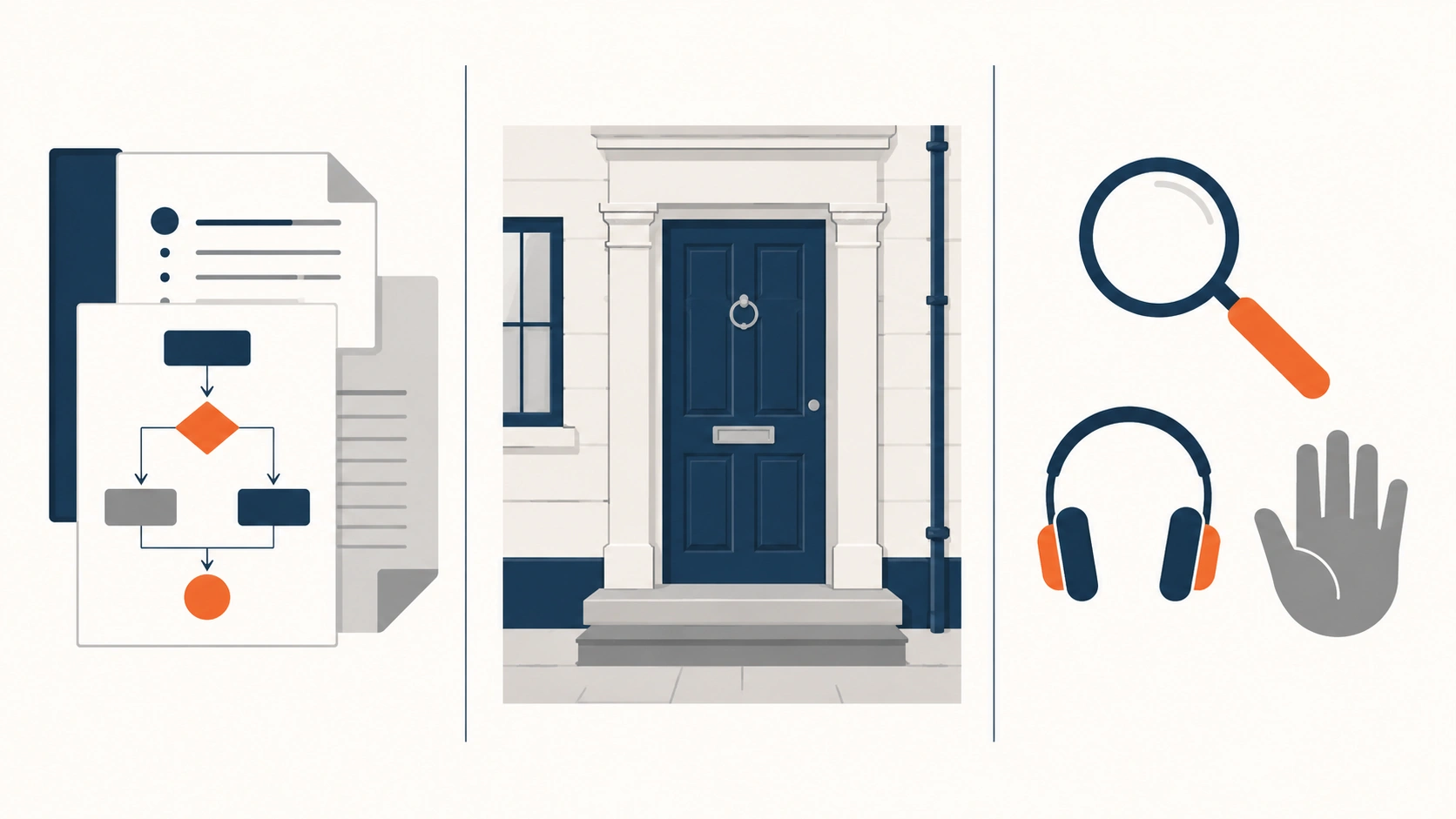
Section 20 sets out three distinct situations in which the duty arises. Understanding them separately matters because the response to each is different.
Provision, criterion or practice (PCP)
The first situation arises where an employer applies a provision, criterion or practice that puts a disabled person at a substantial disadvantage compared to those who aren’t disabled. A ‘PCP’ is interpreted broadly: formal policies, informal practices, one-off decisions, and the way things have always been done can all count.
Examples include a requirement to work specific hours that conflict with treatment schedules; an expectation that all communication is by phone, which disadvantages a deaf employee; a rotational shift pattern that disrupts the routine an autistic employee depends on; an attendance policy that triggers warnings based on absence levels without considering disability-related sickness.
Physical features
The second situation arises where a physical feature of premises puts a disabled person at a substantial disadvantage. The feature might be a step at the entrance, the layout of furniture, the height of work surfaces, the brightness or volume of the environment, the absence of accessible toilets.
For employers, the duty extends to physical features of the workplace. For service providers, it extends to physical features of premises from which services are provided.
Auxiliary aids and services
The third situation arises where a disabled person would, but for the provision of an auxiliary aid, be at a substantial disadvantage. An auxiliary aid might be assistive software, a specialist keyboard, voice recognition technology, a screen reader, an induction loop, a BSL interpreter, a support worker.
The three triggers overlap in practice. A disabled employee who can’t access the upper floor of an office because the only route is by stairs is facing a physical feature problem; if there’s a lift available but they need a key to use it, the lack of routine key provision is a PCP problem; if they need an evacuation chair, that’s an auxiliary aid issue.
What ‘reasonable’ means
The Equality Act doesn’t define ‘reasonable’ in detail, but case law and the Equality and Human Rights Commission’s statutory codes of practice identify several relevant factors:
- The effectiveness of the adjustment in removing the disadvantage.
- The practicability of making it.
- The financial cost relative to the employer’s resources.
- The disruption it would cause.
- The availability of financial or other assistance (such as Access to Work funding).
- The nature of the employer’s activities and size.
A small business with limited cash flow won’t be expected to make the same adjustments as a FTSE 100 company. A safety-critical role has different constraints than an office role. The test is contextual — what’s reasonable for this employer, this employee, this situation.
What ‘reasonable’ doesn’t depend on is whether the adjustment is convenient for the employer or whether other employees might be slightly inconvenienced. The fact that an adjustment costs money is not on its own a defence; the question is whether the cost is disproportionate given the employer’s circumstances.
Adjustments by functional need, not by condition
Most guidance on reasonable adjustments lists examples by condition: ‘adjustments for dyslexia’, ‘adjustments for autism’, ‘adjustments for chronic fatigue syndrome’. This is useful as a starting point but misleading in practice. The Equality Act doesn’t care about the label; it cares about the impact.

A more useful frame organises adjustments by the functional need they address:
Sensory needs
Quieter spaces, dimmable lighting, noise-cancelling headphones, screen brightness controls, reduced sensory load in shared areas. Relevant for autistic employees, employees with migraines, employees with PTSD, employees with sensory processing differences regardless of underlying diagnosis.
Cognitive load
Written instructions following verbal ones, advance agendas for meetings, breaking complex tasks into smaller steps, reducing context-switching, structured handover documents. Relevant for employees with ADHD, dyslexia, brain injury, long Covid, depression, anxiety — the underlying cause is less important than the cognitive impact.
Communication needs
Email rather than phone, captions on video calls, written rather than verbal feedback, advance notice of changes, BSL interpretation. Relevant for deaf or hard-of-hearing employees, autistic employees who prefer written communication, employees with anxiety, employees whose first language isn’t English.
Physical access
Lifts, ramps, accessible toilets, ergonomic workstations, adjustable desks and chairs, parking close to the entrance, accessible routes. Relevant for wheelchair users, employees with mobility impairments, employees recovering from surgery, pregnant employees, employees with chronic pain.
Flexibility
Adjusted hours, phased return from sickness absence, breaks during the day, working from home some or all of the time, flexible attendance requirements, time off for medical appointments. Relevant across most disabilities.
Thinking in terms of functional need has two practical benefits. It avoids forcing employees to disclose a specific diagnosis they may not have or want to share. And it produces adjustments that often help more than one person — captioned video calls help deaf employees and many others; structured handover documents help ADHD employees and many others.
Anticipatory duty vs reactive duty
There’s an important distinction in how the duty applies to different contexts.
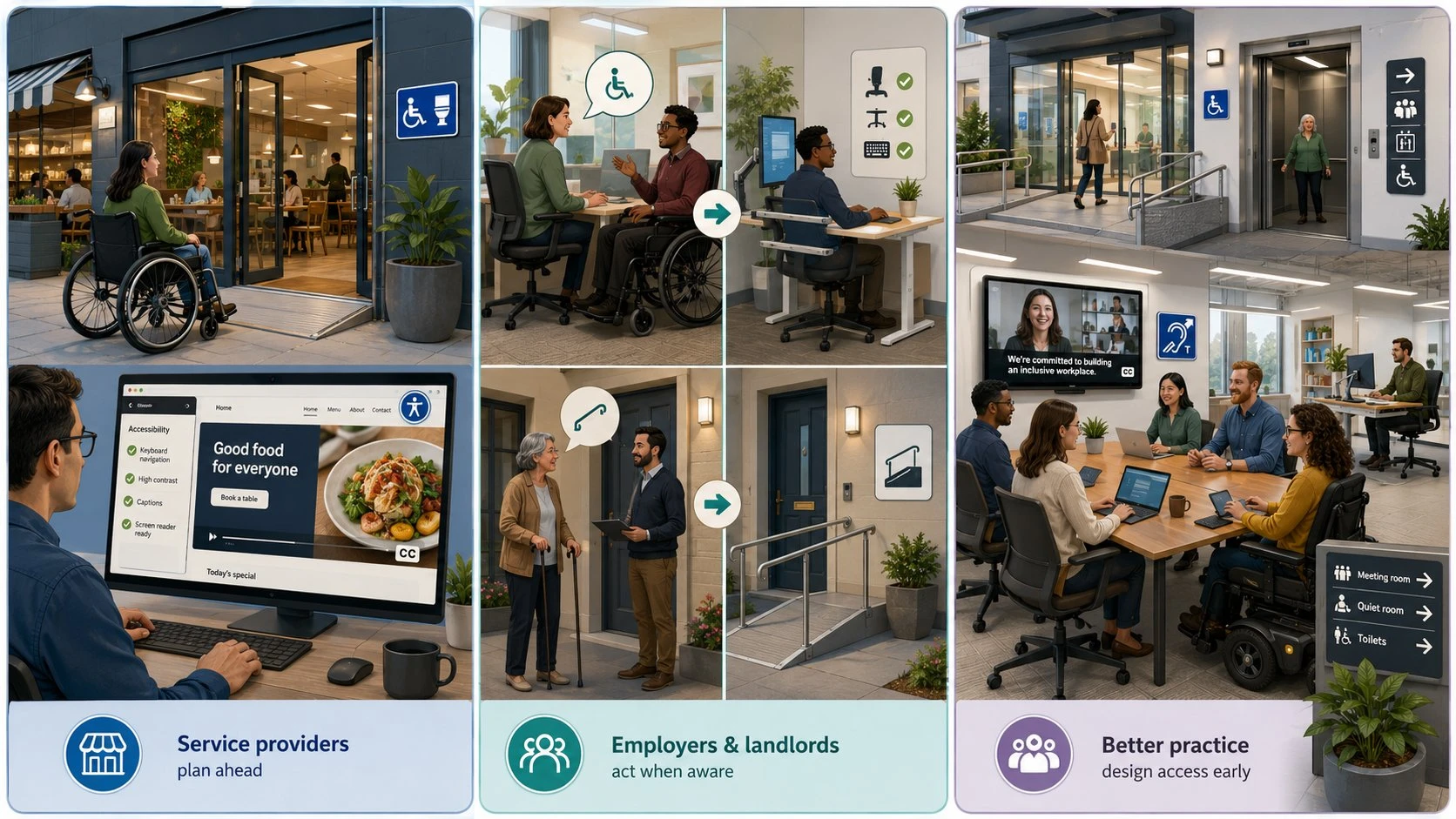
For service providers, the duty is anticipatory. Providers must think in advance about what disabled customers might need and put adjustments in place before being asked. A restaurant should have an accessible toilet before a wheelchair user shows up, not in response to one. A website should be accessible at design time, not when a screen-reader user complains.
For employers and landlords, the duty is reactive. It arises once the employer or landlord knows, or could reasonably be expected to know, that the person is disabled and at a substantial disadvantage. Employers aren’t required to make every workplace fully accessible to every conceivable disability in advance — but they are required to act once the situation arises, and they can’t avoid the duty by deliberately remaining ignorant of disability.
In practice, sensible employers operate partly on an anticipatory basis anyway. A workplace designed with accessibility in mind from the start avoids the cost and disruption of retrofitting later.
How to handle requests
A workable process for handling adjustment requests has four stages.
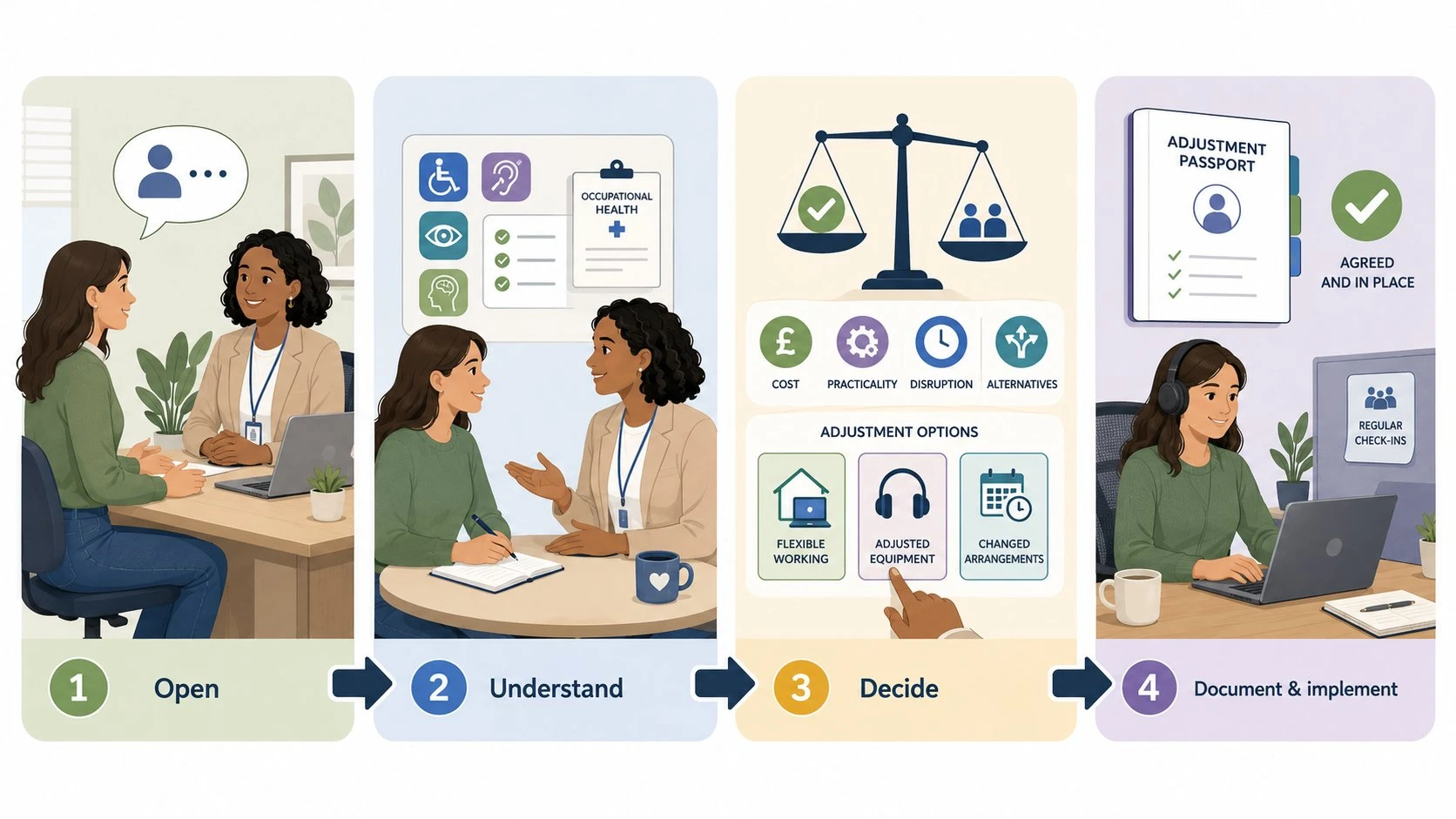
Open the conversation
Adjustments can be requested at any point — at recruitment, on starting a role, during employment, after a change in condition. The route should be obvious and the response should be welcoming, not defensive. An employee who has to fight to get their request taken seriously is one who will probably escalate to a tribunal claim later.
Understand the need
What’s the actual problem? What are the impacts on the employee’s ability to do the job? This often means a conversation with the employee, sometimes supplemented by occupational health advice. The employee is usually the best authority on what works for them. An employer doesn’t need a medical diagnosis to make adjustments — ACAS guidance is clear on this. What’s needed is enough information to understand the impact and the proposed solution.
Decide what’s reasonable
Apply the factors above. Consider the cost, the practicability, the disruption, the alternatives. If something the employee has asked for isn’t reasonable, can a different adjustment achieve the same effect? The duty isn’t to provide the specific adjustment requested — it’s to remove the substantial disadvantage. If there are several ways of doing that, the employer can choose.
Document and implement
Record the discussion, the decision, the rationale, and the adjustment itself. Where adjustments will travel with the employee through future role changes, a ‘workplace adjustment passport’ that captures them avoids the employee having to re-explain their needs every time.
Who pays for adjustments
The cost of reasonable adjustments falls on the employer or service provider. The disabled person doesn’t pay for their own adjustments.
For employment specifically, employers can apply for Access to Work — a UK government scheme that funds practical support for disabled and neurodivergent people in work, including specialist equipment, support workers, communication support and travel costs where these are needed because of a disability. Access to Work funding can reduce the cost to the employer substantially.
The fact that funding is available doesn’t change the employer’s underlying duty. If an adjustment is reasonable, it should be made even where Access to Work funding is delayed or unavailable.
What happens when an adjustment isn’t made
Failure to make a reasonable adjustment is a form of discrimination under section 21 of the Act. The disabled person can bring a claim in the Employment Tribunal (for employment matters) or the County Court (for services, education, housing). Compensation is uncapped and includes injury to feelings; the disabled person doesn’t have to show that the failure was deliberate or malicious.
Failure to make reasonable adjustments remains one of the most common disability-related claims at Employment Tribunal — the Equality and Human Rights Commission consistently identifies it as a top-three issue. The cases that succeed often share common features: the employer didn’t take the request seriously, didn’t engage with what the employee actually needed, didn’t seek occupational health advice in good time, or treated the duty as an optional accommodation rather than a legal obligation.
Common mistakes
A few patterns come up repeatedly.
Requiring a formal diagnosis before considering an adjustment
The Equality Act doesn’t require a diagnosis to consider someone disabled, and ACAS guidance is clear that employers should engage with adjustment requests even without one. Insisting on diagnosis can itself be discriminatory where the practical need is clear.
Treating the duty as optional
Some employers approach adjustments as a ‘nice to have’ that they’ll do if it’s convenient. The duty is a legal obligation, and failure is actionable.
Confusing ‘reasonable’ with ‘convenient’
What’s reasonable depends on cost, practicability and disruption — not on whether the adjustment fits the employer’s existing way of doing things.
Failing to keep records
Adjustment requests, the rationale for decisions, and the adjustments themselves should be documented. Tribunals routinely look at how decisions were made, not just at what was decided.
Withdrawing adjustments without consultation
An adjustment that’s been agreed shouldn’t be withdrawn unilaterally because of a management change, an office move or a policy refresh. Adjustments are part of the employment relationship and need to be reviewed in dialogue.
Frequently asked questions
What is a reasonable adjustment?
A change an employer, service provider, school or other duty-holder makes to remove a substantial disadvantage faced by a disabled person — for example providing assistive technology, changing working hours, adjusting policies, modifying physical premises, or supplying an auxiliary aid.
Who has to make reasonable adjustments?
Employers, service providers, education providers, housing providers, public bodies exercising public functions, and associations with 25 or more members.
Do I need a diagnosis to request adjustments?
No. The Equality Act doesn’t require a formal diagnosis to be considered disabled, and ACAS guidance is clear that employers should engage with adjustment requests on the basis of the practical need, not on documentation alone.
What’s the difference between anticipatory and reactive duty?
Anticipatory duty applies to service providers, who must put adjustments in place before being asked. Reactive duty applies to employers and landlords, where the duty arises once they know or could reasonably be expected to know that the person is disabled and at a substantial disadvantage.
Who pays for reasonable adjustments?
The employer or service provider pays. The disabled person doesn’t pay for their own adjustments. For employment specifically, the government’s Access to Work scheme can contribute funding for specialist equipment, support workers and other practical support.
What if my employer refuses to make adjustments?
Raise the issue in writing through the employer’s grievance procedure first. If unresolved, you can take advice from ACAS or the Equality Advisory and Support Service, and ultimately bring a claim in the Employment Tribunal within three months less one day of the relevant act (extended by ACAS early conciliation).
Reasonable adjustments are one of the most actively litigated provisions of the Equality Act 2010. They sit alongside the wider framework of the nine protected characteristics and the duties of public bodies under the Public Sector Equality Duty. To train your managers to handle adjustment requests well — confidently, lawfully, and in a way that doesn’t end in tribunal — our Equality, Diversity & Inclusion Training course covers the duty in detail with worked examples and current case law.
Related guides
- Equality Act 2010: The Complete UK Guide
- The Nine Protected Characteristics Under the Equality Act 2010
- Equality and Diversity in Health and Social Care: A UK Guide
Train your managers to handle adjustment requests confidently and lawfully.
Explore the Equality, Diversity & Inclusion course →
Mark writes about workplace equality, diversity & inclusion and accredited online training for Equality, Diversity & Inclusion Training, part of Online CPD Academy.