
A decade after Shared Parental Leave launched, the UK’s parental leave system is under more scrutiny than at any point since 2015 — a government review is due to report in 2026, paternity leave became a day-one right in April 2026, and HMRC’s payroll data shows shared parental pay claims at a record high even though overall take-up remains marginal. This page compiles the key numbers in one fully cited reference: take-up rates, claimant counts from HMRC’s Real Time Information data published by the Department for Business and Trade (DBT), statutory pay rates for 2026-27 from GOV.UK, and the reform timeline. It covers leave uptake, pay and policy; for how pregnant women and new mothers are actually treated at work — dismissal, demotion, disadvantage — see our companion page on maternity discrimination statistics.
Key facts and figures
- 1% of mothers and 4% of fathers take Shared Parental Leave (Parental Rights Survey 2019, restated in the government’s review evidence, September 2025).
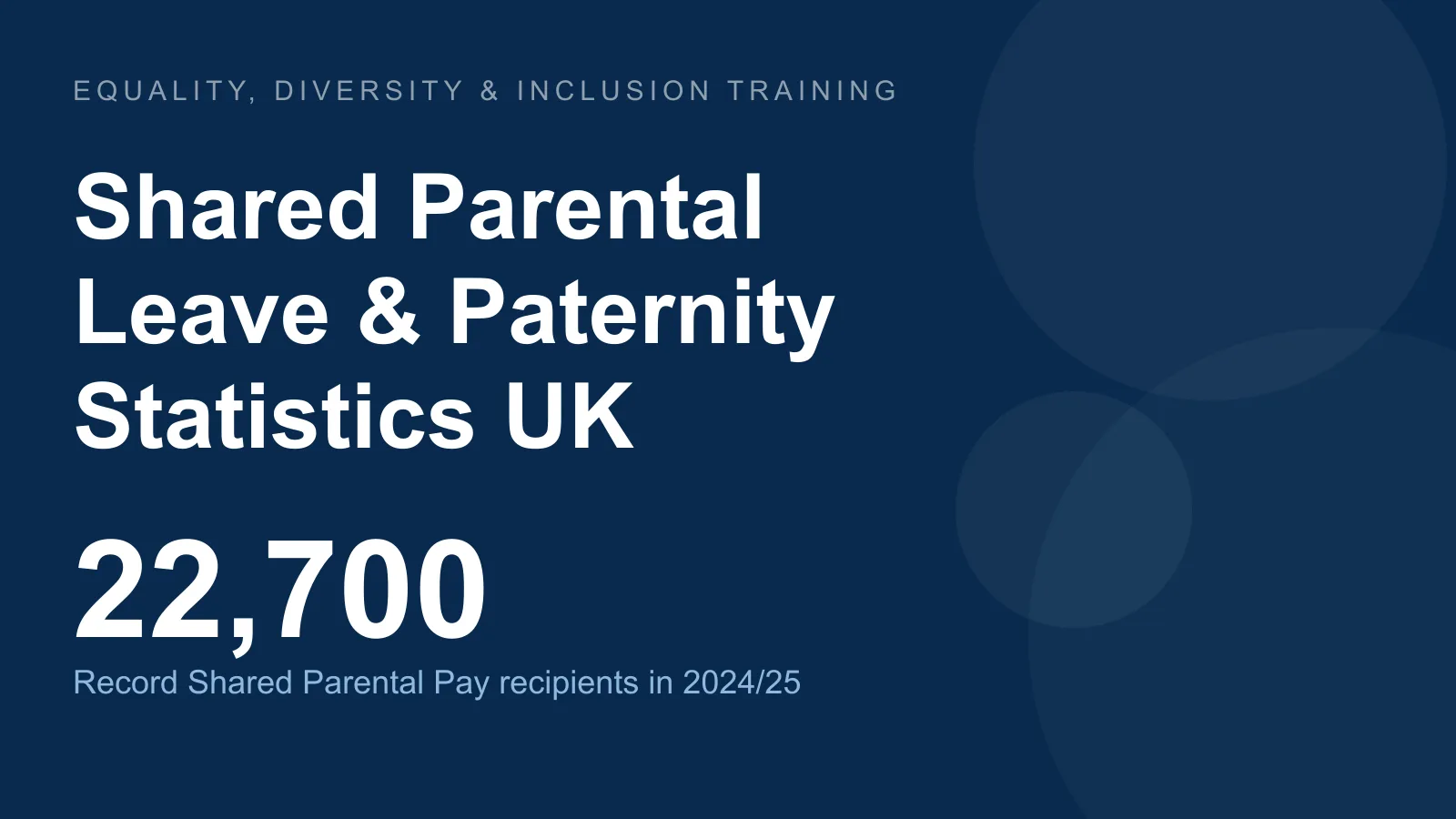
- 22,700 people received Statutory Shared Parental Pay in 2024/25 — a record, up 32% on 2023/24 and nearly eight times the 2014/15 figure.
- 50/50 — Shared Parental Pay recipients split evenly between men and women for the first time in 2024/25 (11,300 men, 11,400 women).
- £49.5 million in Shared Parental Pay was paid out in 2024/25, up 44% from £34.4 million the year before.
- 216,300 people received Statutory Paternity Pay in 2024/25 — roughly one for every 2.9 maternity pay recipients.
- £194.32 a week is the statutory paternity and shared parental pay rate from 6 April 2026, up from £187.18.
- Zero Shared Parental Pay claims have come from the bottom two income deciles in every year since 2014/15.
- 2 weeks at a flat rate is the UK’s paternity offer, against an OECD average of 8.1 weeks at full-pay equivalent.
These figures are the latest available as of July 2026. The main refresh points are DBT’s publication of HMRC parental pay data (the current tables, published 10 September 2025, cover April 2014 to March 2025), the statutory rate uprating each April, and the conclusions of the Parental Leave and Pay Review expected during 2026.
What percentage of parents take Shared Parental Leave?
Just 1% of mothers and 4% of fathers take Shared Parental Leave, according to the Parental Rights Survey 2019 — figures the government restated in its Parental Leave and Pay Review evidence summary (September 2025) as the best national estimate. Among fathers who are employees — the group actually entitled to the scheme — take-up rises only slightly, to 5%.
Shared Parental Leave (SPL) was introduced for babies due on or after 5 April 2015. It lets a mother curtail her maternity leave and share up to 50 weeks of leave and up to 37 weeks of pay with her partner. The policy intent was to rebalance caring responsibilities; ten years of data show that ambition has not been realised at scale. In 2024/25, HMRC’s payroll records counted 22,700 Shared Parental Pay recipients against 630,900 Statutory Maternity Pay recipients — the scheme remains a small annexe to the maternity system rather than a mainstream alternative.
How many people claim Shared Parental Pay?
A record 22,700 individuals received Statutory Shared Parental Pay (ShPP) in 2024/25 — up 32% from 17,200 in 2023/24, and nearly eight times the 2,900 recorded in 2014/15, the scheme’s first (partial) year. The figures come from HMRC’s Real Time Information payroll data, published by the Department for Business and Trade in its parental leave and pay evidence tables (September 2025).
The money follows the same curve: total ShPP paid reached £49.5 million in 2024/25, up 44% from £34.4 million in 2023/24. Claims are getting longer as well as more numerous — the derived average ShPP payment duration was 11.8 weeks in 2024/25, up from 9.0 weeks in 2015/16.
The least-reported finding in the data is the gender split. In 2024/25, ShPP recipients divided 50/50 between men and women for the first time — 11,300 men and 11,400 women — compared with a recipient base that was 95% male in 2014/15. Because a mother who curtails maternity pay and moves onto ShPP is counted as a female recipient, the shift suggests recent growth is coming as much from mothers switching into the shared scheme as from fathers claiming it.
| Measure | Figure | Trend / note |
|---|---|---|
| ShPP recipients, 2024/25 | 22,700 | Record high; up 32% from 17,200 in 2023/24 |
| ShPP recipients, 2014/15 | 2,900 | First year of the scheme — recipients up nearly 8x since |
| Total ShPP paid, 2024/25 | £49.5m | Up 44% from £34.4m in 2023/24 |
| Gender split, 2024/25 | 11,300 men / 11,400 women | First 50/50 year; 95% male in 2014/15 |
| Average payment duration, 2024/25 | 11.8 weeks | Up from 9.0 weeks in 2015/16 |
| Recipients in bottom two income deciles | 0 | In every year since 2014/15 |
Source: HMRC Real Time Information data published by DBT, September 2025 (tables covering April 2014 to March 2025). DBT is refreshing this evidence base alongside the Parental Leave and Pay Review, so treat the series as annual.
How many fathers take paternity leave?
59% of fathers took paternity leave around the birth of their child, compared with 83% of mothers taking maternity leave, according to the Parental Rights Survey 2019 — the most recent national survey, restated in the government’s review evidence summary (September 2025). Among employees, the figures rise to 70% of fathers and 89% of mothers.
The payroll data tells the same story at scale: 216,300 people received Statutory Paternity Pay in 2024/25, totalling £77.2 million, against 630,900 receiving Statutory Maternity Pay (£3.59 billion) — roughly one paternity pay recipient for every 2.9 maternity pay recipients (HMRC RTI via DBT, 2024/25). The gap between the survey take-up rate and the claimant count partly reflects eligibility: self-employed fathers have no paternity leave entitlement at all, and until 6 April 2026 employees needed 26 weeks’ service to qualify.
Pay makes a visible difference to behaviour. 58% of fathers received full pay throughout their paternity leave (Parental Rights Survey 2019) — typically because their employer topped up the statutory rate — while affordability is the most common reason given for not taking leave at all, as the next sections show.
How much is statutory paternity and shared parental pay in 2026?
£194.32 a week, or 90% of average weekly earnings if that is lower — the statutory rate for both paternity pay and Shared Parental Pay from 6 April 2026, up from £187.18 in 2025-26, per the GOV.UK rates and thresholds for employers 2026 to 2027. Statutory Paternity Pay covers up to two weeks; ShPP covers up to 37 weeks shared between the parents; Statutory Maternity Pay pays 90% of earnings (uncapped) for the first six weeks, then the same flat rate for up to 33 further weeks.
| Payment | 2025-26 rate | 2026-27 rate (from 6 April 2026) |
|---|---|---|
| Statutory Paternity Pay (up to 2 weeks) | £187.18/week | £194.32/week |
| Statutory Shared Parental Pay (up to 37 weeks) | £187.18/week | £194.32/week |
| Statutory Maternity Pay — first 6 weeks | 90% of average weekly earnings | 90% of average weekly earnings |
| Statutory Maternity Pay — up to 33 further weeks | £187.18/week | £194.32/week |
All flat rates are paid at 90% of average weekly earnings where that is lower. How low the flat rate sits is central to the take-up debate: the Women and Equalities Committee calculated in its June 2025 report that the then-rate of £187.18 equated to just 44% of what an over-21 earns working full time on the National Living Wage (£12.21 an hour). A father on statutory pay alone therefore takes a pay cut of more than half of even minimum-wage earnings.
The affordability effect shows up directly in the government’s own evaluation: 35% of fathers who took no statutory leave said they could not afford to — more than three times the 11% of mothers who said the same (Shared Parental Leave evaluation report, 2023).
Who actually uses Shared Parental Pay?
28% of ShPP recipients in 2024/25 were in the top income decile (down from 33% in 2023/24), and — most strikingly — zero ShPP claims have been recorded from the bottom two income deciles in every single year since 2014/15 (HMRC RTI via DBT, Table 13b; a pattern highlighted by the Women and Equalities Committee and the Equal Parenting Project). Shared Parental Leave, as used in practice, is overwhelmingly a scheme for higher-earning households.
The skew has a mechanical explanation as well as a financial one. Both parents must pass work and earnings tests for the couple to qualify, which screens out households with a self-employed, low-paid or non-working partner. And because the father is the higher earner in most couples, swapping his salary for a flat £194.32 a week (2026-27 rate) costs the household more than the mother remaining on maternity pay — a trade-off only better-off families can comfortably absorb. The result is that a policy designed to spread caring more evenly is, on the government’s own data (2014/15 to 2024/25), used least by the families with least.
How does the UK compare internationally?
OECD countries offer fathers an average of 8.1 weeks of leave at full-pay equivalent; the UK offers two weeks at a flat rate — an offer the Joseph Rowntree Foundation describes as the least generous in Europe (JRF, March 2026). On JRF’s analysis the UK’s two statutory weeks, paid at well under half of minimum-wage earnings, leave British fathers with both the shortest and one of the worst-paid entitlements among comparable economies.
Employer opinion is ahead of the statute book: 48% of employers supported extending statutory paternity leave and pay in 2024, up from 46% in 2022, according to CIPD data cited in the Women and Equalities Committee’s June 2025 report. The Committee itself recommended working towards a six-week paternity entitlement — the reform most often floated as the review window closes.
When are UK paternity and parental leave rules changing?
The reform timeline is unusually busy, which is why this page’s figures carry dates so prominently:
- 6 April 2025 — neonatal care leave and pay became a new statutory entitlement, giving parents of babies in neonatal care up to 12 weeks of additional paid leave.
- 10 June 2025 — the Women and Equalities Committee published Equality at work: paternity and shared parental leave (HC 502), calling the current system defective and recommending a phased move to six weeks of paternity leave.
- 1 July 2025 — the government launched its Parental Leave and Pay Review; the call for evidence closed on 26 August 2025, and conclusions are expected during 2026.
- 6 April 2026 — paternity leave and unpaid parental leave became day-one rights under the Employment Rights Act 2025 (SI 2026/15), removing the 26-week qualifying service requirement.
- Every April — statutory rates are uprated; the 2026-27 rate is £194.32 a week.
The near-term thing to watch is the review’s report in 2026: with the WEC pressing for a six-week paternity entitlement, employers half-persuaded and the day-one right already in force, the statistics on this page describe a system that may be about to change more than at any point since 2015. For the discrimination side of the same story — how pregnancy and new parenthood are treated at work — see our maternity discrimination statistics page.
Frequently asked questions
What percentage of parents take Shared Parental Leave in the UK?
Around 1% of mothers and 4% of fathers (5% of employee fathers) take Shared Parental Leave, per the Parental Rights Survey 2019, restated in the government’s review evidence summary in September 2025. In payroll terms, a record 22,700 people received Shared Parental Pay in 2024/25 — against 630,900 maternity pay recipients.
How many fathers take paternity leave in the UK?
59% of all fathers and 70% of employee fathers took paternity leave (Parental Rights Survey 2019). HMRC payroll data counted 216,300 Statutory Paternity Pay recipients in 2024/25, roughly one for every 2.9 maternity pay recipients.
How much is statutory paternity and shared parental pay in 2026?
From 6 April 2026, Statutory Paternity Pay and Statutory Shared Parental Pay are £194.32 a week, or 90% of average weekly earnings if that is lower — up from £187.18 in 2025-26. Paternity pay runs for up to two weeks; ShPP for up to 37 weeks shared between parents.
Why is Shared Parental Leave take-up so low?
The main documented reasons are money and eligibility. The flat statutory rate equated to just 44% of full-time National Living Wage earnings in 2025, 35% of fathers who took no statutory leave said they could not afford to (2023 evaluation), and both parents must pass work and earnings tests. The result is a steep income skew: 28% of 2024/25 recipients were in the top income decile and none were recorded in the bottom two deciles in any year since 2014/15.
When are UK paternity leave rules changing?
Paternity leave became a day-one right on 6 April 2026 under the Employment Rights Act 2025. The government’s Parental Leave and Pay Review, launched on 1 July 2025, is expected to report during 2026, and the Women and Equalities Committee has recommended moving to a six-week paternity entitlement.
Is Shared Parental Leave use growing?
Yes — from 2,900 Shared Parental Pay recipients in 2014/15 to a record 22,700 in 2024/25, with £49.5 million paid out (up 44% year on year) and the recipient base reaching a 50/50 male-female split for the first time. Growth is strong in percentage terms but from a very low base: take-up remains around 1% of mothers and 4% of fathers.
Related guides
- Maternity Discrimination Statistics UK
- Women in Leadership Statistics UK
- Workplace Discrimination Statistics UK: Tribunal Claims, Prevalence & Protected Characteristics
- Equality Act 2010: The Complete UK Guide
- The Nine Protected Characteristics Under the Equality Act 2010
Sources & references
- Department for Business and Trade — Parental leave and pay evidence: HMRC data covering April 2014 to March 2025 (published 10 September 2025)
- GOV.UK — Parental leave and pay review: summary of existing evidence (updated 10 September 2025)
- Department for Business and Trade — Shared Parental Leave evaluation report (June 2023)
- Women and Equalities Committee — Equality at work: paternity and shared parental leave, HC 502 (10 June 2025)
- Joseph Rowntree Foundation — UK paternity leave: limited and unequal (March 2026)
- GOV.UK — Rates and thresholds for employers 2026 to 2027
- House of Commons Library — Family-related leave and pay (CBP-7984)
- legislation.gov.uk — SI 2026/15: day-one paternity and unpaid parental leave regulations under the Employment Rights Act 2025 (in force 6 April 2026)
Pregnancy, maternity and family-leave rights sit at the heart of the Equality Act 2010 — make sure your managers and HR team handle them confidently.
Explore the Equality, Diversity & Inclusion course →
Mark writes about equality, diversity and inclusion, UK workplace compliance and accredited online training for Equality, Diversity & Inclusion Training, part of Online CPD Academy.