
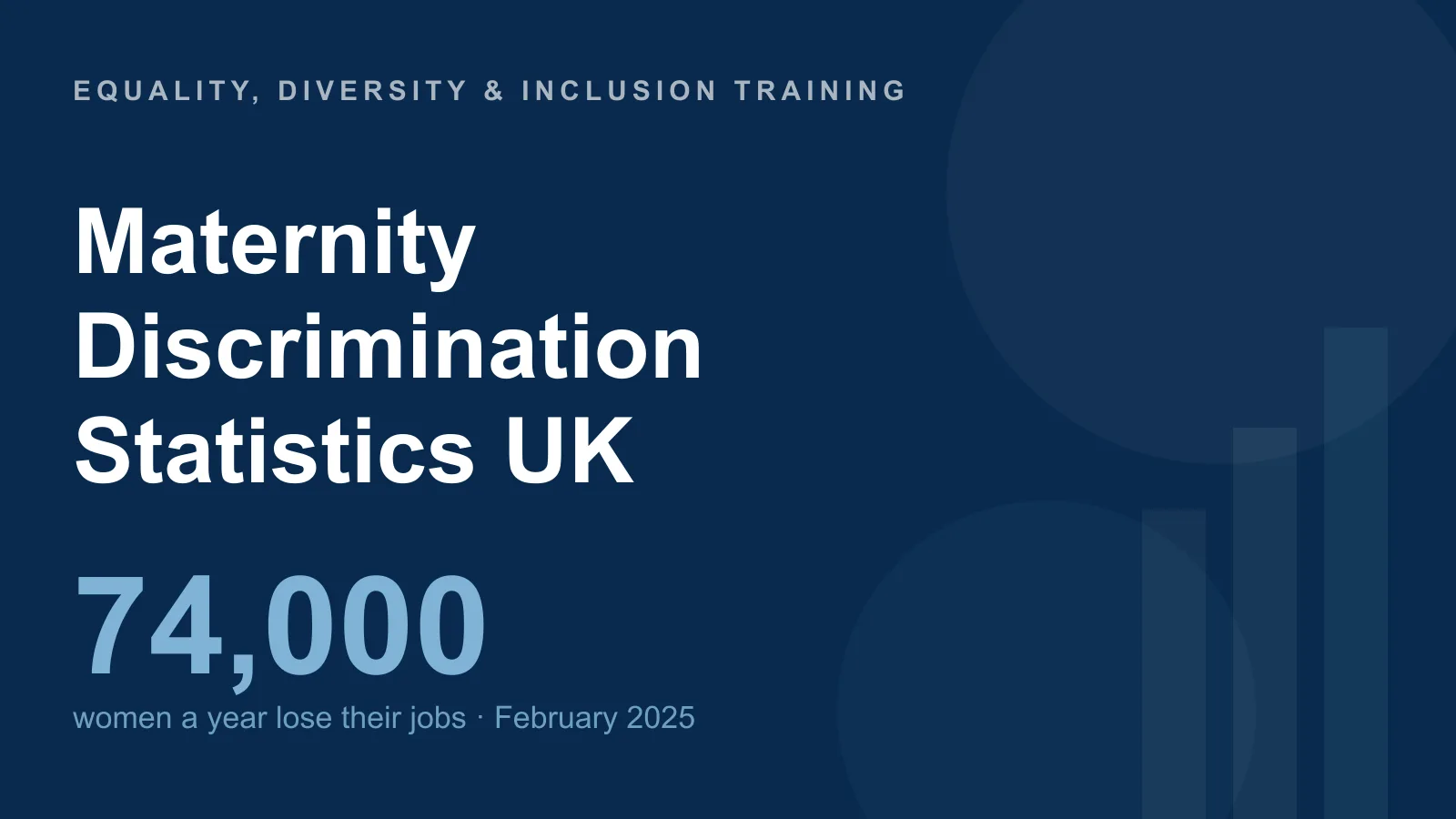
Pregnancy and maternity discrimination is one of the most heavily documented — and most poorly refreshed — areas of UK workplace inequality. The definitive government study, published by the Department for Business, Innovation and Skills (BIS) and the Equality and Human Rights Commission in 2016, found that one in nine mothers felt forced out of her job; independent research by Pregnant Then Screwed and Women In Data, published in February 2025, suggests that figure has since risen by 37% to roughly 74,000 women a year. This page brings both datasets together, alongside the Department for Business and Trade’s factsheet on the Employment Rights Act dismissal protections expected in 2027 — every figure is dated and linked to its source.
Key facts and figures
- 77% of mothers reported a negative or possibly discriminatory experience during pregnancy, maternity leave or on return to work — up to 390,000 mothers a year (BIS/EHRC, 2016).
- 1 in 9 mothers (11%) felt forced out of their job — equivalent to up to 54,000 women a year (BIS/EHRC, 2016).
- ~74,000 women a year now lose their jobs for getting pregnant or taking maternity leave — a 37% rise on the 2016 estimate (Pregnant Then Screwed × Women In Data, Feb 2025).
- 12.3% of women are sacked, constructively dismissed or made redundant while pregnant, on maternity leave or within a year of returning (Feb 2025).
- 1 in 5 mothers experienced harassment or negative comments from their employer or colleagues related to pregnancy or flexible working (2016).
- Only 2% of women who experience pregnancy or maternity discrimination raise an employment tribunal claim (Feb 2025).
- 59% of employers agreed a woman should have to disclose whether she is pregnant during recruitment (EHRC/YouGov, Feb 2018).
- ~4,100 women a year could benefit from the Employment Rights Act’s new dismissal protections, per the government’s impact assessment (DBT, 2024).
These figures are the latest available as of July 2026; the main refresh source is the annual Pregnant Then Screwed × Women In Data State of the Nation report, published each spring (the 2026 survey closed on 23 January 2026).
How many women lose their jobs because of pregnancy or maternity?
Around 74,000 women a year in the UK lose their jobs for getting pregnant or taking maternity leave, according to the Pregnant Then Screwed × Women In Data State of the Nation research published on 27 February 2025. That is a 37% rise on the official estimate of up to 54,000 a year made a decade earlier.
The 54,000 baseline comes from the largest study of its kind ever conducted in Britain. In 2015–16, BIS and the EHRC interviewed 3,254 mothers and 3,034 employers for the pregnancy and maternity-related discrimination and disadvantage study (published March 2016). It found that one in nine mothers (11%) felt forced out of their job: 9% said they were treated so poorly they felt they had to leave, 1% were made compulsorily redundant when colleagues were not, and 1% were dismissed. Scaled to the population of mothers in work, that equated to up to 54,000 job losses a year (2016).
The 2025 research puts the forced-out rate higher still: 12.3% of women were sacked, constructively dismissed or made redundant while pregnant, on maternity leave or within a year of returning to work (Feb 2025). The survey drew responses from 35,800 people, with headline estimates based on a representative sample of 5,870.
The two studies used different methodologies, so the comparison is indicative rather than exact — but the direction of travel is consistent: a decade on from the government’s landmark study, more mothers report losing their jobs, not fewer.
What percentage of mothers experience pregnancy or maternity discrimination?
77% of mothers reported a negative or possibly discriminatory experience during pregnancy, maternity leave and/or on return from maternity leave in the 2016 BIS/EHRC study — equivalent to as many as 390,000 mothers a year if scaled to the working population (2016).
The 2016 study broke that experience down further. One in five mothers experienced harassment or negative comments from their employer or colleagues related to pregnancy or flexible working; 10% were discouraged from attending antenatal appointments — which pregnant employees have a statutory right to attend on paid time; and 20% reported a financial loss, such as a missed promotion or reduced pay, because of pregnancy or maternity (all 2016).
The February 2025 Pregnant Then Screwed × Women In Data research, using a narrower definition, found that 49.5% of women who were pregnant, on maternity leave or returning to work said they had a negative experience at work, and of those, 20.6% left their employer as a result (Feb 2025). A further 35.9% of women felt sidelined or demoted while pregnant, on maternity leave or shortly after returning (Feb 2025).
Why do the statistics date from 2016 and 2025?
The government has never repeated its 2016 study — despite committing to do so roughly every five years. The Women and Equalities Committee’s pregnancy and maternity discrimination inquiry reported in August 2016, and the government’s January 2017 response accepted the need for ongoing monitoring. No successor study has been commissioned, which is why law firms, HR publications and charities still cite the 2016 PDFs a decade later.
That gap is now filled by Pregnant Then Screwed’s independent annual State of the Nation survey, run with Women In Data. The most recent published report (27 February 2025) is the primary source for current-year figures; the follow-up survey closed on 23 January 2026, with updated findings due to be published in 2026. The table below sets the two datasets side by side.
| Measure | Figure | Data period & source |
|---|---|---|
| Mothers with a negative or possibly discriminatory experience | 77% — up to 390,000 a year | 2016 · BIS/EHRC |
| Mothers forced out of their job | 11% (1 in 9) — up to 54,000 a year | 2016 · BIS/EHRC |
| Women sacked, constructively dismissed or made redundant | 12.3% — around 74,000 a year | Feb 2025 · PTS × Women In Data |
| Women reporting a negative experience at work | 49.5% | Feb 2025 · PTS × Women In Data |
| Women who felt sidelined or demoted | 35.9% | Feb 2025 · PTS × Women In Data |
| Mothers facing pregnancy-related harassment or negative comments | 1 in 5 | 2016 · BIS/EHRC |
| Affected women who raise an employment tribunal claim | 2% | Feb 2025 · PTS × Women In Data |
What do employers think about pregnancy at work?
59% of employers — around six in ten — agreed that a woman should have to disclose whether she is pregnant during recruitment, according to a February 2018 EHRC/YouGov survey of more than 1,100 senior decision-makers in the private sector.
The same survey found that 36% of private-sector employers thought it reasonable to ask women about their plans to have children during recruitment (Feb 2018). Both practices would expose an employer to serious legal risk: pregnancy and maternity is one of the nine protected characteristics under the Equality Act 2010, and treating a candidate unfavourably because she is pregnant — or might become pregnant — is unlawful discrimination.
The attitudes data matters because it shows the problem is not confined to a few rogue employers. When a majority of senior decision-makers believe pregnancy disclosure should be part of recruitment, the discrimination measured in the prevalence studies above is the predictable result — and it is the reason workplace equality training exists as a compliance discipline rather than a nice-to-have.
How many women take legal action over maternity discrimination?
Only 2% of women who experience pregnancy or maternity discrimination go on to raise an employment tribunal claim, according to the Pregnant Then Screwed × Women In Data research (Feb 2025). Set against roughly 74,000 job losses a year, that means the overwhelming majority of potentially unlawful treatment never reaches a tribunal at all.
The barriers are practical as much as legal: the standard three-month time limit for lodging a claim falls precisely when a woman is heavily pregnant or caring for a newborn, and the cost, stress and career risk of litigation deter many from starting. Advice services see the demand that tribunals do not — Citizens Advice reported that almost 2,000 people sought its help with pregnancy and maternity discrimination in April 2015–March 2016, up 25% from just over 1,500 the year before, while its online advice on the subject was viewed 22,000 times (2016).
For tribunal claim volumes, outcomes and compensation awards across all discrimination types, see our workplace discrimination statistics page, which tracks the Ministry of Justice quarterly data.
What legal protections exist — and what changes in 2027?
Around 4,100 women a year could benefit from the Employment Rights Act’s enhanced dismissal protections for pregnant women and new mothers, according to the government’s impact assessment cited in the Department for Business and Trade factsheet (DBT, 2024, cited October 2025).
The current legal framework has three layers. First, the Equality Act 2010 makes unfavourable treatment because of pregnancy or maternity unlawful throughout the ‘protected period’ of pregnancy and maternity leave. Second, since 6 April 2024, regulations made under the Protection from Redundancy (Pregnancy and Family Leave) Act 2023 extend redundancy protection across an 18-month window — from the point an employee tells her employer she is pregnant until 18 months after the birth — giving her priority for suitable alternative vacancies in a redundancy situation (House of Commons Library briefing CBP-9609). Third, the Employment Rights Act adds enhanced protection against dismissal for pregnant women and new mothers, expected to commence in 2027; the government’s Make Work Pay consultation on how those protections will work ran from 23 October 2025 to 15 January 2026, with the response due later in 2026.
It is worth being precise about what the 2024 change does and does not do: it does not ban redundancy during pregnancy or maternity leave, but it does give protected employees first refusal on suitable alternative roles — and selecting someone for redundancy because of her pregnancy or maternity remains automatically unfair and discriminatory. The advice charity Maternity Action publishes detailed rights guidance for affected women. Statutory leave entitlements themselves — and how many parents actually use them — are covered on our shared parental leave statistics page.
Frequently asked questions
How many women lose their jobs each year in the UK because of pregnancy or maternity?
Around 74,000 women a year lose their jobs for getting pregnant or taking maternity leave, according to Pregnant Then Screwed × Women In Data research published in February 2025. That is a 37% rise on the official estimate of up to 54,000 a year from the 2016 BIS/EHRC government study.
What percentage of mothers experience pregnancy or maternity discrimination at work?
The 2016 BIS/EHRC study found 77% of mothers had a negative or possibly discriminatory experience during pregnancy, maternity leave or on return to work — up to 390,000 a year. The February 2025 Pregnant Then Screwed research, using a narrower definition, found 49.5% reported a negative experience, with 35.9% feeling sidelined or demoted.
Is it legal to make someone redundant while pregnant or on maternity leave?
Redundancy itself is not automatically unlawful, but selecting someone for redundancy because of pregnancy or maternity is discrimination under the Equality Act 2010. Since 6 April 2024, employees are also protected across an 18-month window — from notifying the employer of pregnancy until 18 months after birth — during which they have priority for suitable alternative vacancies in any redundancy exercise.
How many women who face maternity discrimination actually take their employer to a tribunal?
Only 2%, according to the February 2025 Pregnant Then Screwed × Women In Data research. The three-month claim time limit, which falls during late pregnancy or early motherhood, is one of the main barriers to access to justice.
How often are UK maternity discrimination statistics updated?
The government’s definitive 2016 study has never been repeated, despite a commitment to refresh it every five years. The main current source is the annual Pregnant Then Screwed × Women In Data State of the Nation report, published each spring; the 2026 survey closed on 23 January 2026.
Related guides
- Workplace Discrimination Statistics UK: Tribunal Claims & Prevalence
- Shared Parental Leave Statistics UK
- Menopause in the Workplace Statistics UK
- Women in Leadership Statistics UK
- The Nine Protected Characteristics Under the Equality Act 2010
- Equality Act 2010: The Complete UK Guide
Sources & references
- GOV.UK (BIS/EHRC) — Pregnancy and maternity-related discrimination and disadvantage: final reports (March 2016)
- Pregnant Then Screwed × Women In Data — State of the Nation 2025 (27 February 2025)
- Department for Business & Trade — Employment Rights Act factsheet: enhanced dismissal protections for pregnant women and new mothers (PDF)
- Equality and Human Rights Commission — Pregnancy and maternity discrimination research findings
- House of Commons Library — Protection from Redundancy (Pregnancy and Family Leave) Bill briefing CBP-9609
- Women and Equalities Committee — Pregnancy and maternity discrimination inquiry (report August 2016; government response January 2017)
- Citizens Advice — 25% rise in people reporting pregnancy and maternity discrimination (2016)
- Maternity Action — Pregnancy discrimination: your rights
Make sure your managers understand pregnancy and maternity rights — and never become one of these statistics.
Explore the Equality, Diversity & Inclusion course →
Mark writes about equality, diversity and inclusion, UK workplace compliance and accredited online training for Equality, Diversity & Inclusion Training, part of Online CPD Academy.