
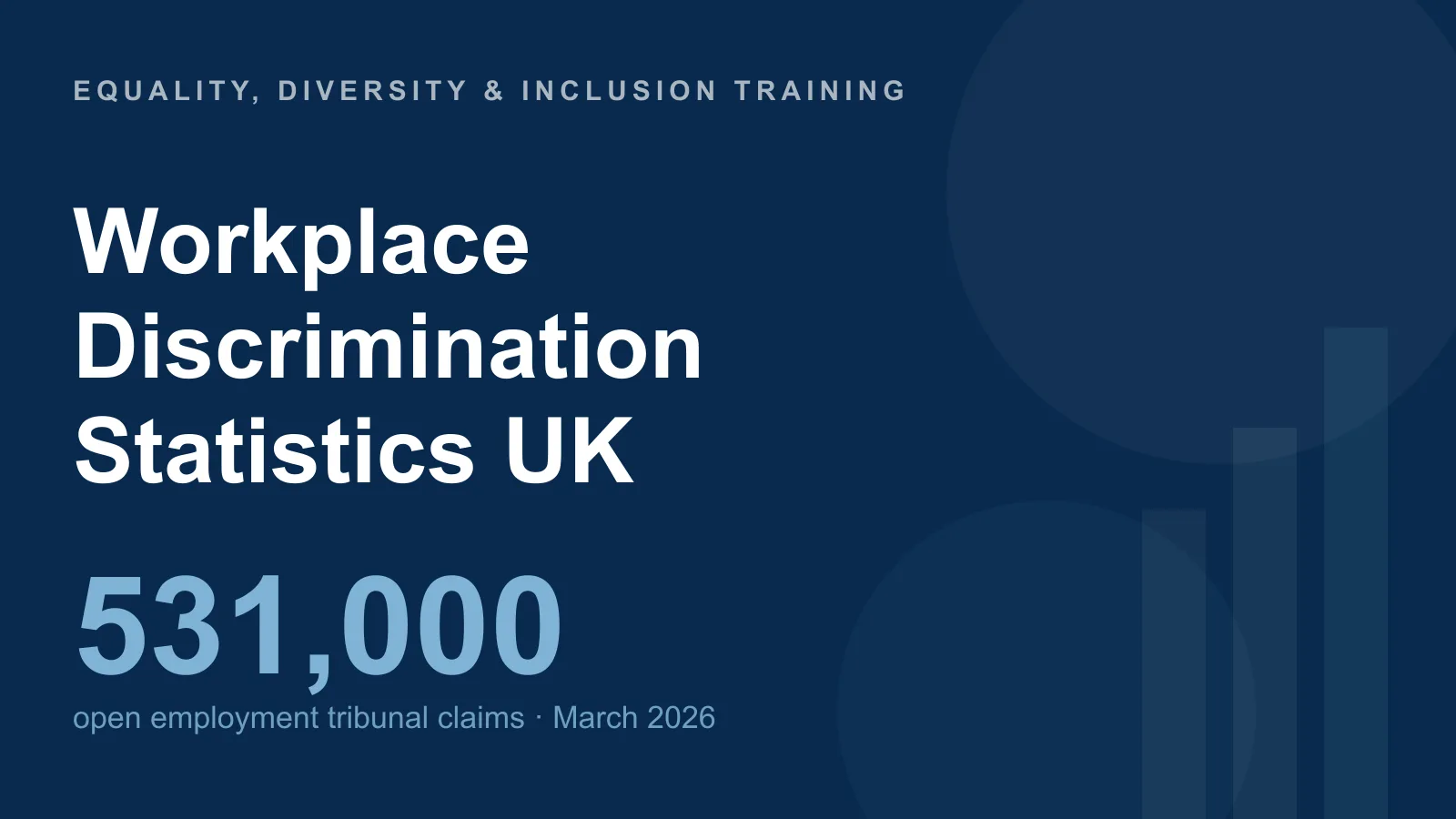
Workplace discrimination in the UK is measured in two very different ways: the official record — the Ministry of Justice’s quarterly employment tribunal statistics and Acas’s early conciliation data — and prevalence surveys that ask workers what they have actually experienced. This page brings both together on one fully cited reference: tribunal claim volumes and the record backlog, conciliation caseloads, average compensation awards by protected characteristic, and the survey evidence on how common discrimination at work really is. Every figure is drawn from a named source, with the data period stated alongside it and full references listed at the end.
Key facts and figures
- 531,000 employment tribunal claims were open at the end of March 2026 — up from 491,000 a year earlier.
- +79% year-on-year rise in disability discrimination complaints received by tribunals in January to March 2026.
- 22,000 new tribunal claims arrived in January to March 2026, but only around 11,000 were disposed of.
- 117,000+ individual early conciliation cases were handled by Acas in 2024/25 — around 9 in 10 resolved without a tribunal hearing.
- £53,403 was the average sex discrimination award in 2023/24, up from £37,607 the year before.
- £995,128 was the highest single discrimination award of 2023/24 — a sex discrimination case. Awards are uncapped.
- 45% of UK adults report experiencing discrimination at work or when applying for jobs (survey, February 2025).
- 19% report age discrimination — the most common form of workplace discrimination in UK survey data (2025).
These figures are the latest available as of July 2026, and this page is updated as new data is released — chiefly the Ministry of Justice’s quarterly tribunal statistics (published in March, June, September and December, with annual award tables each summer) and Acas’s annual report.
How many discrimination claims reach employment tribunals?
531,000 employment tribunal claims were open and awaiting resolution at the end of March 2026, according to the Ministry of Justice’s tribunals statistics quarterly (published 11 June 2026). That is up from 491,000 a year earlier — a rise of 40,000 open cases in twelve months — and it is the backdrop to every discrimination dispute in Britain: with disposals running at roughly half the rate of new receipts, waiting times keep lengthening.
The backlog is growing because claims are arriving roughly twice as fast as the system can resolve them. In January to March 2026, tribunals received around 22,000 new claims but disposed of only about 11,000 — so for every case closed, two new ones joined the queue.
A note on how the counting works: a single tribunal claim can contain several ‘jurisdictional complaints’. Someone dismissed after raising a grievance might claim unfair dismissal, disability discrimination and victimisation in one case, and each element is counted separately in the jurisdiction tables. Discrimination complaints are recorded under the relevant Equality Act 2010 jurisdiction — age, disability, race, religion or belief, sex, sexual orientation, and so on — which is what makes the quarterly tables such a useful barometer of which protected characteristics are generating disputes.
Why are disability discrimination claims rising so fast?
Disability discrimination complaints received by tribunals rose 79% year-on-year in January to March 2026, and accounted for around 16% of all jurisdictional complaints received in the quarter — the standout trend in the Ministry of Justice’s most recent quarterly data.
The surge shows up earlier in the pipeline too. Acas early conciliation notifications for disability discrimination rose 31%, from 15,361 in 2023/24 to 20,180 in 2024/25 — the year ending March 2025 — so the tribunal figures are not a blip but the downstream end of a sustained rise in disputes.
Several forces are widely credited with driving it: greater awareness among workers of the duty to make reasonable adjustments, more disputes over ill-health absence and flexible working, and the fact that disability discrimination claims — like all discrimination claims — carry no qualifying service requirement and no cap on compensation. A growing share of these cases involve neurodivergent employees, part of a wider surge in tribunal claims relating to autism, ADHD and dyslexia that we cover separately in our neurodiversity statistics page.
How much do tribunals award for discrimination?
The average sex discrimination award was £53,403 in 2023/24, up sharply from £37,607 in 2022/23, according to the Ministry of Justice’s annual Employment Tribunal award tables. The average race discrimination award was £29,532 in 2023/24, up from £23,070 the year before. Age discrimination produced the largest average award of any discrimination jurisdiction in 2023/24, at around £100,000.
The top of the range illustrates why discrimination claims carry so much financial risk for employers: the highest single award of 2023/24 was £995,128, in a sex discrimination case. Unlike unfair dismissal, discrimination awards under the Equality Act 2010 are uncapped — they compensate the full financial loss plus injury to feelings. Averages are pulled upwards by a small number of very large awards, but even mid-range discrimination cases regularly settle or resolve at five-figure sums.
| Measure | Figure (2023/24) | Trend / note |
|---|---|---|
| Average sex discrimination award | £53,403 | Up from £37,607 in 2022/23 |
| Average race discrimination award | £29,532 | Up from £23,070 in 2022/23 |
| Largest average award (age discrimination) | ~£100,000 | Highest of any discrimination jurisdiction |
| Highest single award | £995,128 | Sex discrimination case |
| Statutory cap on discrimination awards | None | Discrimination awards are uncapped |
The award tables are published once a year by the Ministry of Justice, alongside the June quarterly release, so the 2024/25 tables are the next scheduled update to this section.
How many disputes does Acas resolve before tribunal?
Acas handled more than 117,000 individual early conciliation cases in 2024/25 — the year ending March 2025 — around 13,000 more than the previous year, and resolved roughly nine in ten of them without the need for a tribunal hearing, according to the Acas annual report and accounts 2024 to 2025.
Early conciliation matters because it is the mandatory first step: anyone who wants to bring an employment tribunal claim in England, Scotland or Wales must notify Acas first, and the conciliation period pauses the tribunal time limit. That makes the Acas figures the widest official measure of workplace disputes — a funnel that starts with everything workers formally raise and narrows to the minority of cases that reach a hearing. The 31% jump in disability discrimination notifications described above is the clearest example of how a trend appears in the Acas data a year or more before it fully lands in the tribunal backlog.
How common is workplace discrimination in the UK?
45% of UK adults report having experienced discrimination in the workplace or while job hunting, according to HR software firm Ciphr’s survey published in February 2025 — 38% say it happened at work and 39% when applying for jobs. The official claim statistics, in other words, are the visible tip of a much larger experience: millions of workers report discrimination, while tens of thousands of cases a year enter the formal system.
Ageism tops the list, reported by 19% of UK adults in the 2025 survey — making age discrimination the most commonly experienced form, ahead of the characteristics that generate the most litigation. That mismatch between what people experience and what reaches a tribunal is one of the most consistent findings in this field: bringing a claim takes time, money and resilience, and the three-month time limit for most employment discrimination claims is one of the shortest in civil law.
Prevalence surveys are not official statistics — they are snapshots of self-reported experience, and definitions vary between polls — but run alongside the Ministry of Justice and Acas data they answer the question the official record cannot: how much discrimination never becomes a case at all.
Which protected characteristics see the most discrimination?
The Equality Act 2010 protects nine characteristics, and the data tells a different story for each:
- Age — the most commonly self-reported form of workplace discrimination, at 19% of UK adults (2025), and the discrimination jurisdiction with the largest average tribunal award (~£100,000 in 2023/24).
- Disability — the surging area of formal complaint: tribunal receipts up 79% year-on-year in January to March 2026, and Acas early conciliation notifications up 31% in 2024/25.
- Race — 41% of Black and minority ethnic workers experienced racist ‘jokes’ or ‘banter’ at work in 2025, up from 36% in 2020, according to TUC polling reported by People Management. The average race discrimination award was £29,532 in 2023/24.
- Sex — the jurisdiction behind both the year’s highest single award (£995,128 in 2023/24) and a fast-rising average (£53,403, up from £37,607).
Sexual harassment — a specific form of harassment under the Act, now subject to the preventative duty in force since 26 October 2024 — has its own body of survey and tribunal data, which we cover in depth in our sexual harassment at work statistics page. Pay differences between men and women are measured separately through the Office for National Statistics’ annual gender pay gap release rather than through discrimination claims data, and sit outside the scope of this page.
Frequently asked questions
How many discrimination claims are there in UK employment tribunals?
The Ministry of Justice reported 531,000 open employment tribunal claims at the end of March 2026, up from 491,000 a year earlier. Around 22,000 new claims arrived in January to March 2026 alone, and disability discrimination accounted for roughly 16% of all jurisdictional complaints received in that quarter.
What is the average payout for discrimination in the UK?
In 2023/24 the average employment tribunal award was £53,403 for sex discrimination and £29,532 for race discrimination, while age discrimination had the largest average award at around £100,000. The highest single award of the year was £995,128.
What is the most common type of discrimination at work in the UK?
In survey data, age discrimination is the most commonly reported form — 19% of UK adults said they had experienced ageism at work or when job hunting in Ciphr’s February 2025 survey. In the tribunal system, disability discrimination complaints are rising fastest in the most recent data, up 79% year-on-year in early 2026.
How common is race discrimination at work in the UK?
TUC polling in 2025 found that 41% of Black and minority ethnic workers had experienced racist ‘jokes’ or ‘banter’ at work, up from 36% in 2020. At tribunal, the average race discrimination award rose to £29,532 in 2023/24, from £23,070 the year before.
Are employment tribunal discrimination awards capped?
No. Unlike unfair dismissal compensation, awards for discrimination under the Equality Act 2010 are uncapped. They cover financial loss and injury to feelings, which is why individual awards can approach £1 million — the highest in 2023/24 was £995,128.
Where do official workplace discrimination statistics come from?
The two main official sources are the Ministry of Justice’s tribunals statistics quarterly (claim receipts, disposals, open caseload and annual award tables) and Acas’s early conciliation and annual report data. Prevalence surveys from organisations such as Ciphr, the TUC and the CIPD measure experiences that never reach the formal system.
Related guides
- Sexual Harassment at Work Statistics UK: Prevalence, Reporting Rates & the New Preventative Duty
- Neurodiversity Statistics UK: Autism, ADHD & Dyslexia Prevalence and Employment
- Equality Act 2010: The Complete UK Guide
- The Nine Protected Characteristics Under the Equality Act 2010
- Reasonable Adjustments Under the Equality Act 2010: A UK Employer’s Guide
Sources & references
- Ministry of Justice — Tribunals statistics quarterly (GOV.UK collection)
- Ministry of Justice — Tribunal statistics quarterly: Employment Tribunal and EAT annual award tables
- Acas — Annual report and accounts 2024 to 2025
- Acas — Early conciliation and employment tribunal cases data 2024 to 2025
- Ciphr — Workplace discrimination statistics survey (February 2025)
- People Management — TUC warns of ‘shocking’ increase in workplace racism (TUC polling, 2025)
- CIPD — Discrimination in the workplace factsheet
The best discrimination claim is the one that never happens — train your team on the Equality Act 2010 and their day-to-day responsibilities.
Explore the Equality, Diversity & Inclusion course →
Mark writes about equality, diversity and inclusion, UK workplace compliance and accredited online training for Equality, Diversity & Inclusion Training, part of Online CPD Academy.