
Around one worker in seven in the UK is juggling a paid job with looking after an ill, older or disabled relative, and the caring workforce is now large enough that no employer can treat it as a niche. This page compiles the workplace numbers in one fully cited reference, drawing on the ONS Census 2021 unpaid-care tables, Carers UK’s Facts about Carers (March 2025) and State of Caring 2025 survey, Carers Week research, and the Carer’s Leave Act 2023. It covers how many carers are in work, the carer employment gap, giving-up-work and reduced-hours figures, the career and earnings hit, and how employers are responding to the new day-one right to carer’s leave. It is deliberately scoped to the workplace: for the bigger picture on the UK’s roughly 5.8 million unpaid carers — caring hours, health, poverty and Carer’s Allowance — Carers UK’s facts hub is the definitive source.
Key facts and figures
- 2.5 million carers are in employment in England and Wales — about 9% of the workforce (ONS Census 2021, via Carers UK Facts about Carers, March 2025).
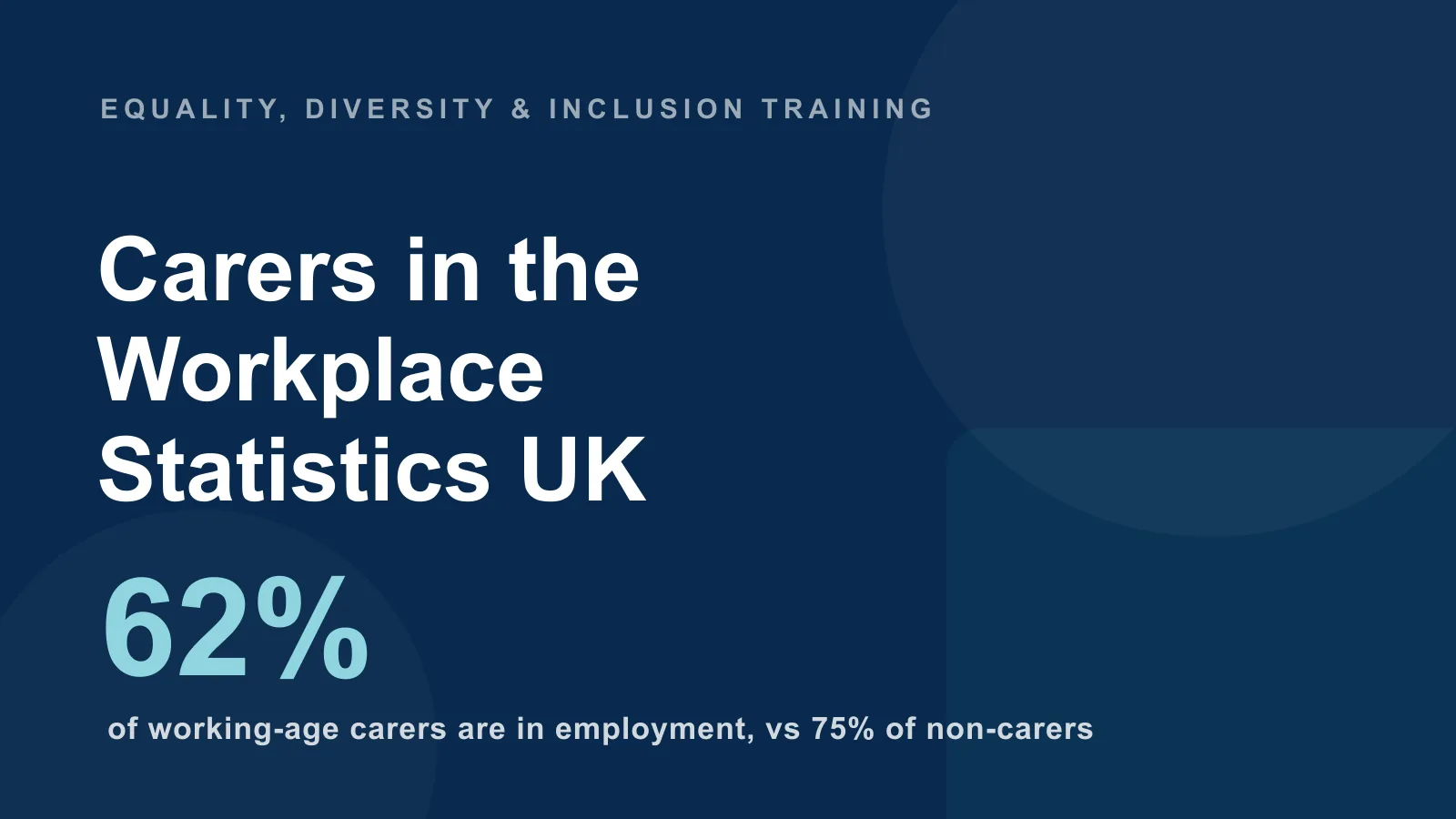
- 62% vs 75% — the employment rate for working-age carers is 62%, against 75% for non-carers (WPI Economics for Carers Week Caring About Equality, June 2025).
- 1 in 7 workers (14%) are juggling work and unpaid care (Carers UK polling, via Facts about Carers, March 2025).
- 600 a day — an estimated 600 people a day give up work to provide unpaid care (Carers UK, via State of Caring 2025, October 2025).
- 2.6 million people have given up work to care, and 2 million have reduced their hours to care (Carers UK polling, via Facts about Carers, March 2025).
- 36% of working carers turned down a job, promotion, or decided not to apply, in the last 12 months because of caring (University of Sheffield, via Carers Week, June 2025).
- Day-one right — the Carer’s Leave Act 2023 gives employees up to one week (5 days) of unpaid carer’s leave every 12 months from their first day (in force 6 April 2024).
- £37 billion a year is the cost to the economy of unpaid carers being out of work (DWP, March 2025).
These figures are the latest available as of July 2026. The main refresh points are Carers UK’s State of Caring report each autumn (the 2025 edition surveyed 10,539 carers, fieldwork June–August 2025), its Facts about Carers update roughly twice a year, Carers Week research each June, and any change to the Carer’s Leave Act if the promised move to paid leave lands this Parliament. The ONS Census base is decennial and stable until the next census.
How many carers are in employment in the UK?
2.5 million carers are in employment in England and Wales, making up around 9% of the workforce, according to ONS Census 2021 data as reported in Carers UK’s Facts about Carers (March 2025). Looked at across the whole UK and using Carers UK’s polling-based estimate, roughly 3 million carers aged 16 and over are in paid employment while about 2.7 million are not — so the caring population splits close to evenly between those in and out of work.
The caring workforce is larger than many employers assume, and it is not confined to junior roles. Census 2021 recorded over 317,000 managers, directors and senior officials providing unpaid care, more than 47,000 of them caring for 50 or more hours a week. In the NHS, Carers UK estimates that around 32% of staff (roughly half a million people) are providing unpaid care, rising to 43% of NHS staff aged 51 to 65 (NHS staff survey data, via Facts about Carers, March 2025). Caring peaks in the years many people are also at the height of their careers.
| Measure | Figure | Source / period |
|---|---|---|
| Carers in employment, England & Wales | 2.5 million (~9% of the workforce) | ONS Census 2021 |
| Carers aged 16+ in paid work, UK | ~3 million (vs ~2.7 million not in paid work) | Carers UK, March 2025 |
| Workers juggling work and care | 1 in 7 (14%) | Carers UK polling, March 2025 |
| Managers/directors/senior officials caring | 317,000+ (47,000+ caring 50+ hrs/week) | ONS Census 2021 |
| NHS staff providing unpaid care | ~32% (43% of those aged 51–65) | NHS staff survey, via Carers UK |
The two frames differ: Census 2021 counts people in England and Wales who identified as providing unpaid care on census day, while Carers UK’s larger UK-wide figures come from population polling that captures more short-term caring. Both point the same way — a caring workforce measured in millions.
Are working carers less likely to be employed than non-carers?
Yes — 62% of working-age carers are in employment, compared with 75% of non-carers, a 13-percentage-point carer employment gap identified in WPI Economics’ analysis for Carers Week’s Caring About Equality report (June 2025). The gap widens sharply with caring intensity: people providing heavy round-the-clock care are far less likely to hold down a job than those caring for a few hours a week, because the practical demands of intensive care collide directly with fixed working hours.
The gap is why Carers UK argues that caring behaves, in employment terms, much like a protected characteristic, and why it has called for caring to be recognised more explicitly under the Equality Act 2010. Carers already get some protection through the “discrimination by association” principle: a worker treated less favourably because of a disabled or elderly person they care for may have a claim linked to that person’s protected characteristic. For where caring sits alongside the nine formal grounds, see our guide to the protected characteristics.
How many people give up work to care each year?
An estimated 600 people a day give up work to provide unpaid care in the UK, according to Carers UK’s modelling reported in State of Caring 2025 (October 2025). Cumulatively, 2.6 million people have left work at some point to care, and around 2 million have reduced their working hours for the same reason (Carers UK polling, via Facts about Carers, March 2025). Leaving or scaling back work is the single most common way caring reshapes someone’s employment.
Carers UK’s 2025 survey of 10,539 carers puts numbers on the mechanics for those who stay employees. 35% of carers who are employees have reduced their working hours because of caring, and 20% have moved from full-time to part-time work (State of Caring 2025, October 2025). That survey is self-selecting rather than nationally representative, so read it as evidence about working carers who responded rather than a population rate — but the direction is consistent with the census.
The census confirms the part-time skew at population scale: 38% of carers in employment work part time, compared with 29% of non-carers (ONS Census 2021, via Facts about Carers, March 2025). Caring pushes a substantial minority of workers into shorter hours — with the earnings and pension consequences that follow.
How does caring affect careers and productivity?
36% of working carers turned down a job offer or promotion, or decided not to apply for a job, in the last 12 months because of their caring role, according to University of Sheffield research reported in Carers Week’s Caring About Equality (June 2025). Over a working life, that repeated self-selection out of opportunities compounds into a measurable career penalty.
Carers UK’s State of Caring 2025 survey (October 2025) fills in the day-to-day texture behind that headline:
- 61% of working carers said caring has affected the type of employment they have taken on, and 21% took on a lower-paid or more junior role to fit around caring.
- 69% of carers who are employees said they have not been able to focus on their career as much as they would like.
- 64% found it difficult to concentrate at work and be as productive as they would like, and 23% could not attend training or professional development.
For employers, the productivity finding is the one with an immediate business case: a workforce where nearly two-thirds of carers report concentration and productivity problems, and almost a quarter are missing training, is one where retention support and flexibility pay back directly. The financial impact on carers is real too — 24% of carers have cut back on, paused or stopped paying into a pension because of the costs of care (State of Caring 2025, October 2025), storing up disadvantage that lasts into retirement. How working patterns are actually negotiated — flexible-working requests, compressed hours and the like — is a related question we keep on our discrimination and leave pages rather than duplicate here.
What is the Carer's Leave Act 2023 and how much leave does it give?
The Carer’s Leave Act 2023 gives employees a day-one right to up to one week — five working days — of unpaid carer’s leave every 12 months, and it came into force on 6 April 2024. The leave is available to employees caring for a spouse, partner, child, parent, other dependant, or anyone who relies on them for care, where that person has a long-term care need. There is no qualifying service period: the right applies from an employee’s first day, and it can be taken in individual days or half-days rather than a single block.
The Act makes carer support a formal HR obligation rather than a nice-to-have, which is why it anchors this page. Two limits matter. First, the statutory entitlement is unpaid — employers may offer paid carer’s leave, and many do, but the law does not require it. Second, five days a year is modest against the scale of caring described above, which is why Carers UK continues to campaign for paid leave. Any move to paid statutory carer’s leave would be the single biggest change to watch on this page.
How are employers responding to the Carer's Leave Act?
Six months after the Act came into force, 51% of organisations had a specific, dedicated carer’s leave policy — up from 23% before the Act — and 44% offered some form of paid carer’s leave, according to the Carers UK / Employers for Carers survey The Carer’s Leave Act 2023: Six Months On (2024). The legislation more than doubled the proportion of surveyed employers with a formal policy in half a year, and a substantial minority went beyond the statutory unpaid minimum to offer pay.
Just as important for employers weighing the administrative cost: 88% of responding employers said they had experienced no challenges implementing the Carer’s Leave Act (Employers for Carers, 2024). The survey draws on employers engaged enough to respond — Employers for Carers members skew towards larger, more carer-aware organisations — so read it as evidence that implementation is straightforward where employers engage, not a representative snapshot of every UK business. Even so, the finding undercuts the assumption that the new right is a burden.
| Employer measure (six months after the Act) | Figure |
|---|---|
| Had a dedicated carer’s leave policy | 51% (up from 23% before the Act) |
| Offered some form of paid carer’s leave | 44% |
| Reported no challenges implementing the Act | 88% |
Source: Carers UK / Employers for Carers, The Carer’s Leave Act 2023: Six Months On (2024). Treat as a survey of engaged employers, not a national census.
What does carers leaving work cost the economy?
The cost to the economy of unpaid carers being out of work is £37 billion a year, a Department for Work and Pensions figure published in March 2025 (reported via Carers UK). The estimate captures the lost output, taxes and additional support costs when people who would otherwise be working are pushed out of the labour market by caring — a direct economic argument for the retention measures the Carer’s Leave Act begins to address.
A broader estimate looks at the value of the care itself. Carers Trust and the University of Sheffield calculated that the “lost labour” of unpaid carers costs carers and the economy up to £47.7 billion a year (2024), reflecting the earnings carers forgo and the value of the unpaid work they do instead. The two figures answer different questions — the £37 billion is the workforce cost of carers being out of work; the £47.7 billion is the wider value of lost labour — but both underline that carer employment is an economic issue, not only a welfare one, and central to the equality case for supporting carers at work.
Frequently asked questions
How many carers are in employment in the UK?
Around 2.5 million carers are in employment in England and Wales — about 9% of the workforce (ONS Census 2021). Across the whole UK, Carers UK estimates roughly 3 million carers aged 16 and over are in paid work, against about 2.7 million who are not. Roughly one worker in seven is juggling a job with unpaid care.
How many people give up work to care each year?
An estimated 600 people a day give up work to care (Carers UK, State of Caring 2025). Cumulatively, 2.6 million people have left work at some point to care and about 2 million have reduced their hours (Carers UK polling, March 2025).
What is the Carer's Leave Act 2023 and how much leave does it give?
The Carer’s Leave Act 2023, in force since 6 April 2024, gives employees a day-one right to up to one week (five working days) of unpaid carer’s leave every 12 months to care for a dependant with a long-term care need. The statutory entitlement is unpaid, though employers can choose to pay it, and it can be taken in individual days or half-days.
Are working carers less likely to be employed than non-carers?
Yes. The employment rate for working-age carers is 62%, compared with 75% for non-carers — a 13-percentage-point gap (WPI Economics for Carers Week, June 2025). The gap widens the more intensively someone cares, because heavy care collides with fixed working hours.
How many employers have a carer's leave policy?
Six months after the Carer’s Leave Act came into force, 51% of surveyed organisations had a dedicated carer’s leave policy (up from 23% before the Act) and 44% offered some form of paid carer’s leave; 88% reported no challenges implementing it (Carers UK / Employers for Carers, 2024). This surveys engaged employers rather than every UK business.
What does it cost the economy when carers leave work?
The DWP put the cost of unpaid carers being out of work at £37 billion a year (March 2025). A broader Carers Trust / University of Sheffield estimate values the lost labour of unpaid carers at up to £47.7 billion a year (2024).
Related guides
- Disability Employment Gap Statistics UK
- Menopause in the Workplace Statistics UK
- Women in Leadership Statistics UK
- Workplace Discrimination Statistics UK
- Equality Act 2010: The Complete UK Guide
Sources & references
- Carers UK — Facts about Carers (March 2025)
- Carers UK — State of Caring 2025: The Cost of Caring (October 2025; survey of 10,539 carers, fieldwork June–August 2025)
- Carers UK / Employers for Carers — The Carer's Leave Act 2023: Six Months On (2024)
- Carers Week — Caring About Equality (June 2025), analysis by WPI Economics and the University of Sheffield
- ONS — Unpaid care, England and Wales: Census 2021
- DWP — £37 billion annual cost of unpaid carers being out of work (March 2025), reported by Carers UK
- Carers Trust / University of Sheffield — Lost labour of unpaid carers costs up to £47.7 billion a year (2024)
- House of Commons Library — Informal carers: who provides unpaid care? (CBP-10017)
Carers make up around one in seven of your workforce — make sure your managers understand carer’s leave, associative discrimination and how to support them under the Equality Act 2010.
Explore the Equality, Diversity & Inclusion course →
Mark writes about equality, diversity and inclusion, UK workplace compliance and accredited online training for Equality, Diversity & Inclusion Training, part of Online CPD Academy.