
The menopause has moved from an unmentioned subject to one of the best-documented workplace issues in the UK, and from spring 2027 it becomes a legal reporting matter for every large employer. This page gathers the workplace numbers in one fully cited place — absence and sick leave, the retention damage, career-progression impact, the cost to the economy, and the size of the employer-support gap. The core sources are the CIPD’s 2023 survey of employed women aged 40–60, the Fawcett Society’s landmark 2022 survey, the Women and Equalities Committee’s 2022 inquiry and the Department for Work and Pensions’ 2025 literature review, with the data period stated next to every figure.
One paragraph of health context before the workplace data: around 13 million people in the UK are currently peri- or menopausal — roughly a third of the UK female population — according to an estimate from the charity Wellbeing of Women that is cited across NHS and local-government workforce guidance, and the average age of menopause onset in the UK is 51 (DWP literature review, July 2025). Because most women reach that age while still in work, the menopause is, for the majority, a workplace event — and everything below is about what the data says happens next.
Key facts and figures
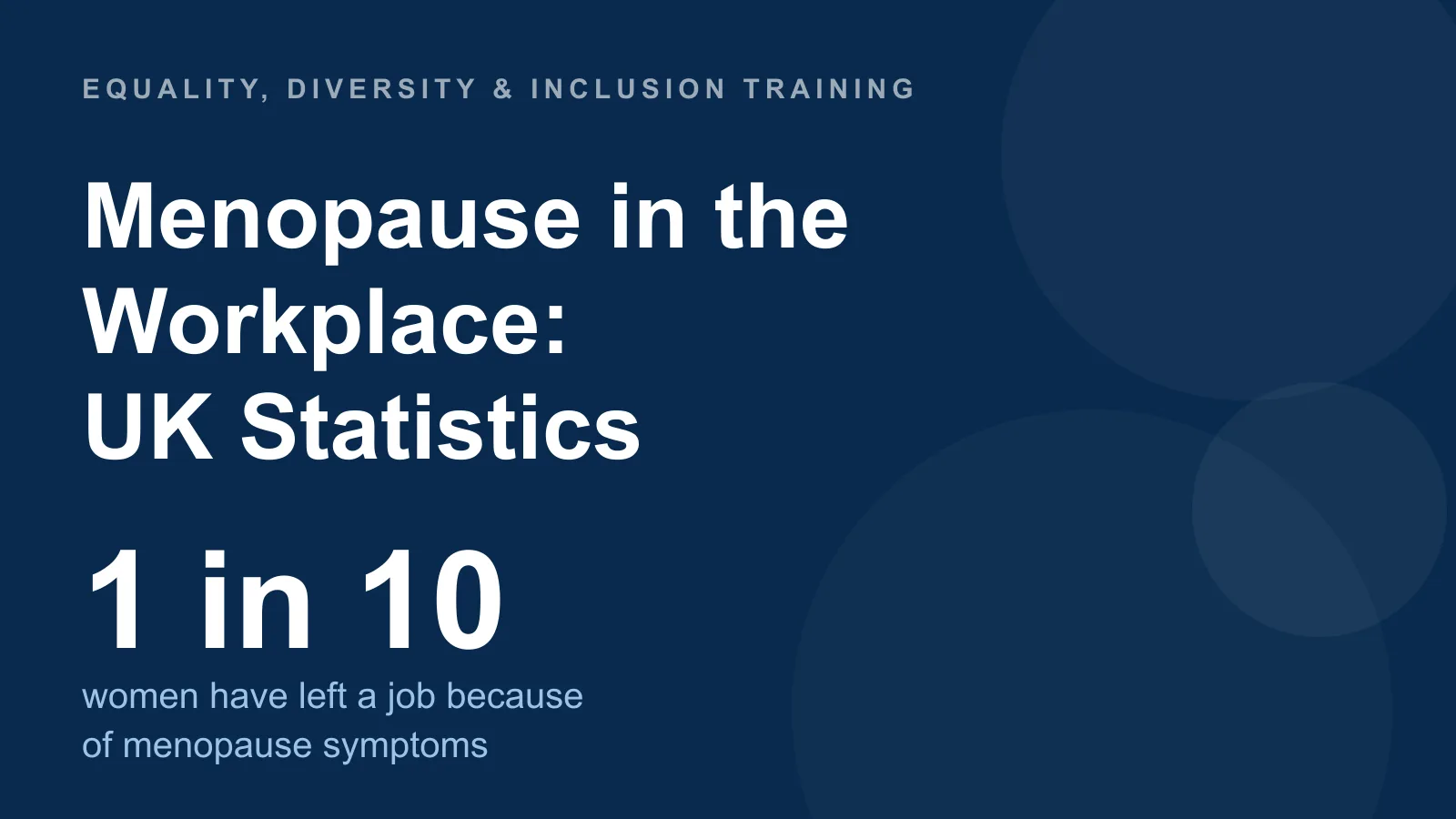
- 1 in 10 women who worked during the menopause have left a job because of their symptoms (Fawcett Society, 2022).
- 67% of employed women aged 40–60 with menopause symptoms say they have had a mostly negative effect on them at work (CIPD, 2023).
- 53% of symptomatic working women have been unable to go into work at some point because of menopause symptoms (CIPD, 2023).
- £1.5 billion a year — the estimated cost of menopause-attributable unemployment to the UK (DWP literature review, 2025).
- ~60,000 UK women are estimated to be out of employment altogether because of menopause symptoms (DWP literature review, 2025).
- 24% of women aged 40–60 say their employer has a menopause policy or other support in place (CIPD, 2023).
- 4.6 million women aged 50–64 are economically active in the UK labour market (DWP literature review, 2025).
- Spring 2027 — menopause support becomes a mandatory part of equality action plans for employers with 250+ staff (voluntary from April 2026).
These are the latest figures available as of July 2026; the main refresh points are the CIPD’s periodic menopause survey (last full wave October 2023) and the Employment Rights Act 2025 action-plan milestones, and this page is reviewed as each lands.
How many working women in the UK are affected by the menopause?
Around 4.6 million women aged 50–64 are economically active in the UK labour market, according to the DWP’s literature review published in July 2025 — the age band in which most women experience the menopause transition. That figure has been climbing for years: the Women and Equalities Committee’s July 2022 report noted that women over 50 were the fastest-growing group in the UK workforce before the pandemic, with around 4.5 million women aged 50–64 in employment at the time of the inquiry.
The direction of travel matters as much as the level. Later state pension ages and longer working lives mean more women than ever are working through the menopause rather than after it — which is why a set of symptoms once treated as a private medical matter has become a measurable driver of absence, attrition and lost output, and why Parliament, the regulator and successive governments have all commissioned data on it since 2022.
How much menopause-related absence is there?
53% of working women aged 40–60 who experience menopause symptoms have been unable to go into work at some point because of them, according to the CIPD’s October 2023 survey of more than 2,000 employed women (fieldwork May–June 2023). That is not a fringe experience — it is over half of the symptomatic workforce in the affected age band.
The aggregate cost of that absence is estimated at £191 million a year in absenteeism, plus £22.4 million in presenteeism — working while unwell and less productively — according to the DWP’s July 2025 literature review, which synthesised 42 publications covering evidence from April 2016 to October 2024.
A measurement caveat worth knowing if you are citing these numbers: menopause-related absence is rarely recorded as such in HR systems, because many women give a different reason or no reason at all when symptoms keep them at home. Survey data of the CIPD’s kind therefore captures far more of the picture than employer absence records do — and the true totals are widely assumed to sit above, not below, the published estimates.
How do menopause symptoms affect women at work?
67% of employed women aged 40–60 with menopause symptoms say the symptoms have had a mostly negative effect on them at work (CIPD, October 2023). Asked what that looks like in practice, 79% said they were less able to concentrate and 68% reported increased stress at work as impacts of their symptoms — alongside the fatigue, disrupted sleep and hot flushes that drive the absence figures above (CIPD, 2023).
The longer-term effect is on careers, not just working days. 27% of women aged 40–60 who have experienced symptoms — an estimated 1.2 million women — say the menopause has negatively affected their career progression (CIPD, October 2023). That hits precisely the career stage at which women would otherwise be moving into senior roles, making menopause support a pipeline issue as much as a wellbeing one — our women in leadership statistics page shows where that pipeline currently stands.
How many women leave work because of the menopause?
1 in 10 women who worked during the menopause have left a job because of their symptoms, according to the Fawcett Society’s May 2022 survey of 4,014 women aged 45–55 — still the canonical UK retention figure four years on. The same survey found 14% of women working through the menopause had reduced their hours and a further 14% had gone part-time because of symptoms (Fawcett Society, 2022).
The CIPD’s 2023 data shows the attrition pipeline in motion: 17% of symptomatic working women have considered leaving their job because of a lack of menopause support, and 6% have actually left (CIPD, October 2023). At the whole-economy level, the DWP’s July 2025 review put the stock of lost workers at an estimated 60,000 UK women not in employment because of menopause symptoms (evidence to October 2024).
| Measure | Figure | Source (data period) |
|---|---|---|
| Left a job because of menopause symptoms | 1 in 10 | Fawcett Society (2022) |
| Reduced their working hours | 14% | Fawcett Society (2022) |
| Moved to part-time work | 14% | Fawcett Society (2022) |
| Considered leaving over lack of support | 17% | CIPD (2023) |
| Actually left over lack of support | 6% | CIPD (2023) |
| Women out of employment due to symptoms | ~60,000 | DWP literature review (evidence to Oct 2024) |
| Annual cost of menopause-attributable unemployment | £1.5 billion | DWP literature review (evidence to Oct 2024) |
Put together, the pattern is a ratchet: hours are cut first, then seniority, then employment itself — each step largely invisible to the employer unless support and disclosure routes exist.
What does the menopause cost the UK economy?
Menopause-attributable unemployment is estimated to cost the UK £1.5 billion a year, according to the DWP’s July 2025 literature review — on top of the £191 million absenteeism and £22.4 million presenteeism costs noted above (evidence to October 2024). The £1.5 billion figure is the value of lost employment among the roughly 60,000 women out of work because of symptoms, which is why unemployment dominates the total: losing a worker entirely costs far more than losing days.
These are conservative, formally-evidenced estimates rather than headline advocacy numbers — the DWP review deliberately synthesised only published research. Costs that resist quantification, such as lost promotions, reduced hours and the recruitment and retraining bill for replacing experienced staff, sit on top of them.
How much employer support is actually in place?
Only 24% of women aged 40–60 say their employer has a menopause policy or other support in place (CIPD, October 2023). The Fawcett Society found the gap even wider in 2022: 8 in 10 women said their employer had not shared information, trained staff, or put a menopause absence policy in place (Fawcett Society, May 2022).
Awareness lags even where support exists. Just 19% of workers are aware of any workplace menopause support their employer offers, ranging from 43% in public administration to 8.2% in education, according to the DWP literature review (evidence to October 2024). The public-sector lead reflects several years of policy work by employers such as councils and the NHS — the Local Government Association maintains a menopause factfile for exactly this purpose — while awareness in most private-sector industries remains in the low teens or worse.
Government has been trying to close the gap by persuasion as well as legislation: the DWP appointed England’s first Menopause Employment Champion in 2023, whose Shattering the Silence 12-month progress report (March 2024) set out sector-by-sector plans for improving workplace support. From 2027, as the next section explains, persuasion gives way to obligation for large employers.
Is menopause a disability under the Equality Act 2010?
Menopause is not a protected characteristic in its own right — but workers experiencing it are protected through three characteristics that are: age, sex and disability. The Equality and Human Rights Commission’s employer guidance of 22 February 2024 makes the disability point explicit: where menopause symptoms have a long-term and substantial effect on a woman’s ability to carry out normal day-to-day activities, they can meet the Equality Act 2010 definition of disability — triggering the duty to make reasonable adjustments and protection from discrimination arising from disability.
The Women and Equalities Committee’s July 2022 report recommended consulting on making menopause a standalone protected characteristic; the Government rejected that recommendation in its January 2023 response, so the age/sex/disability route remains the legal framework. Employers should treat the EHRC guidance as the practical baseline — it is the regulator’s statement of how existing Equality Act 2010 duties apply, not new law. Menopause-related employment tribunal claims are counted within those existing jurisdictions rather than separately; for claim volumes and award levels across the Equality Act heads, see our workplace discrimination statistics page.
What are menopause action plans and when do they become mandatory?
From spring 2027, employers with 250 or more employees must publish equality action plans that include support for employees going through the menopause, under the Employment Rights Act 2025. Publication is voluntary from April 2026, and government guidance on business.gov.uk sets out 18 recommended actions employers can draw on — from flexible working and absence-policy changes to training for line managers. The first compulsory plans are expected by around April 2028, giving large employers roughly a year of reporting run-in from the spring 2027 start (GOV.UK / business.gov.uk, 2026 guidance).
This is the single biggest change in the menopause-at-work landscape since the data above was gathered, and the reason the employer-support percentages in the previous section are likely to move sharply over the next two reporting cycles: a policy that only 24% of women could point to in 2023 becomes a published legal expectation for every large employer. The same action plans also cover steps on the gender pay gap, which is measured separately by the Office for National Statistics and sits outside the scope of this page.
For anyone tracking the timeline, the milestones are: voluntary action plans from April 2026; mandatory plans, including menopause support, for 250+ employers from spring 2027; first compulsory plans expected by around April 2028.
Frequently asked questions
How many working women in the UK are affected by the menopause?
Around 4.6 million women aged 50–64 are economically active in the UK (DWP literature review, 2025) — the band in which most women experience the transition. Among employed women aged 40–60 who have symptoms, 67% say the symptoms have had a mostly negative effect on them at work (CIPD, 2023).
How many women leave work because of menopause symptoms?
The Fawcett Society’s 2022 survey found 1 in 10 women who worked during the menopause have left a job because of their symptoms. The CIPD found 17% of symptomatic working women have considered leaving over lack of support and 6% have left (2023), and the DWP estimates around 60,000 UK women are out of employment because of menopause symptoms (2025).
How much sick leave does the menopause cause in the UK?
53% of working women aged 40–60 with symptoms have been unable to go into work at some point because of them (CIPD, 2023). Menopause-related absenteeism is estimated to cost the UK £191 million a year, with a further £22.4 million in presenteeism (DWP literature review, 2025).
Is menopause a disability under the Equality Act 2010?
Not automatically — menopause is not a protected characteristic. But EHRC guidance (February 2024) confirms that where symptoms have a long-term and substantial effect on day-to-day activities, they can meet the Equality Act 2010 definition of disability, requiring reasonable adjustments. Menopause discrimination claims are typically brought under age, sex or disability.
What are menopause action plans and when do they become mandatory?
Under the Employment Rights Act 2025, employers with 250+ employees must publish equality action plans that include menopause support. Publication is voluntary from April 2026 and mandatory from spring 2027, with the first compulsory plans expected by around April 2028. Government guidance lists 18 recommended actions.
Do most UK employers have a menopause policy?
No. Only 24% of women aged 40–60 say their employer has a menopause policy or other support in place (CIPD, 2023), and just 19% of workers are aware of any menopause support their employer offers — from 43% in public administration down to 8.2% in education (DWP literature review, 2025).
Related guides
- Women in Leadership Statistics UK
- Workplace Discrimination Statistics UK: Tribunal Claims, Prevalence & Protected Characteristics
- Maternity Discrimination Statistics UK
- Disability Employment Gap Statistics UK
- Reasonable Adjustments Under the Equality Act 2010: A UK Employer’s Guide
- Equality Act 2010: The Complete UK Guide
Sources & references
- CIPD — Menopause in the workplace: employee experiences in 2023 (October 2023)
- DWP — Menopause in the Workplace: A Literature Review (July 2025)
- Women and Equalities Committee — Menopause and the workplace, HC 91 (July 2022)
- Fawcett Society — Menopause and the Workplace (May 2022)
- GOV.UK / business.gov.uk — Employer action plans: gender pay gap and menopause guidance (2026)
- DWP — Shattering the Silence about Menopause: 12-month progress report (March 2024)
- EHRC — Menopause in the workplace: guidance for employers (February 2024)
- Local Government Association — Menopause factfile
Menopause support is about to become a legal expectation for large employers — train your team on the Equality Act 2010 and inclusive workplace practice before the 2027 action-plan duty lands.
Explore the Equality, Diversity & Inclusion course →
Mark writes about equality, diversity and inclusion, UK workplace compliance and accredited online training for Equality, Diversity & Inclusion Training, part of Online CPD Academy.