
How LGBT+ people experience work in Britain is measured on two very different footings: the official demographic baseline — the Office for National Statistics’ annual ‘Sexual orientation, UK’ bulletin, which counts how many of us identify as lesbian, gay or bisexual — and the workplace research from bodies such as Stonewall, the CIPD and the recruiter Randstad, which asks LGBT+ workers what actually happens once they are in a job. This page brings both together on one fully cited reference: how many people are LGB, how many still conceal their identity at work, and the measurable impact on career, pay and psychological safety. Every figure names its source and states the data period alongside it, with full references at the end.
Key facts and figures
- 3.7% of the UK population aged 16+ identified as lesbian, gay or bisexual in 2024 — about 2.0 million people — up from 2.7% in 2019 (ONS).
- 8.0% of 16–24-year-olds identified as LGB in 2024, versus just 1.2% of those aged 65 and over (ONS).
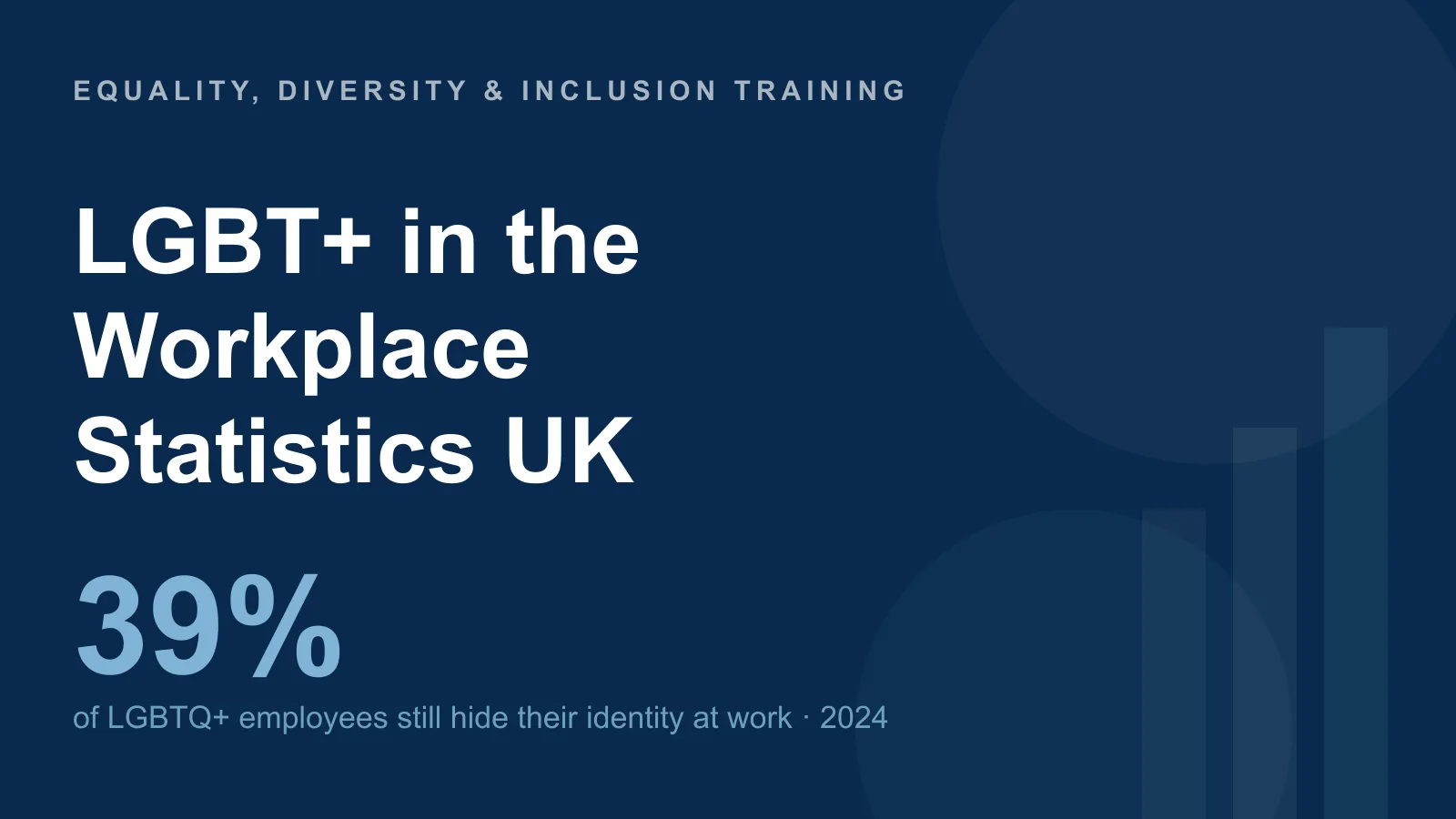
- 39% of LGBTQ+ employees still feel the need to hide that they are LGBTQ+ at work (Stonewall, 2024).
- 31% of LGBTQ+ employees did not agree they could be themselves at work (Stonewall, 2024).
- 33% of LGBTQI+ workers believe their sexuality or gender identity has negatively affected their career (Randstad, 2024).
- 55% of trans workers reported a conflict at work over a 12-month period, versus 40% of LGB+ workers (CIPD, 2021).
- 16% of LGB+ workers felt psychologically unsafe at work, rising to 18% of trans workers, against 10% of heterosexual staff (CIPD, 2021).
- £6,703 a year — the pay gap between LGBT+ and straight workers in a widely cited 2019 UK survey (roughly 16%).
These figures are the latest available as of July 2026, and this page is refreshed as new data is released — chiefly the ONS ‘Sexual orientation, UK’ bulletin, which now updates annually (the 2024 edition was published on 9 December 2025), with the Stonewall, CIPD and Randstad workplace surveys swapped in as newer waves land.
How many people in the UK are LGBT+?
3.7% of the UK household population aged 16 and over identified as lesbian, gay or bisexual (LGB) in 2024 — around 2.0 million people, according to the ONS ‘Sexual orientation, UK: 2024’ bulletin published on 9 December 2025. That is up from 2.7% in 2019, a marked rise over five years and the clearest sign that the proportion of the workforce that is LGB is growing, not shrinking.
Within that 2024 total, 2.1% (about 1.2 million people) identified as gay or lesbian and 1.6% (about 855,000) as bisexual. The ONS figures are drawn from the Annual Population Survey and are classed as official statistics in development; they measure sexual orientation but do not yet provide a comparable annual count of the trans and non-binary population, which is why the workplace surveys below carry more of the weight on trans-specific experience.
The generational gap is stark. 8.0% of people aged 16 to 24 identified as LGB in 2024, compared with just 1.2% of those aged 65 and over, and the fastest growth was among 25 to 34-year-olds, rising from 3.6% in 2019 to 6.4% in 2024. As younger, more openly LGB+ cohorts move through their careers, the share of the working-age population that is LGB is set to keep climbing — which makes inclusive practice a rising, not a niche, workforce issue.
How many LGBT+ workers hide their identity at work?
Almost 40% (39%) of LGBTQ+ employees still feel the need to hide that they are LGBTQ+ at work, according to Stonewall research published in 2024. Concealment is the defining experience this page tracks: it is not a fringe worry but something close to two in five LGBTQ+ workers manage every working day, editing pronouns, weekend plans and partners out of ordinary conversation.
The same Stonewall research found that nearly a third (31%) of LGBTQ+ employees did not agree they could be themselves at work, and that 36% of employees had heard discriminatory comments made about an LGBTQ+ colleague — a reminder that concealment is a rational response to an environment where hostile remarks are common, not simply a matter of personal reticence. Most strikingly, 12% of LGBTQ+ employees believed they were fired or dismissed because they are LGBTQ+, which anchors the concealment data to a concrete fear of career consequences.
Openness among trans and non-binary staff is more constrained still. CIPD research found that 26% of trans and non-binary workers are not open about their gender identity at all at work, while 39% are mostly or completely open — meaning the ‘out at work’ picture is very different depending on which part of the LGBT+ population you look at.
Does being LGBT+ affect career and pay?
One in three (33%) LGBTQI+ workers believe their sexuality or gender identity has negatively affected their career, and 35% report a negative impact on their remuneration or progression, according to Randstad’s 2024 survey (fieldwork 15 April to 3 May 2024, n=2,361 across seven markets including the UK). The same research found that 41% of LGBTQI+ workers have faced discrimination or prejudice at work, and that 29% have quit a job over discrimination concerns — turnover that carries a direct cost to employers as well as to the individuals affected.
On pay, the most-cited UK figure comes from a 2019 survey of 4,000 workers, which found that LGBT+ workers earned on average 16% — about £6,703 a year — less than straight colleagues, roughly double the UK gender pay gap at the time. This is a one-off survey rather than an official statistic, and it predates the pandemic, so it is best read as an indicative order of magnitude rather than a current national measure; there is no equivalent mandatory ‘LGBT pay gap’ reporting in the UK the way there is for the sex-based gender pay gap the ONS publishes each year. The perception data from Randstad, where more than a third of LGBTQI+ workers say their identity has cost them pay or progression, is the more current signal.
| Measure | Figure | Source & period |
|---|---|---|
| Career negatively affected by being LGBTQI+ | 33% | Randstad, 2024 |
| Pay / progression negatively affected | 35% | Randstad, 2024 |
| Faced discrimination or prejudice at work | 41% | Randstad, 2024 |
| Quit a job over discrimination concerns | 29% | Randstad, 2024 |
| Average LGBT+ vs straight pay gap | ~16% (~£6,703/yr) | UK survey, 2019 (n=4,000) |
How safe do LGBT+ employees feel at work?
16% of LGB+ workers felt psychologically unsafe at work, compared with 10% of heterosexual workers — rising to 18% among trans workers, according to the CIPD’s ‘Inclusion at work: perspectives on LGBT+ working lives’ research (published February 2021, drawing on UK Working Lives data plus a bespoke trans survey of 193 respondents). Psychological safety — the confidence to speak up, ask questions or raise concerns without fear of humiliation or reprisal — is where concealment, discriminatory remarks and career anxiety all converge, and the CIPD data shows LGB+ and especially trans workers carry a measurably heavier load of it.
The same research found that 40% of LGB+ workers reported experiencing a conflict at work over a 12-month period, rising to 55% of trans workers — far higher than the rates for heterosexual, cisgender staff. Taken together, the CIPD numbers describe an environment in which LGBT+ staff, and trans staff most of all, spend more energy on managing interpersonal friction and less on their actual jobs.
Do trans employees face more barriers than LGB colleagues?
Yes — on every comparable CIPD measure, trans workers report worse outcomes than LGB+ colleagues, who in turn report worse outcomes than heterosexual, cisgender staff. Conflict at work rose from 40% among LGB+ workers to 55% among trans workers; the share feeling psychologically unsafe rose from 16% to 18%; and 26% of trans and non-binary workers are not open about their gender identity at work at all (CIPD, 2021).
The gradient matters for employers because trans and non-binary staff are protected under the Equality Act 2010 through the ‘gender reassignment’ protected characteristic, which applies whether or not a person holds a Gender Recognition Certificate and does not require any medical process. That protection was explicitly reaffirmed by the Supreme Court in April 2025, which ruled that while ‘sex’ in the Act means biological sex, transgender people remain fully protected under the separate characteristic of gender reassignment. Inclusive practice for trans staff — from correct pronouns to confidential handling of transition — sits squarely within the nine protected characteristics every employer already has a duty to uphold.
How much harassment do LGBT+ workers face?
52% of LGBT+ people reported being bullied or harassed at work in the last five years, according to TUC research (report published January 2025, with updated analysis in July 2025). We cite this single headline here as context — harassment is the majority experience for LGBT+ workers, and it is the mechanism behind much of the concealment and career impact described above.
The full breakdown of harassment of LGBT+ workers — verbal abuse, unwanted touching, reporting rates and the new preventative duty on employers — sits on our dedicated sexual harassment at work statistics page, which owns the harassment survey umbrella across all protected groups. If your interest is specifically in what LGBT+ workers experience by way of bullying and harassment and how employers must now respond, that page carries the detail; this one keeps its focus on identity, career and demographic data.
What do the numbers mean for UK employers?
Read together, the data describes a workforce that is growing more openly LGB+ by generation while a large minority still conceal their identity and carry a measurable career, pay and safety penalty for who they are. With 3.7% of adults identifying as LGB and that share doubling among under-25s, an inclusive culture is no longer an optional extra — it is a retention and productivity issue, given that 29% of LGBTQI+ workers have left a job over discrimination concerns (Randstad, 2024).
The practical levers are well established: visible leadership commitment, clear and enforced anti-harassment policy, inclusive language and benefits, confidential routes to raise concerns, and training that helps every colleague understand what the 36% of employees who have heard discriminatory comments about an LGBTQ+ colleague should do differently. None of it is exotic; most of it is simply applying the Equality Act 2010 duties an employer already has, consistently, to sexual orientation and gender reassignment. LGBT+ inclusion also sits alongside the wider equality picture — the disability employment gap, the ethnicity pay gap and the under-representation of women in leadership — that shapes how genuinely inclusive a workplace really is.
Frequently asked questions
What percentage of UK employees are LGBT+?
The ONS reports that 3.7% of the UK population aged 16 and over identified as lesbian, gay or bisexual in 2024 — about 2.0 million people — up from 2.7% in 2019. The proportion is much higher among younger workers: 8.0% of 16 to 24-year-olds identified as LGB, against 1.2% of those aged 65 and over. The ONS baseline covers sexual orientation; it does not yet publish a comparable annual count of the trans and non-binary population.
How many LGBT+ workers hide their identity at work?
Almost 40% (39%) of LGBTQ+ employees still feel the need to hide that they are LGBTQ+ at work, according to Stonewall research from 2024, and 31% did not agree they could be themselves at work. Among trans and non-binary staff, 26% are not open about their gender identity at work at all (CIPD, 2021).
Is there an LGBT pay gap in the UK?
There is no mandatory LGBT pay gap reporting in the UK. The most-cited estimate comes from a 2019 survey of 4,000 workers, which found LGBT+ workers earned on average 16% — about £6,703 a year — less than straight colleagues. More recently, 35% of LGBTQI+ workers told Randstad in 2024 that their identity had negatively affected their pay or progression. Both are survey measures, not official statistics.
Do trans employees face more workplace barriers than LGB colleagues?
On the available CIPD data, yes. In 2021, 55% of trans workers reported a conflict at work over a 12-month period versus 40% of LGB+ workers, 18% felt psychologically unsafe versus 16% of LGB+ workers, and 26% of trans and non-binary workers were not open about their gender identity at work at all. Trans staff are protected under the ‘gender reassignment’ characteristic of the Equality Act 2010, a protection the Supreme Court reaffirmed in April 2025.
Where do UK LGBT+ workplace statistics come from?
The demographic baseline is the ONS ‘Sexual orientation, UK’ bulletin, now published annually. Workplace experience data comes from research bodies and recruiters — chiefly Stonewall (concealment and inclusion), the CIPD (psychological safety, conflict and trans-specific data) and Randstad (career, pay and discrimination). Harassment prevalence figures come from the TUC.
Related guides
- Sexual Harassment at Work Statistics UK: Prevalence, Reporting Rates & the New Preventative Duty
- Disability Employment Gap Statistics UK
- Ethnicity Pay Gap Statistics UK
- Women in Leadership Statistics UK
- Equality Act 2010: The Complete UK Guide
Sources & references
- Office for National Statistics — Sexual orientation, UK: 2024 (published 9 December 2025)
- Office for National Statistics — Sexual orientation, UK: 2023 (prior-year baseline)
- Stonewall — Almost 40% of LGBTQ+ employees still hide their identity at work (2024)
- CIPD — Inclusion at work: perspectives on LGBT+ working lives (February 2021)
- Randstad — One in three LGBTQI+ workers say identity has negatively affected their career (2024)
- TUC — Bullying, harassment and discrimination of LGBT people in the workplace (2025)
- People Management — LGBT staff earn £6,700 less than straight workers (survey of 4,000 workers, 2019)
An inclusive workplace for LGBT+ colleagues starts with a team that understands the Equality Act 2010 and their everyday responsibilities under it.
Explore the Equality, Diversity & Inclusion course →
Mark writes about equality, diversity and inclusion, UK workplace compliance and accredited online training for Equality, Diversity & Inclusion Training, part of Online CPD Academy.