
Sexual harassment remains one of the most widespread — and least reported — problems in UK workplaces, and since 26 October 2024 every employer has been under a positive legal duty to prevent it. This page brings the key UK statistics together in one place, drawing on the Government Equalities Office’s 2020 national survey, the Office for National Statistics’ Crime Survey for England and Wales, TUC polling, Unite the Union’s landmark 2025 survey of more than 23,000 workers, and employment tribunal and Acas data.
Key facts and figures
- 60% of women have experienced sexual harassment at some point in their working lives (Unite the Union survey of 23,000+ workers, July 2025).
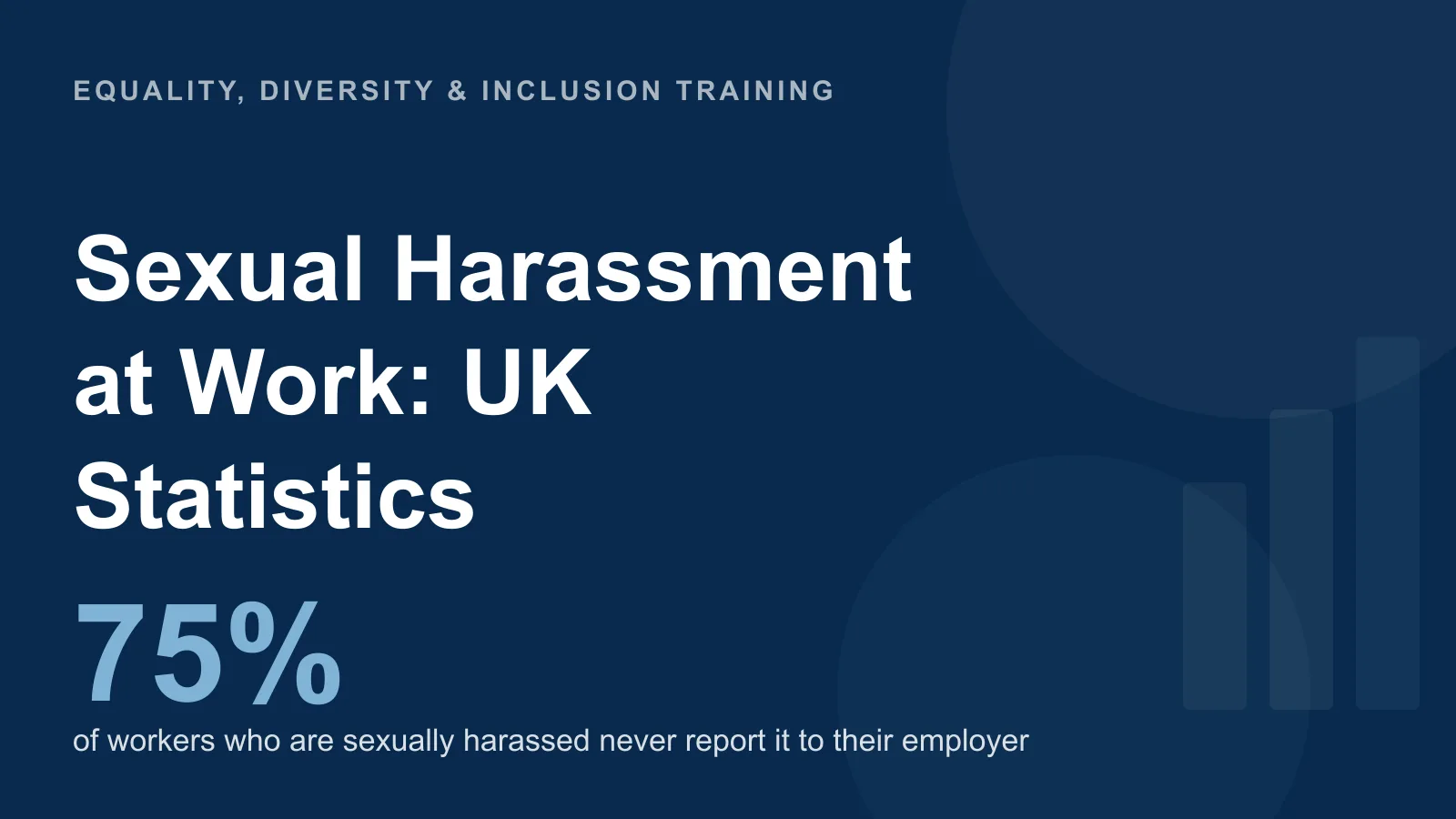
- 75% of those who experienced sexual harassment never reported it to their employer (Unite, 2025).
- 25% of women report having been sexually assaulted at work (Unite, 2025).
- 58% of women have experienced sexual harassment, bullying or verbal abuse at work, rising to 62% of those aged 25–34 (TUC/Opinium poll, April 2023).
- 68% of LGBT workers have been sexually harassed at work (TUC, 2019).
- 8% of women and 3% of men experienced sexual harassment in the previous 12 months (Crime Survey for England and Wales, October 2022 to March 2023).
- 125 sexual harassment employment tribunal cases in the first three quarters of 2024 — up 7% on the same period in 2023 (HMCTS data analysed by Irwin Mitchell).
- 39% year-on-year rise in harassment calls to the Acas helpline in January–June 2025 — 5,583 calls, up from 4,001 (Acas helpline data).
These figures are the latest available as of July 2026, and we update this page when new data is released — chiefly the Ministry of Justice’s quarterly tribunal statistics and new survey waves from the TUC, Unite and the ONS.
Sexual harassment statistics at a glance
The table below summarises the headline measures, the latest figure for each, and the source and data period behind it.
| Measure | Figure | Source and period |
|---|---|---|
| Women who have experienced sexual harassment in their working lives | 60% | Unite the Union, 2025 |
| Women sexually assaulted at work | 25% | Unite the Union, 2025 |
| Victims who never reported it to their employer | 75% | Unite the Union, 2025 |
| Women aged 25–34 experiencing harassment, bullying or verbal abuse at work | 62% | TUC/Opinium, April 2023 |
| LGBT workers sexually harassed at work | 68% | TUC, 2019 |
| Disabled women sexually harassed at work | Around 7 in 10 | TUC, 2021 |
| Sexual harassment employment tribunal cases, Q1–Q3 2024 | 125 (up 7% on 2023) | HMCTS via Irwin Mitchell, October 2024 |
| Harassment calls to the Acas helpline, January–June 2025 | 5,583 (up 39% year on year) | Acas helpline data, 2025 |
How many women experience sexual harassment at work?
60% of women have experienced sexual harassment at some point in their working lives, according to Unite the Union’s landmark survey of more than 23,000 workers across 19 sectors, published in July 2025. It is the largest and most recent UK dataset on the subject, and its other findings are starker still: 25% of women report having been sexually assaulted at work, and 8% say they have been victims of sexual coercion.
Unite’s figures sit consistently alongside earlier polling. A TUC/Opinium poll of 1,010 working women, carried out in April 2023, found that 58% had experienced sexual harassment, bullying or verbal abuse at work — rising to 62% among women aged 25–34.
The official national baseline is the Government Equalities Office’s 2020 Sexual Harassment Survey, the largest government study of its kind, with more than 12,000 respondents (fieldwork in 2020, published July 2021). Among people harassed in the workplace, 63% said the perpetrator was a man. No repeat of the survey has been announced, which is why union polling and the crime survey now carry much of the weight in tracking the problem.
Who is most at risk of sexual harassment at work?
68% of LGBT workers have been sexually harassed at work, according to TUC research published in 2019 — the highest prevalence recorded for any group in UK workplace surveys. Disabled women are also disproportionately affected: around 7 in 10 disabled women said they had been sexually harassed at work in the TUC’s 2021 survey.
Age is a clear risk factor too. The TUC’s April 2023 polling found 62% of women aged 25–34 had experienced sexual harassment, bullying or verbal abuse at work, against 58% of working women overall. Several of the groups most affected — sex, sexual orientation, gender reassignment and disability — map directly onto the protected characteristics of the Equality Act 2010.
Official crime-survey data shows the same gendered pattern across the wider population. In the Crime Survey for England and Wales covering October 2022 to March 2023, 8% of women and 3% of men said they had experienced sexual harassment in the previous 12 months — and 26% of those victims said it happened at their place of work, making the workplace one of the most common settings for harassment (ONS, published December 2023).
How many people report sexual harassment at work?
75% of workers who experienced sexual harassment never reported it to their employer, according to Unite’s 2025 survey. That is consistent with the TUC’s earlier polling, which in 2016 put non-reporting among women at 79%. However the data is cut, roughly three-quarters or more of incidents never enter any formal workplace process.
Under-reporting is even more acute where speaking up carries an extra personal risk. Among LGBT workers who were harassed, 66% did not report it — and one in four stayed silent specifically for fear of being outed at work (TUC, 2019).
The cost of that silence shows up in the harm data. In the Government Equalities Office’s 2020 survey, 54% of people who had experienced sexual harassment in the previous year said it affected their quality of life. Reporting rates matter legally as well as morally: clear, trusted reporting channels are one of the core steps the Equality and Human Rights Commission expects employers to take under the preventative duty described below.
What counts as sexual harassment at work?
Under section 26(2) of the Equality Act 2010, sexual harassment is unwanted conduct of a sexual nature that has the purpose or effect of violating a person’s dignity, or of creating an intimidating, hostile, degrading, humiliating or offensive environment for them. The EHRC’s technical guidance gives examples ranging from sexual comments and so-called ‘banter’ to unwelcome touching, sexual advances and sharing sexually explicit messages or images. Intent is irrelevant — conduct can be harassment because of its effect alone. Our guide to the Equality Act 2010 covers the legal framework in full.
One data-literacy note when quoting the statistics above: the surveys measure slightly different things. Unite’s 60% and the GEO baseline measure sexual harassment specifically; the TUC’s 58% covers sexual harassment, bullying or verbal abuse together; and the ONS crime-survey figures measure experiences in the previous 12 months across all settings, not just work. The data periods quoted alongside each figure on this page tell you which is which.
What do tribunal and Acas figures show?
There were 125 sexual harassment employment tribunal cases in the first three quarters of 2024, up 7% on the same period in 2023, according to Irwin Mitchell’s October 2024 analysis of HMCTS tribunal data. Set against the prevalence figures above, the number is strikingly small — a reflection of the 75% who never report, let alone litigate.
Demand for advice is rising much faster than caseloads. The Acas helpline took 5,583 calls about workplace harassment between January and June 2025 — up 39% from 4,001 in the same period of 2024, the first half-year fully after the new preventative duty came into force (Acas helpline data reported by People Management, 2025).
The financial stakes have risen too. Since 26 October 2024, tribunals can uplift compensation by up to 25% where an employer has breached the duty to prevent sexual harassment — on top of discrimination awards that are already uncapped. For the wider tribunal picture — claim volumes, the backlog and average awards across all discrimination jurisdictions — see our companion page on workplace discrimination statistics.
What is the employer duty to prevent sexual harassment?
Since 26 October 2024, every employer in Great Britain has been under a positive legal duty to take reasonable steps to prevent sexual harassment of their workers. The Worker Protection (Amendment of Equality Act 2010) Act 2023 inserted section 40A into the Equality Act, shifting the law from reacting to harassment after it happens to requiring employers to anticipate and prevent it.
The Equality and Human Rights Commission updated its technical guidance on 26 September 2024 and published an eight-step guide for employers, covering an effective anti-harassment policy, risk assessment, reporting routes, training and monitoring. Enforcement runs on two tracks: the EHRC can investigate and take action against non-compliant employers in its own right, and tribunals can apply the up-to-25% compensation uplift in individual claims.
The bar rises again in October 2026. The Employment Rights Act 2025 upgrades the standard from ‘reasonable steps’ to ‘all reasonable steps’ — an employer will need to show it took every reasonable step, not merely a proportionate selection — and reintroduces employer liability for harassment of staff by third parties such as customers and clients. In January 2026 the Government consulted on enabling regulations that will specify what ‘all reasonable steps’ requires in practice, with regard to matters such as policies, complaint handling and training. Employers who treated October 2024 as a one-off policy exercise will need to revisit their arrangements before October 2026.
Frequently asked questions
What percentage of women experience sexual harassment at work in the UK?
60% of women say they have experienced sexual harassment at some point in their working lives, according to Unite the Union’s 2025 survey of more than 23,000 workers. A TUC/Opinium poll in April 2023 found 58% of working women had experienced sexual harassment, bullying or verbal abuse at work, rising to 62% of those aged 25–34.
How many people report sexual harassment at work?
Very few. 75% of those who experienced sexual harassment never reported it to their employer (Unite, 2025), and the TUC’s earlier polling put non-reporting among women at 79% (2016).
What are the sexual harassment statistics for LGBT workers?
68% of LGBT workers have been sexually harassed at work, 66% of those harassed did not report it, and one in four kept silent for fear of being outed (TUC, 2019).
What is the Worker Protection Act 2023?
The Worker Protection (Amendment of Equality Act 2010) Act 2023 inserted section 40A into the Equality Act 2010. In force since 26 October 2024, it requires every employer to take reasonable steps to prevent sexual harassment of their workers, with EHRC enforcement powers and a compensation uplift of up to 25% for breaches.
What changes for employers in October 2026?
The Employment Rights Act 2025 raises the standard to ‘all reasonable steps’ and reintroduces employer liability for harassment by third parties such as customers. The Government consulted in January 2026 on regulations specifying what ‘all reasonable steps’ will require.
Can an employment tribunal increase compensation for sexual harassment?
Yes. Where an employer has breached the preventative duty, the tribunal can uplift the compensation awarded by up to 25% — and discrimination awards are uncapped.
Related guides
- Workplace Discrimination Statistics UK: Tribunal Claims, Prevalence & Protected Characteristics
- Neurodiversity Statistics UK: Autism, ADHD & Dyslexia Prevalence and Employment
- Equality Act 2010: The Complete UK Guide
- The Nine Protected Characteristics Under the Equality Act 2010
- How to Write an Equality and Diversity Policy: A UK Guide
Sources & references
- Government Equalities Office / IFF Research — 2020 Sexual Harassment Survey (published July 2021)
- Office for National Statistics — Experiences of harassment in England and Wales: December 2023
- Unite the Union — Sexual harassment endemic in UK workplaces, landmark Unite survey finds (July 2025)
- TUC — Polling on sexual harassment, bullying and verbal abuse at work (working women 2023; LGBT workers 2019; disabled women 2021)
- Equality and Human Rights Commission — Sexual harassment and harassment at work: technical guidance (updated 26 September 2024)
- Irwin Mitchell — Sexual harassment employment tribunal statistics reveal seven per cent annual rise (October 2024)
- GOV.UK — Preventing workplace sexual harassment: enabling regulations about reasonable steps (consultation, January 2026)
- People Management — Sexual harassment enquiries to Acas spike by a third in first half of year (Acas helpline data, 2025)
Training is one of the core reasonable steps the EHRC expects employers to take to prevent harassment — get your team certified.
Explore the Equality, Diversity & Inclusion course →
Mark writes about equality, diversity and inclusion, UK workplace compliance and accredited online training for Equality, Diversity & Inclusion Training, part of Online CPD Academy.