
Recruitment bias in the UK is measured chiefly through field experiments — studies where researchers send matched, fictitious CVs to real job vacancies and record who gets called back. The definitive UK evidence comes from Nuffield College’s Centre for Social Investigation, whose 2019 GEMM correspondence study tested thousands of real jobs, corroborated by the British Academy’s analysis of the same programme. Alongside that sit the Information Commissioner’s Office 2024 audit of AI recruitment tools, the CIPD’s Resourcing and Talent Planning survey on name-blind hiring, and field trials from the Behavioural Insights Team. This page brings the hiring-stage evidence together on one fully cited reference — every figure carries a named source and the period it covers, with full references at the end.
The scope here is deliberately narrow: this page covers bias at the point of entry — CV screening, callbacks, name-blind recruitment, interview questions and algorithmic shortlisting. In-work discrimination once someone is hired sits on our workplace discrimination statistics page, and the wider ethnic employment and pay gaps sit on our ethnicity pay gap statistics page.
Key facts and figures
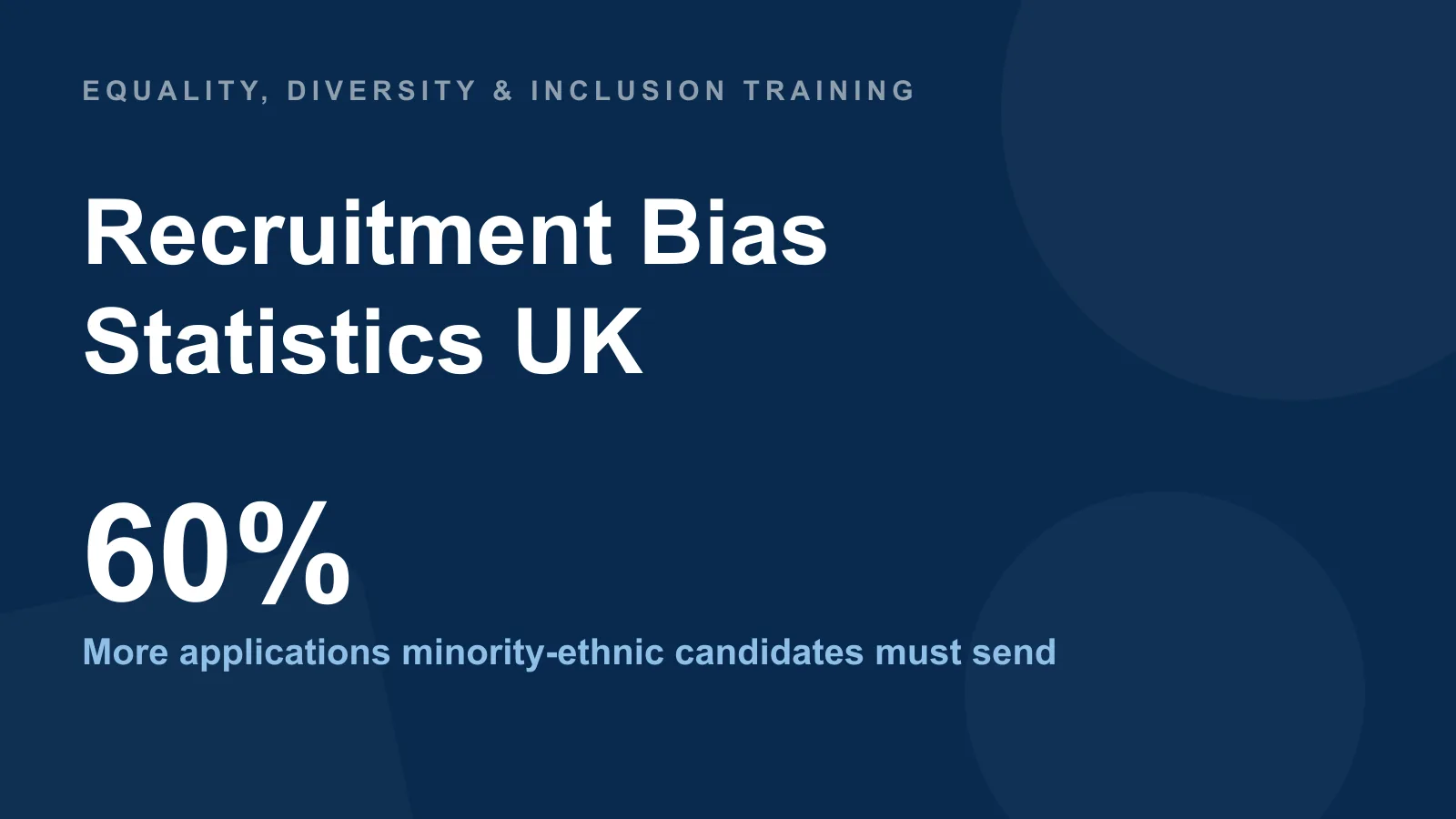
- 60% more job applications minority-ethnic candidates in Britain must send to get the same positive response as identical white British applicants (Nuffield/CSI GEMM, 2019).
- 24% vs 15% — positive employer response rate for white British applicants against minority-ethnic applicants with identical CVs (British Academy, 2019).
- 90% more applications sent by Middle Eastern & North African-origin applicants; 80% more for Nigerian origin; 70% more for Pakistani origin (CSI/GEMM, 2019).
- ~50 years — no measurable fall in discrimination against Black Caribbean and South Asian applicants since the late 1960s (CSI/GEMM, 2019).
- ~300 recommendations issued by the ICO’s 2024 audit of AI recruitment tools; some let recruiters filter by protected characteristics (ICO, Nov 2024).
- 67% of UK employers do not use name-blind CVs in selection — up from 53% in 2022 (CIPD via People Management, 2024).
- 63% of UK jobseekers report facing discriminatory or biased interview questions (People Management survey, 2024).
- ~11% — how much more likely blind-recruitment organisations are to hire ethnic-minority candidates (Behavioural Insights Team, 2023).
These figures are the latest available as of July 2026. The spine of the page is a small number of landmark UK field experiments with no scheduled successor, so it is reviewed annually rather than on a fixed release date — refreshed as new AI-screening-bias audits (ICO and academic) and recurring recruiter surveys such as the CIPD Resourcing and Talent Planning report are published.
Do UK employers discriminate based on the name on a CV?
Yes — the evidence is direct and unusually robust. The clearest UK measure comes from the Nuffield College Centre for Social Investigation (CSI), which in 2016–2018 ran a large correspondence study as the British arm of the cross-national GEMM project. Researchers responded to around 3,200 real job vacancies with carefully matched applications that were identical in every respect — qualifications, experience, covering letter — except for a name signalling the applicant’s ethnic background. Because everything else was held constant, any difference in the employer’s response can be attributed to the name and the ethnicity it signalled.
The headline result: minority-ethnic applicants had to send 60% more applications to receive the same number of positive responses as white British applicants with identical CVs (Nuffield College / CSI, published January 2019). A ‘positive response’ here means being invited to interview or asked to get in touch — the first callback, not a job offer — which makes this a precise measure of bias at the very first sift.
The British Academy, drawing on the same programme, put the same finding in absolute terms: 24% of applications from white British candidates received a positive response, against just 15% from minority-ethnic candidates using otherwise identical CVs and covering letters (British Academy, 2019). Perhaps the most sobering conclusion was historical — the CSI team found no reduction in discrimination against Black Caribbean and South Asian applicants over roughly the previous 50 years, with rates essentially unchanged since comparable British audit studies in the late 1960s and 1970s.
How many more applications do ethnic-minority candidates have to send?
The 60% average conceals a steep gradient between groups. The GEMM data, reported in accessible form by Raconteur in October 2019, shows how the penalty varied by origin — always measured against identical white British applicants:
| Applicant background | Extra applications needed vs identical white British CV | Source / period |
|---|---|---|
| Minority-ethnic applicants (overall average) | +60% | CSI/GEMM, 2016–2018 |
| Pakistani origin | +70% | Raconteur summarising CSI/GEMM, 2019 |
| Nigerian origin | +80% | Raconteur summarising CSI/GEMM, 2019 |
| Middle Eastern / North African origin | +90% | Raconteur summarising CSI/GEMM, 2019 |
Applicants of Middle Eastern and North African origin faced the steepest penalty, needing to send 90% more applications; those of Nigerian origin needed 80% more, and Pakistani-origin applicants 70% more (Raconteur summarising CSI/GEMM, October 2019). Crucially, the penalty did not disappear for stronger candidates: the CSI study found that Nigerian applicants with a degree and relevant experience still had to send roughly twice as many applications to be considered for software-engineering and marketing roles (Nuffield College / CSI, 2019). Because the CVs were matched, this is a measure of hiring-stage bias specifically, and does not describe the broader ethnic employment-rate or pay differences that we cover on our ethnicity pay gap statistics page.
Does name-blind recruitment actually reduce hiring bias?
The field evidence suggests it helps — organisations using blind recruitment were around 11% more likely to hire candidates from ethnic-minority backgrounds, according to analysis cited by the Behavioural Insights Team (2023). Name-blind (or anonymised) recruitment strips identifying details — name, and often age, gender and address — from applications before the first sift, so that the shortlist is drawn on the evidence of skills and experience alone. The logic follows directly from the correspondence studies: if a name alone changes callback rates, removing the name at the sift stage removes the trigger.
Anonymising the CV is not the only lever. A Behavioural Insights Team field trial found that reformatting CVs to replace employment dates with years of experience raised callback rates by 14.6% for applicants with a CV gap (Behavioural Insights Team age-bias trial, cited 2023), showing that how information is presented — not only whether a name is shown — shapes the sift. At scale, the UK Civil Service adopted name-blind recruitment across departments from 2015, a policy that covered over 500,000 applications a year (Civil Service / gov.uk, 2015).
Adoption in the wider labour market, however, is going backwards. Two-thirds — 67% — of UK employers do not use name-blind CVs during selection, up from 53% in 2022 (CIPD Resourcing and Talent Planning, reported via People Management, 2024). Diverse interview panels, another recognised debias measure, are also far from universal: 56% of UK employers have no policy of using diverse interview panels (CIPD via People Management, 2024). In short, a low-cost intervention with supportive evidence is being used by a shrinking minority of employers.
How common are discriminatory interview questions?
63% of UK jobseekers reported facing discriminatory or biased questions during interviews, according to survey data reported by People Management in 2024. The most common themes were age (raised with 48% of those affected), gender (25%) and race (23%). Questions of this kind — about someone’s age, whether they plan to have children, their marital status or their background — are a recognised route through which bias enters the hiring decision, because they invite the interviewer to weigh factors unrelated to the ability to do the job.
Under the Equality Act 2010, using answers to such questions to reject a candidate can amount to direct discrimination on the relevant protected characteristic. There are tight limits on health and disability questions in particular: section 60 of the Act generally prohibits employers from asking about health or disability before a job offer, other than for a defined set of purposes such as establishing whether reasonable adjustments are needed for the assessment itself. Survey prevalence figures like these are self-reported snapshots rather than official statistics, but they map closely onto the correspondence-study evidence: bias that shows up in the CV sift does not stop at the interview-room door.
Is AI recruitment software making hiring bias better or worse?
The Information Commissioner’s Office audited AI recruitment tools in 2024 and issued almost 300 recommendations to improve compliance — finding that some tools allowed recruiters to filter out candidates with certain protected characteristics (ICO, November 2024). The audit is the most authoritative UK look yet at algorithmic hiring, and its findings are a caution against assuming that automation removes human bias rather than encoding it at scale.
Two findings stand out. First, some AI tools inferred candidates’ gender and ethnicity from their name — the very signal the correspondence studies show drives discrimination — and the providers could not demonstrate that those inferences were reliable enough to mitigate bias (ICO, 2024). Second, some systems allowed recruiters to filter candidates by protected characteristics, or collected far more personal data than the role required. The risk is structural: a screening model trained on a company’s past hiring decisions can learn and reproduce the historical pattern in which certain names were called back less often, then apply it to every future applicant automatically.
The ICO audit is the natural refresh lifeline for this page, because algorithmic hiring is where the newest evidence is emerging — through regulator audits, academic studies and independent algorithm audits. For UK employers, the practical takeaway is that deploying an AI screening tool does not transfer away responsibility: the Equality Act 2010 and UK data-protection law apply to an automated sift exactly as they do to a human one.
What does international evidence add?
The UK is not unusual: correspondence studies in many countries find the same name penalty, which is why the British findings are widely regarded as robust rather than a local quirk. One frequently cited recent example is King’s College London’s ‘Resume Bias’ study (Adamovic, 2024), which found that English-named applicants received positive responses to 26.8% of leadership-role applications, against 11.3% for applicants with non-English names. That is a striking gap — but the data behind it is Australian, not British, so it belongs here only as international corroboration and should never be presented as a UK statistic. Its value is in confirming the direction and rough scale of the effect that the Nuffield/CSI field experiment measured directly for Britain.
Frequently asked questions
Do employers in the UK discriminate based on the name on a CV?
Yes. The Nuffield College Centre for Social Investigation ran a correspondence study across roughly 3,200 real UK vacancies in 2016–2018, sending identical CVs that differed only in a name signalling ethnicity. Minority-ethnic applicants had to send 60% more applications to get the same positive response as white British applicants, and the British Academy put the callback gap at 24% versus 15%.
How many more job applications do ethnic-minority candidates have to send?
On average, 60% more than identical white British applicants (CSI/GEMM, 2019). The penalty is steeper for some groups: around 70% more for Pakistani-origin applicants, 80% more for Nigerian-origin applicants and 90% more for those of Middle Eastern or North African origin, as reported by Raconteur summarising the GEMM data in 2019.
Does blind (name-blind) recruitment actually reduce hiring bias?
The evidence points that way. The Behavioural Insights Team reported that organisations using blind recruitment were around 11% more likely to hire ethnic-minority candidates, and the UK Civil Service applied name-blind recruitment across departments from 2015. Adoption is falling in the wider market, though: 67% of UK employers did not use name-blind CVs in 2024, up from 53% in 2022 (CIPD).
Is AI recruitment software making hiring bias better or worse?
It can make it worse if unchecked. The ICO’s 2024 audit of AI recruitment tools issued almost 300 recommendations and found that some tools let recruiters filter out candidates with certain protected characteristics, and inferred gender and ethnicity from names without reliable evidence that the inferences mitigated bias. The Equality Act 2010 applies to an automated sift just as it does to a human one.
What counts as recruitment bias under the Equality Act 2010?
Treating an applicant less favourably because of a protected characteristic — for example rejecting a CV because of the ethnicity a name signals — can be direct discrimination. Applying a neutral-looking criterion that disadvantages one group without justification can be indirect discrimination. Health and disability questions before a job offer are generally prohibited under section 60, with narrow exceptions.
Related guides
- Workplace Discrimination Statistics UK: Tribunal Claims, Prevalence & Protected Characteristics
- Ethnicity Pay Gap Statistics UK: The Latest Data by Group
- Disability Employment Gap Statistics UK
- Equality Act 2010: The Complete UK Guide
- The Nine Protected Characteristics Under the Equality Act 2010
Sources & references
- Nuffield College / Centre for Social Investigation — GEMM field experiment: ‘Are employers in Britain discriminating against ethnic minorities?’ (January 2019)
- The British Academy — How ethnic minorities are still discriminated against in the UK job market (2019)
- Information Commissioner’s Office — AI tools in recruitment: audit outcomes report (November 2024)
- People Management — Candidates face discriminatory interview questions; CIPD name-blind CV adoption (2024)
- Recruitment & Employment Confederation (REC) — Discrimination and unconscious bias in recruitment (January 2024)
- Raconteur — Name bias in recruitment: is your name holding you back? (October 2019)
- Behavioural Insights Team — Reducing age bias and blind-recruitment field evidence (2023)
- King’s College London — The Resume Bias: How Names and Ethnicity Influence Employment Opportunities (Adamovic, 2024 — Australian data, international corroboration only)
The bias measured in these studies happens at the very first sift — train your hiring managers on the Equality Act 2010 and fair, structured recruitment.
Explore the Equality, Diversity & Inclusion course →
Mark writes about equality, diversity and inclusion, UK workplace compliance and accredited online training for Equality, Diversity & Inclusion Training, part of Online CPD Academy.