
The UK’s evidence on religion and belief at work is scattered across very different sources: the decennial ONS Census 2021, which set the demographic baseline; the largest survey of its kind, Pearn Kandola’s Religion at Work Report (6,315 respondents); a follow-up study of Jewish and Muslim employees after 7 October 2023; the Cabinet Office’s annual Civil Service religion breakdown; and Acas guidance on the Equality Act 2010. This page pulls the lived-experience and inclusion figures into one fully cited reference. Tribunal claim counts for religion or belief are covered on our workplace discrimination statistics page, not here.
Key facts and figures
- ~1 million UK workers (around 3% of the workforce) reported having suffered some form of religious discrimination (ComRes survey cited by the CIPD, 2017).
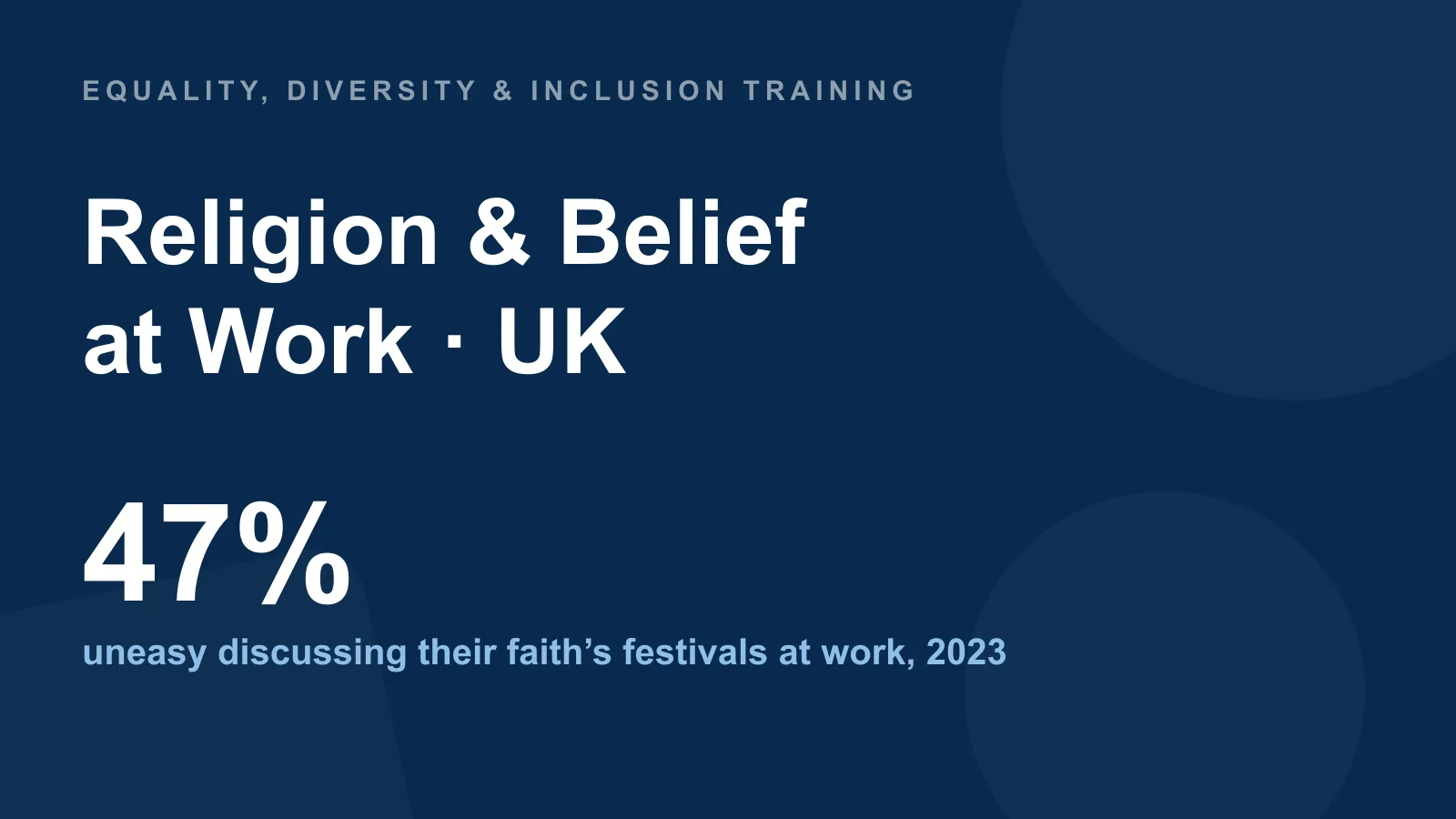
- 47% of workers with a faith did not feel comfortable discussing the religious festivals they celebrate at work (Pearn Kandola Religion at Work Report, 6,315 respondents, 2023).
- 64% of the 3,433 respondents who wear religious dress or symbols were not comfortable wearing them in the workplace (Pearn Kandola, 2023).
- 19% said a request for annual leave for a religious holiday or festival had been rejected (Pearn Kandola, 2023).
- 32% of those who had shared their religious beliefs at work had then experienced an adverse backlash (Pearn Kandola, 2023).
- 47% / 36% of Jewish and Muslim employees respectively said discrimination at work had increased since 7 October 2023 (Pearn Kandola, published October 2024).
- 46.2% of England & Wales identified as Christian — below half for the first time — with 37.2% reporting no religion and 6.5% Muslim (ONS Census 2021).
- 38% said their organisation could do more to be inclusive of people of different faiths (Pearn Kandola, 2023).
These are the latest figures available as of July 2026. The refresh cadence here is editorial rather than release-driven: Census religion data is decennial (next around 2031), the core Pearn Kandola surveys are irregular one-offs, and the Civil Service religion breakdown refreshes annually — so this page is reviewed each year and updated when any new faith-at-work survey or Civil Service release lands.
How common is religious discrimination at work in the UK?
Around one million UK workers — roughly 3% of the workforce — have reported suffering some form of religious discrimination, according to a ComRes survey for the Faith Research Centre cited in the CIPD’s religion and belief viewpoint (survey conducted 2017). It remains the most widely quoted headline figure for the prevalence of faith-based discrimination in British workplaces, even though it now sits some years back.
The more recent and far larger evidence base comes from Pearn Kandola’s Religion at Work Report, which surveyed 6,315 respondents and is the largest UK study of its kind. Rather than a single discrimination rate, it measures the texture of religious experience at work — comfort, disclosure, dress, holidays and backlash — and finds unease is widespread. 47% of workers with a faith did not feel comfortable discussing the religious festivals they celebrate at work, and 38% said their organisation could do more to be inclusive of people of different faiths (2023). Where discrimination is a protected characteristic, religion or belief is one of the nine set out in the Equality Act 2010.
How comfortable are people expressing their religion at work?
64% of the 3,433 respondents who wear religious dress or symbols were not comfortable wearing them in the workplace (Pearn Kandola, 2023) — the starkest single indicator that manifesting a faith openly still carries a perceived cost at work. That discomfort is not paranoia: 32% of those who had shared their religious beliefs at work reported experiencing an adverse backlash as a result (2023).
The chilling effect compounds. When nearly half of people with a faith are uneasy simply mentioning their festivals, and almost two-thirds hesitate over visible dress or symbols, a large share of the workforce is effectively managing its religious identity down to avoid friction. For employers, the practical read-across is that low visible expression is not evidence of an inclusive culture — it can be the opposite. Religious dress and manifestation are areas where employers can apply proportionate limits, but the burden is on them to justify any restriction; Acas sets out the framework in its religion or belief discrimination guidance (last updated October 2024).
Which religious groups are most likely to have holiday requests refused?
19% of respondents said a request for annual leave for a religious holiday or festival had been rejected (Pearn Kandola, 2023) — but that headline masks a sharp disparity by faith. Refusal of a religious-holiday request without good reason ranged from 2% for Christian employees up to 31% for Muslim employees (2023). Because most UK statutory and customary holidays already align with the Christian calendar, employees of other faiths are structurally more likely to need a discretionary request in the first place — and more likely to have it turned down.
| Faith group | Holiday request refused without good reason |
|---|---|
| Christian | 2% |
| Buddhist | 14% |
| Jewish | 20% |
| Hindu | 23% |
| Sikh | 25% |
| Muslim | 31% |
Figures are from the Pearn Kandola Religion at Work Report (2023), showing the share in each group who said a religious-holiday leave request had been refused without good reason. A Christian employee is roughly fifteen times less likely than a Muslim employee to have such a request declined — a gap that a well-drafted religious-observance and annual-leave policy is designed to close. Refusing leave for a religious festival can amount to indirect discrimination if it cannot be objectively justified.
Did religious discrimination at work rise after 7 October 2023?
47% of Jewish and 36% of Muslim employees said discrimination at work had increased since 7 October 2023, according to Pearn Kandola’s Antisemitism & Islamophobia at Work study of more than 1,000 Jewish and Muslim employees (published October 2024). The same study found that 39% of Jewish and 24% of Muslim employees had personally experienced discrimination since that date — a marked, measurable step-change tied to events outside the workplace spilling into it.
Under-reporting is the second half of the picture. Only 29% of Jewish and 16% of Muslim employees who faced incidents reported them to HR (2024), meaning the large majority of episodes never reach a formal channel. That gap between prevalence and reported cases is a warning against reading low internal complaint volumes as low incidence — and a reason employers cannot rely on HR caseloads alone to gauge the climate for religious minorities. (The underlying report is a registration-gated PDF; the figures here follow Pearn Kandola’s published summary of it.)
What does Census 2021 show about religion in the population?
For the first time, fewer than half of people in England and Wales described themselves as Christian: 46.2% (27.5 million), according to the ONS Census 2021 religion bulletin (fieldwork March 2021, published November 2022). ‘No religion’ was the second-largest response at 37.2% (22.2 million), followed by Muslim at 6.5% (3.9 million) and Hindu at 1.7% (1.0 million).
This demographic shift is the backdrop to everything else on this page. A workforce in which a plurality — not a majority — identifies as Christian, and in which more than a third report no religion at all, is one where assumptions about a shared default faith no longer hold. Inclusion policies built around a single dominant tradition are increasingly out of step with the actual composition of the labour market, which is why the demographic baseline matters as much as the experience data.
| Religion (England & Wales) | Share, 2021 | People |
|---|---|---|
| Christian | 46.2% | 27.5m |
| No religion | 37.2% | 22.2m |
| Muslim | 6.5% | 3.9m |
| Hindu | 1.7% | 1.0m |
Source: ONS Census 2021, Religion, England & Wales. The Cabinet Office also publishes an annual Civil Service employment breakdown by religion or belief (data as at 31 March 2023), giving a recurring single-employer view of faith composition across the largest UK public-sector workforce.
What does the Equality Act 2010 say about religion or belief?
Religion or belief is one of the nine protected characteristics under the Equality Act 2010, covered in section 10 of the Act — and it protects both holding a religion or belief and having none. Acas guidance is clear that the protection extends to any religion, any religious or philosophical belief, and a lack of belief, provided a philosophical belief meets the established legal threshold for seriousness and cogency.
The Act prohibits direct and indirect discrimination, harassment and victimisation connected to religion or belief. In practice, the workplace flashpoints map onto the data above: refusing religious-holiday leave, restricting religious dress, and failing to address faith-based harassment are the recurring risk areas. There is separate evidence of a rising trend in belief-related litigation — analysis by TWM Solicitors reported by People Management found protected-belief tribunal cases rose from 6 in 2021 to 29 in 2025, with religion the most common belief type at 31% of the past year’s cases (published June 2026). We treat that as a direction-of-travel signal only; the religion-or-belief tribunal caseload itself lives on our workplace discrimination statistics page to avoid duplicating it here.
Frequently asked questions
How common is religious discrimination at work in the UK?
Around one million UK workers — roughly 3% of the workforce — have reported suffering some form of religious discrimination, according to a 2017 ComRes survey cited by the CIPD. More recent survey work by Pearn Kandola (6,315 respondents, 2023) shows widespread unease rather than a single discrimination rate: 47% of workers with a faith felt uncomfortable discussing their religious festivals at work.
Which religious groups are most likely to have holiday requests refused at work?
Muslim employees are most likely: 31% said a religious-holiday leave request had been refused without good reason, versus just 2% of Christian employees, with Sikh (25%), Hindu (23%), Jewish (20%) and Buddhist (14%) employees in between (Pearn Kandola, 2023). Overall, 19% of respondents had had such a request rejected.
Did religious discrimination at work rise after 7 October 2023?
Survey evidence points that way. In Pearn Kandola’s Antisemitism & Islamophobia at Work study (published October 2024), 47% of Jewish and 36% of Muslim employees said workplace discrimination had increased since 7 October 2023, and 39% of Jewish and 24% of Muslim employees had personally experienced discrimination since then. Most incidents went unreported to HR.
What does the Equality Act 2010 say about religion or belief discrimination at work?
Religion or belief is a protected characteristic under section 10 of the Equality Act 2010, covering any religion, any religious or philosophical belief, and a lack of belief. The Act bans direct and indirect discrimination, harassment and victimisation — so refusing religious-holiday leave or restricting religious dress can be unlawful unless the employer can objectively justify it.
How many people in the UK are religious?
In the 2021 Census for England and Wales, 46.2% identified as Christian (27.5 million) — below half for the first time — 37.2% reported no religion (22.2 million), 6.5% were Muslim (3.9 million) and 1.7% Hindu (1.0 million).
Related guides
- Workplace Discrimination Statistics UK: Tribunal Claims, Prevalence & Protected Characteristics
- Ethnicity Pay Gap Statistics UK
- The Nine Protected Characteristics Under the Equality Act 2010
- Equality Act 2010: The Complete UK Guide
- Equality, Diversity and Inclusion: A UK Guide
Sources & references
- ONS — Religion, England & Wales: Census 2021 (published 29 November 2022)
- Pearn Kandola — Religion at Work Report (6,315 respondents, published 2023)
- Pearn Kandola — Antisemitism & Islamophobia at Work 2024 (1,000+ Jewish/Muslim employees, published 1 October 2024)
- Acas — Religion or belief discrimination (last updated 29 October 2024)
- Cabinet Office — Civil Service employment by religion or belief (as at 31 March 2023)
- CIPD — Religion and belief viewpoint (cites 2017 ComRes ~1m-workers figure)
- People Management — Protected-belief tribunal cases rise, TWM Solicitors analysis (published 2 June 2026)
- Religious Freedom & Business Foundation — New data on faith in the workplace (March 2026)
Religious-holiday leave, faith-based harassment and religious dress are the recurring risk areas — make sure your team understands religion or belief under the Equality Act 2010 before an issue arises.
Explore the Equality, Diversity & Inclusion course →
Mark writes about equality, diversity and inclusion, UK workplace compliance and accredited online training for Equality, Diversity & Inclusion Training, part of Online CPD Academy.