
EDI — equality, diversity and inclusion — is the framing most UK workplaces now use for the work that used to sit under ‘equality and diversity’. The addition of ‘inclusion’ is meaningful: it reflects a recognition that diverse hiring alone doesn’t deliver outcomes if the people brought in don’t experience the workplace as one where they can fully contribute.
This guide explains what EDI actually means, how the three strands relate to each other, how the UK framing differs from the more familiar American ‘DEI’, and what the current state of EDI practice looks like in 2026 — including the impact of the US backlash, the Supreme Court’s April 2025 ruling on sex, and the changes coming into force under the Employment Rights Act 2025.
What EDI stands for
EDI stands for equality, diversity and inclusion. The order matters: equality comes first because in UK law and practice it’s the foundational principle that the rest sits on. Diversity is the description of who is present; inclusion is the experience of those present.
The acronym has been in widespread UK use since around the mid-2010s, when ‘inclusion’ began appearing in policy and strategy documents that had previously talked only about ‘equality and diversity’. The Chartered Institute of Personnel and Development, the main UK industry body for HR, now uses EDI as its default term.
The three strands
Each strand has a distinct meaning. Pulling them apart helps explain what EDI is actually trying to do.
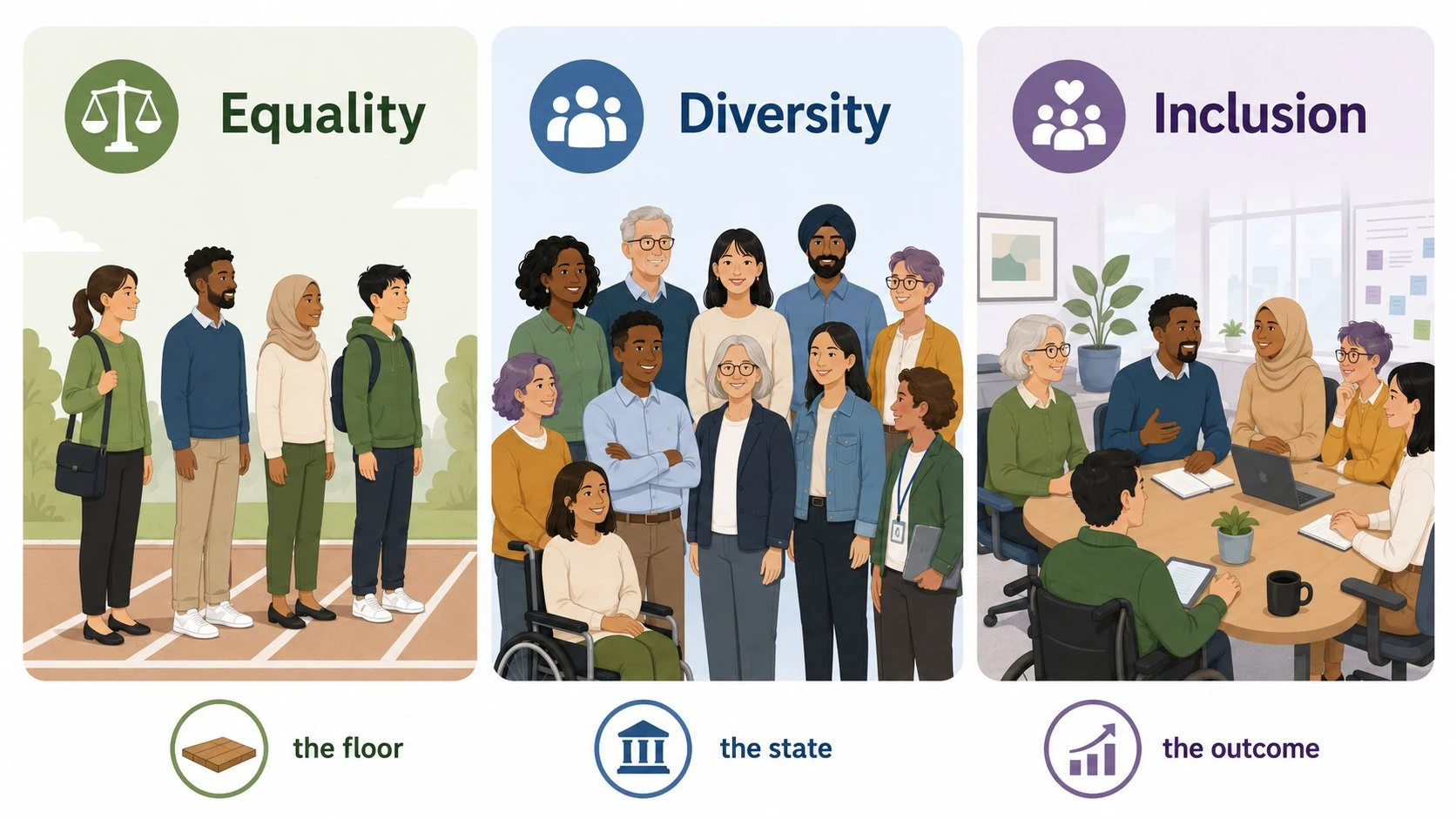
Equality is the principle that people should be treated fairly, without unjustified disadvantage because of who they are. UK law expresses this through the Equality Act 2010, which protects nine characteristics from discrimination, harassment and victimisation. Equality is the baseline — the legal floor that no employer is allowed to go below. For more, see our guide to what equality means.
Diversity is the presence and value of difference in a group — visible differences such as ethnicity, sex and age, and invisible differences such as religion, sexual orientation, neurodivergence and socio-economic background. Diversity describes a state rather than a value: a workforce is more or less diverse depending on who is in it. For more, see our guide to what diversity means.
Inclusion is the experience of the people in a diverse group: whether they can speak, contribute, disagree and develop without unspoken barriers. Inclusion is what makes diversity stable. A workplace can be diverse and not inclusive — and several are — with the result that the people brought in through diverse recruitment then drift out because the culture isn’t built for them.
A useful framing: equality is the floor, diversity is the state, inclusion is the outcome.
EDI vs DEI vs EDIB
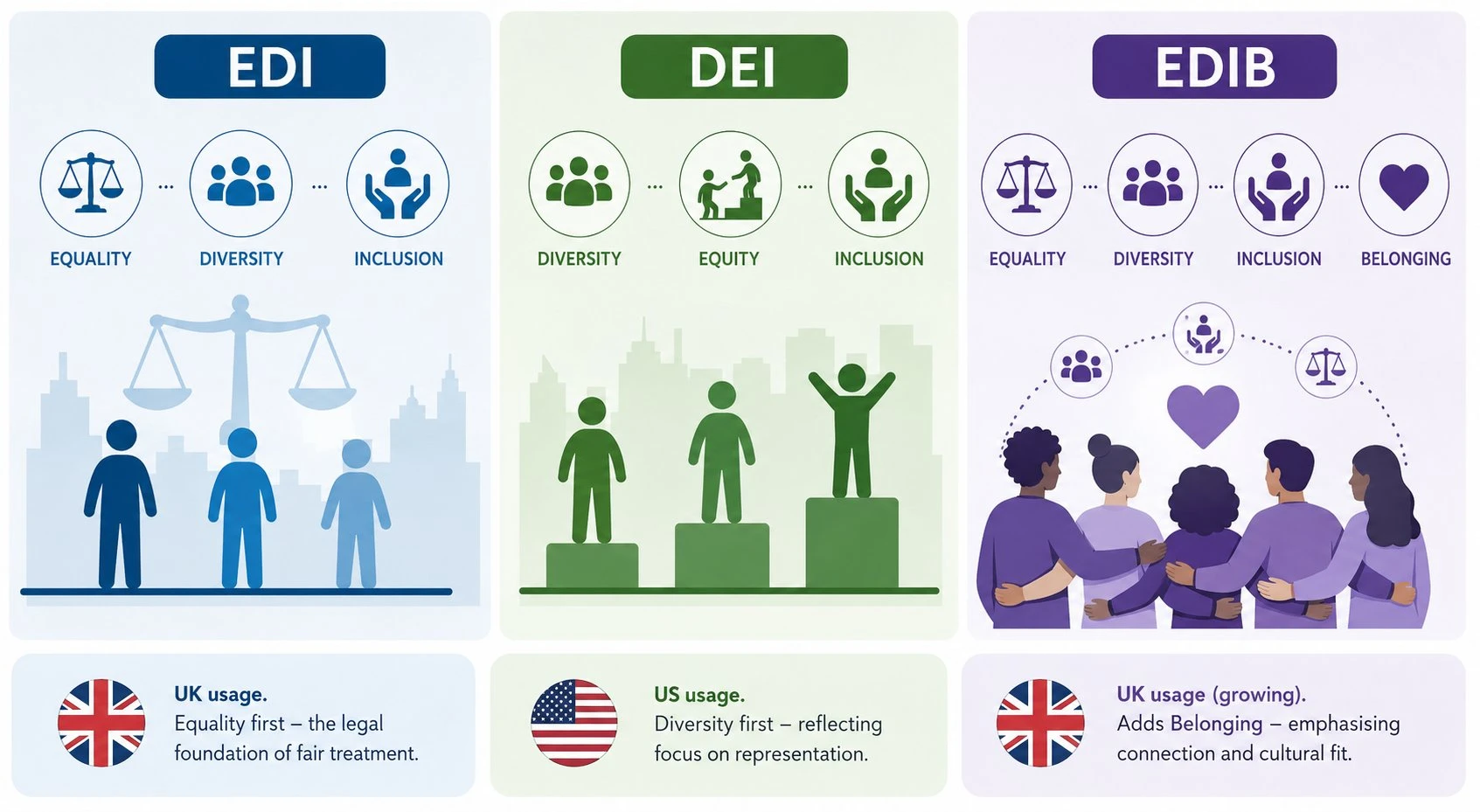
UK usage is EDI. American usage is DEI — diversity, equity and inclusion. The two are similar but not identical.
The order is different. DEI puts diversity first, reflecting the American emphasis on hiring composition. EDI puts equality first, reflecting the UK emphasis on the legal floor of fair treatment.
The middle term is different. DEI uses ‘equity’ rather than ‘equality’. Equity is about giving people what they each need to reach a comparable outcome; equality is more often about giving them the same starting point. UK law uses ‘equality’ as its primary term, but builds in equity-style provisions such as reasonable adjustments for disabled people. We unpack this fully in equality vs equity.
Some UK organisations have started using EDIB — equality, diversity, inclusion and belonging — which adds a fourth strand emphasising the felt experience of being part of a group rather than merely being included in it. Belonging overlaps heavily with inclusion but goes a step further, focusing on emotional connection to the organisation. It’s a less established term than EDI and isn’t universal.
The choice of acronym signals something. UK organisations using DEI are often US-headquartered or US-influenced; organisations using EDIB are usually trying to communicate a deeper cultural commitment. Most UK-headquartered organisations use EDI as the default.
Why ‘inclusion’ was added to ‘equality and diversity’
The shift from ‘equality and diversity’ to ‘equality, diversity and inclusion’ wasn’t decorative. It came from a practical recognition that demographic diversity in itself didn’t produce the outcomes organisations were after.
The pattern was that companies would invest heavily in recruiting under-represented groups, see encouraging numbers in their hiring statistics, and then watch retention figures show that the same under-represented groups left at higher rates than the rest of the workforce. Exit interviews and engagement surveys repeatedly pointed to the same issue: people had joined but hadn’t felt welcome, hadn’t been able to bring their full perspective, hadn’t progressed at the same rate as their peers, and hadn’t been able to challenge ideas without paying a social cost for it.
Inclusion is the work of changing this. It’s about meeting structures, decision processes, performance criteria, day-to-day language, social rituals, and the unwritten codes of who gets listened to. It’s slower, harder and less photogenic than diversity recruitment, and it’s where most of the actual work of an effective EDI programme now sits.
EDI in the UK workplace today
A few things are true of EDI practice in 2026 that weren’t true a few years earlier.
The legal framework has tightened
Section 40A of the Equality Act, inserted by the Worker Protection (Amendment of Equality Act 2010) Act 2023, came into force on 26 October 2024. Employers have an active duty to take reasonable steps to prevent sexual harassment of their workers. Tribunals can uplift discrimination compensation by up to 25% where the duty hasn’t been met. The Employment Rights Act 2025 will raise the standard further in October 2026, requiring ‘all reasonable steps’ and extending employer liability to third-party harassment across all protected characteristics, not just sex.
The political environment has shifted
Late 2024 and early 2025 saw a sharp shift in the United States, with the second Trump administration scaling back federal DEI programmes and several large US companies following suit. The effect in the UK has been more mixed. Some UK subsidiaries of US companies have retrenched in line with their parent organisations. Many UK-headquartered businesses have either recommitted publicly or quietly continued without changing course. The Chartered Institute of Personnel and Development’s ‘Resetting EDI and Reaffirming Inclusion’ report, published in May 2025, captures this picture: more UK organisations are talking about ‘inclusion’ specifically, partly to distance themselves from a politicised ‘DEI’ label, and partly because inclusion is where the harder work sits anyway.
The legal status of sex has been clarified
The Supreme Court’s ruling in For Women Scotland Ltd v The Scottish Ministers on 16 April 2025 confirmed that ‘sex’, ‘man’ and ‘woman’ in the Equality Act mean biological sex. A Gender Recognition Certificate does not change a person’s legal sex for the purposes of the Act. The Equality and Human Rights Commission is updating its statutory guidance accordingly. Transgender people remain protected from discrimination under the separate protected characteristic of gender reassignment.
Measurement has become standard practice
Gender pay gap reporting has been mandatory for employers with 250 or more staff since 2017. Ethnicity pay gap reporting is currently voluntary but increasingly common, and the UK Government has indicated it intends to make it mandatory through the proposed Equality (Race and Disability) Bill. Most large employers now publish at least gender pay data and often ethnicity, disability and (less commonly) sexual orientation data.
Common EDI initiatives
EDI work in UK organisations typically includes a recognisable set of activities. Done well, they reinforce each other; done piecemeal, they can feel performative.
Equality and diversity policy
The written commitment, the framework that the rest hangs on. Covered in detail in our equality and diversity policy guide.
Inclusive recruitment
Job adverts written for the actual role rather than for cultural-fit signalling; structured interviews; diverse shortlists where the pool allows; transparent criteria. The aim is to widen the pool of qualified candidates without compromising on capability.
Training
Mandatory at induction, refreshed periodically, tailored to role. The strongest training is rooted in current case law and the current legal framework — including the 2024 and 2026 changes — and treats equality and diversity as professional skills rather than political statements.
Employee resource groups (ERGs) or staff networks. Voluntary groups organised around shared identity or interest — women’s networks, ethnic minority networks, LGBT+ networks, disability networks, neurodivergent networks, working-parent networks. Effective ERGs have leadership backing, named budgets and a route into decision-making. Tokenistic ERGs become a substitute for leadership action rather than a complement to it.
Reasonable adjustments processes
Clear routes for disabled employees to request adjustments, trained managers, named contacts, and a record-keeping system that doesn’t require people to keep re-explaining their needs. See our reasonable adjustments guide.
Pay gap reporting and action
The reporting itself is mandatory for some employers and voluntary for others, but the more important step is using the data to identify and address the causes of any gap.
Measuring EDI
If EDI is to be more than a brand statement, it needs measurement. Three kinds matter.
Demographic data
Who works here? Who applies, who is shortlisted, who is hired, who progresses, who leaves? Broken down by protected characteristic where the population is large enough to make the data meaningful without identifying individuals.
Outcome data
Pay gaps, promotion rates, performance distribution, retention rates — all broken down by protected characteristic. This is where the patterns show up.
Experience data
Staff survey responses on whether people feel respected, heard, able to be themselves, able to disagree, able to develop. Engagement and inclusion metrics are usually correlated with the outcome data, but tell a more immediate story.
For public sector organisations, equality monitoring data is part of the Public Sector Equality Duty framework. Equality impact assessments draw on the same data when assessing the equality consequences of major decisions.
Where to start
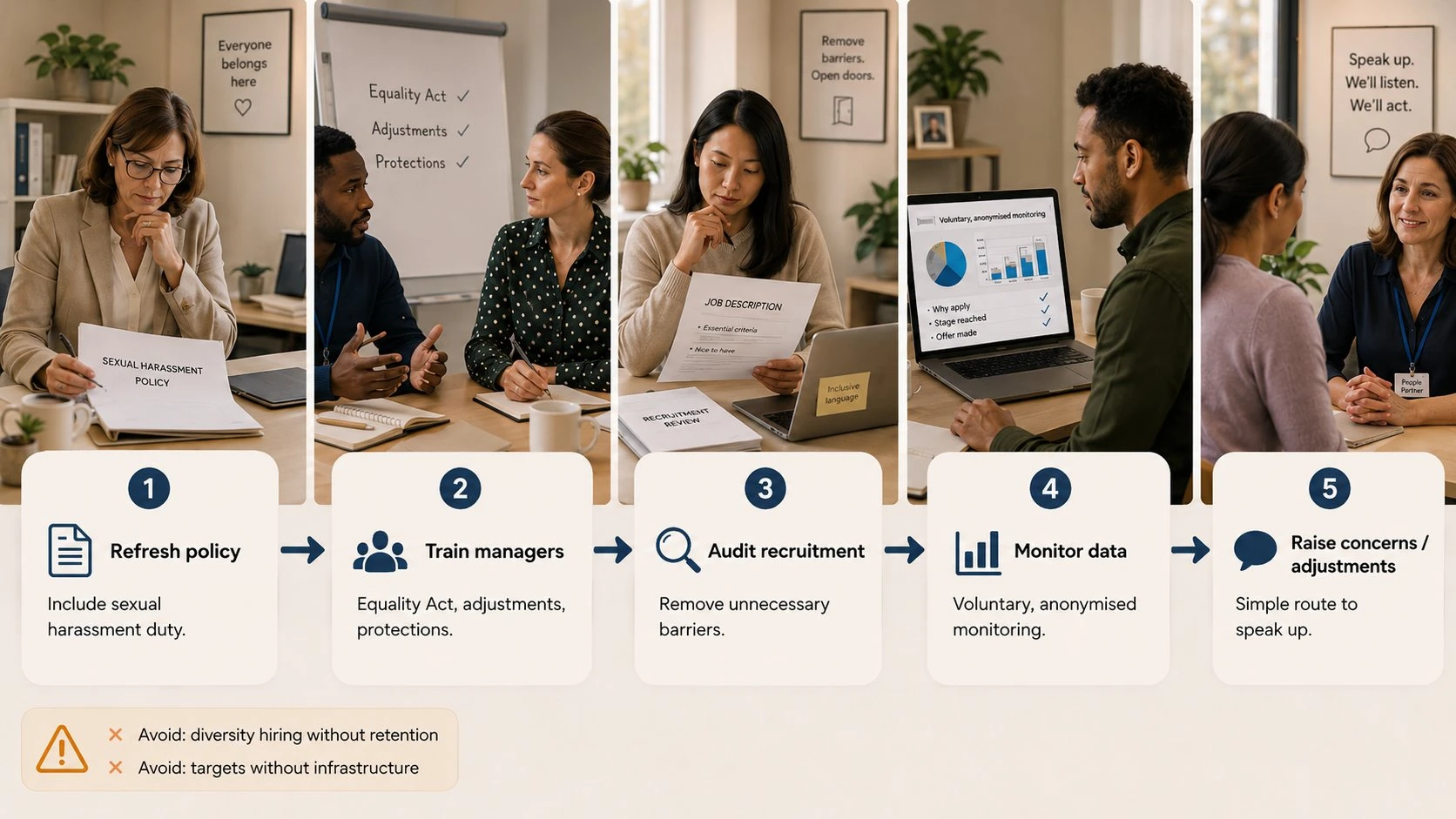
For organisations that haven’t done much in this space, a workable starting sequence is:
Step 1. Write or refresh the equality and diversity policy, making sure it reflects the post-October 2024 sexual harassment duty.
Step 2. Train managers on the Equality Act, including the duty to make reasonable adjustments and the current state of the sex and gender reassignment protections.
Step 3. Audit recruitment processes for the year ahead and remove unnecessary barriers.
Step 4. Begin or refresh equality monitoring data collection on a voluntary, anonymised basis.
Step 5. Set up a simple route for employees to raise concerns or request adjustments, and make sure managers know how to handle them.
What not to do is launch a ‘diversity hiring’ programme without thinking about retention, or commit publicly to numerical targets without the underlying infrastructure to support new hires once they arrive.
Frequently asked questions
What does EDI stand for?
EDI stands for equality, diversity and inclusion. It’s the standard UK framing for workplace work in this area.
What is the difference between EDI and DEI?
EDI is the UK framing — equality, diversity, inclusion — putting equality first and using ‘equality’ as the term for fair treatment. DEI is the American framing — diversity, equity, inclusion — putting diversity first and using ‘equity’ as the term for fair outcomes. The two overlap heavily but the emphasis and legal context differ.
Why is inclusion important?
Because diversity without inclusion produces turnover and disengagement. Inclusion is the experience of being able to contribute fully once you’re in the room — and it’s what makes diverse hiring deliver actual outcomes rather than just better statistics.
Is EDI legally required in the UK?
Equality is — the Equality Act 2010 imposes specific duties on employers and service providers. Diversity and inclusion as such are not directly required, but they are the practical means of meeting equality duties, and are increasingly expected by funders, regulators and partners.
What is an Employee Resource Group?
A voluntary group of employees organised around a shared identity, characteristic or interest — for example a women’s network, an ethnic minority network, an LGBT+ network or a disability network. Effective ERGs have leadership backing and a route into organisational decision-making.
How will the Employment Rights Act 2025 affect EDI?
From October 2026, employers will need to take ‘all reasonable steps’ to prevent sexual harassment (not just ‘reasonable steps’ as under the 2024 duty). Liability for third-party harassment will be reintroduced for all protected characteristics, not just sex. EDI policies, training and harassment-prevention practices will all need to be reviewed before then.
EDI is the workplace framing under which the rest of the cluster sits. The legal foundation is the Equality Act 2010; the conceptual base is equality and diversity. To translate the framework into practice across your organisation, our Equality, Diversity & Inclusion Training course delivers the full picture in a single programme, with current treatment of the 2024 and 2026 legal changes.
Related guides
- Equality and Diversity in Health and Social Care: A UK Guide
- Equality Act 2010: The Complete UK Guide
- The Nine Protected Characteristics Under the Equality Act 2010
Make sure your team understands equality, diversity and inclusion and the law behind it.
Explore the Equality, Diversity & Inclusion Training course →
Mark writes about equality, diversity and inclusion, workplace compliance and accredited online training for Equality, Diversity & Inclusion Training, part of Online CPD Academy.