
Neurodiversity has moved from the margins of HR policy to the centre of the UK equality conversation, and the numbers explain why. This page gathers the most reliable UK statistics on autism, ADHD, dyslexia and neurodivergence more broadly — prevalence estimates, the autism employment gap, NHS assessment waiting lists, workplace disclosure, and the sharp rise in neurodiversity-related employment tribunal claims. The figures are drawn from official and primary sources, including the Department for Work and Pensions, NHS England, the Adult Psychiatric Morbidity Survey, the government's Buckland Review of Autism Employment and analyses of Ministry of Justice tribunal records.
Key facts and figures
- ~1 in 7 people in the UK — roughly 15% — are estimated to be neurodivergent, though no official aggregate figure exists (ONS FOI, January 2026).
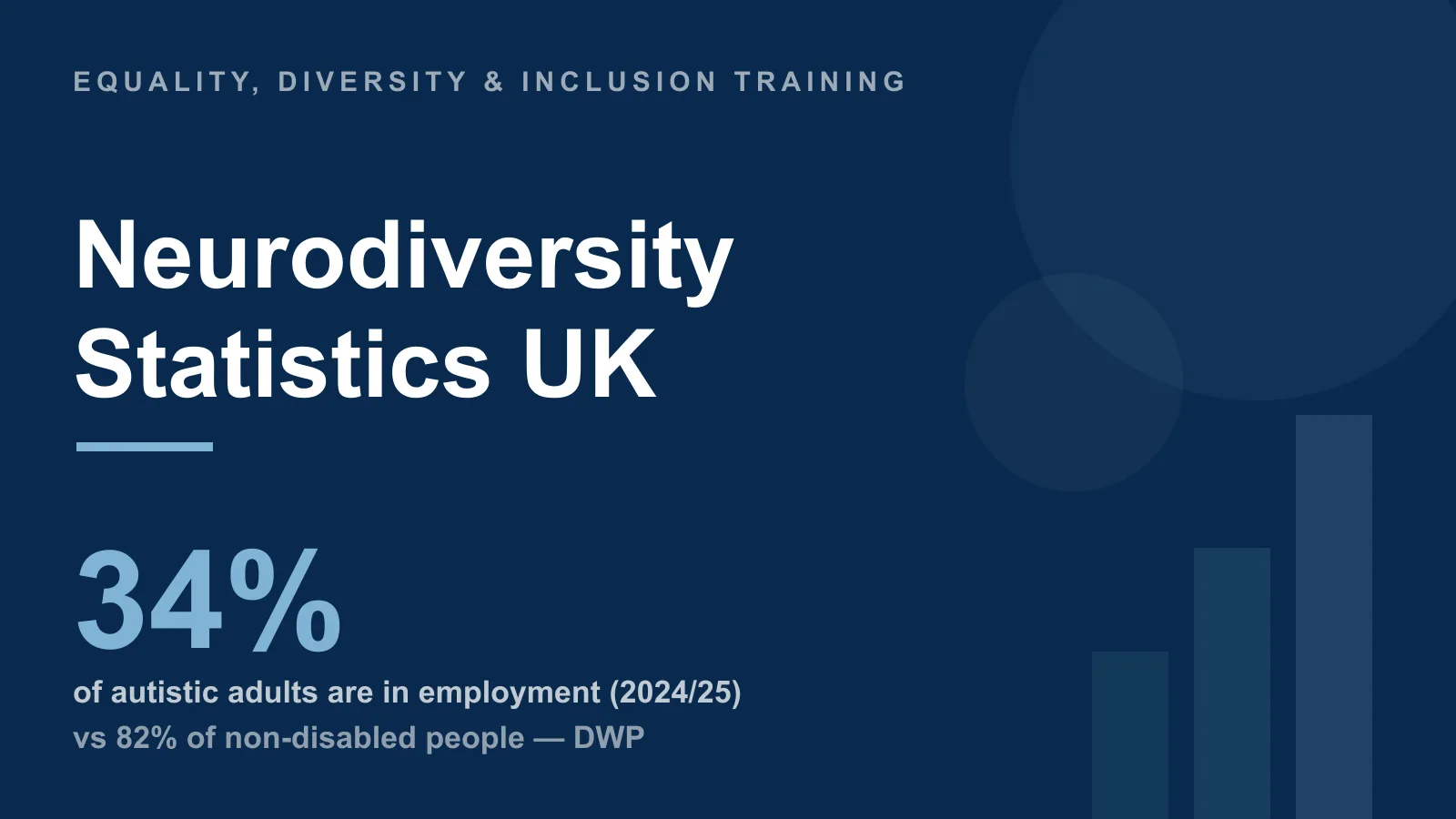
- 34.0% of disabled people with autism were in employment in 2024/25, against 82.0% of non-disabled people (DWP).
- 270,701 patients had an open NHS referral for suspected autism as of March 2026.
- 13.9% of adults in England screened positive for possible ADHD in 2023–24, but only around 1.8% reported a professional diagnosis.
- ~10% of the UK population is estimated to be dyslexic (British Dyslexia Association).
- 65% of neurodivergent employees fear discrimination from management if they disclose at work (Birkbeck, 2023).
- 517 employment tribunal decisions cited neurodiversity in 2025 — almost double the 265 recorded in 2020.
- 3.8% of UK job postings mentioned neurodiversity in December 2024, nearly four times the share in January 2018 (Indeed).
Figures are the latest available as of July 2026, and this page is updated when new data is released — chiefly the DWP's annual employment of disabled people series, NHS England's quarterly autism waiting time statistics and the Ministry of Justice's quarterly tribunal statistics.
| Measure | Figure | Data period |
|---|---|---|
| Estimated neurodivergent share of UK population | ~15% (around 1 in 7) — estimate only | ONS FOI, January 2026 |
| People estimated to be dyslexic | ~10% of the population | British Dyslexia Association, current |
| Employment rate — disabled people with autism | 34.0% | FY 2024/25 |
| Employment rate — all disabled people | 55.3% | FY 2024/25 |
| Employment rate — non-disabled people | 82.0% | FY 2024/25 |
| Open NHS referrals for suspected autism | 270,701 | March 2026 |
| Adults screening positive for possible ADHD | 13.9% (vs ~1.8% diagnosed) | 2023–24 |
| Tribunal decisions citing neurodiversity | 517, up from 265 in 2020 | 2025 |
How many people in the UK are neurodivergent?
Around 1 in 7 people in the UK — roughly 15%, or in the region of 10 million people — are estimated to be neurodivergent. The estimate is widely cited by NHS bodies and the Local Government Association, and covers conditions including autism, ADHD, dyslexia, dyspraxia, dyscalculia and Tourette's syndrome.
An important caveat comes straight from the statisticians. In a Freedom of Information response published on 30 January 2026, the Office for National Statistics confirmed that no official aggregate figure for neurodivergence exists in the UK. The "1 in 7" figure is a composite of condition-level research rather than the output of a single national survey, so it should always be presented as an estimate. Better official data is on the way: the ONS notes that the Annual Population Survey's harmonised health questions now capture autism and ADHD, with data covering October 2024 to September 2025.
Condition-level figures are firmer. The British Dyslexia Association estimates that around 10% of the population is dyslexic, making dyslexia the most common neurodivergent condition in the UK by most counts. For ADHD, the NHS-commissioned taskforce cites true prevalence of around 5% in children and 2–3% in adults (as of its June 2025 report), while autism, ADHD and dyslexia together account for the overwhelming majority of neurodiversity-related workplace cases reaching tribunal.
What is the autism employment gap in the UK?
Just 34.0% of disabled people with autism were in employment in the 2024/25 financial year, compared with 55.3% of all disabled people and 82.0% of non-disabled people, according to the DWP's official publication The employment of disabled people 2025. That is a gap of 48 percentage points against non-disabled workers — and autistic people remain far behind the average for disabled people as a whole.
The government's Buckland Review of Autism Employment, published in February 2024, put the headline even more starkly: only around 3 in 10 autistic people are in work. The review also found that autistic graduates are twice as likely to be unemployed after 15 months as non-disabled graduates, with only 36% finding full-time work. Its recommendations — covering recruitment practices, workplace adjustments and staff training — prompted a government-backed neurodiversity expert panel, launched in January 2025, to carry the work forward.
The same DWP series and the House of Commons Library's autism employment briefing (CBP-10389, updated in 2025) are the places to watch for movement in these figures: the employment data refreshes annually, so the gap can be tracked year by year.
How common is ADHD in the UK?
13.9% of adults in England — roughly 1 in 7 — screened positive for possible ADHD in 2023–24, according to the Adult Psychiatric Morbidity Survey published by NHS England Digital. Yet only around 1.8% of adults reported having received a professional ADHD diagnosis, one of the largest gaps between screening and diagnosis in any UK health dataset.
Recorded diagnosis rates are lower still. NHS England's ADHD management information shows that 1.6% of males and 0.9% of females in England had a recorded ADHD diagnosis in 2024/25. The Independent ADHD Taskforce, whose first report was published in June 2025, cites true prevalence of around 5% in children and 2–3% in adults — several times the recorded rate, which explains the surge in assessment demand now working through NHS services.
For employers, the practical reading is simple: on the survey evidence, most adults with ADHD-consistent traits are undiagnosed, and many will never disclose. Workplace policies that only respond to a formal diagnosis will miss most of the people they are meant to support.
How long are NHS autism assessment waiting lists?
270,701 patients had an open referral for suspected autism as of March 2026, according to NHS England's quarterly autism waiting time statistics. Around 89–90% of those open referrals had already waited longer than the 13-week standard set by NICE for a first assessment appointment — meaning the overwhelming majority of people seeking an autism assessment are outside the recommended window.
The waiting list matters for workplaces as much as for health services. With referral volumes at record levels, a growing share of the workforce is awaiting assessment or self-identifying as neurodivergent without a confirmed diagnosis. Legally, that is not a barrier to support: protection under the Equality Act 2010 depends on the effect a condition has on someone's day-to-day life, not on whether a formal diagnosis has been issued, and the duty to make reasonable adjustments can apply while someone is still on a waiting list.
Do neurodivergent employees feel safe to disclose at work?
65% of neurodivergent employees fear discrimination from management if they disclose their neurodivergence at work, and 55% fear discrimination from colleagues, according to research by Birkbeck, University of London for Neurodiversity in Business, published in 2023. The study surveyed 990 neurodivergent employees and 127 employers — one of the largest UK samples on workplace neurodiversity to date.
The disclosure gap is why headline prevalence estimates and what employers see on paper rarely match. If roughly 1 in 7 people is neurodivergent but most fear the consequences of saying so, the number of declared neurodivergent staff in any organisation will dramatically understate the real figure. Many employees mask instead — expending effort appearing neurotypical rather than asking for the adjustments that would let them work at their best. Building a culture where disclosure feels safe, backed by manager training and a clear adjustments process, is the single most direct response to this statistic.
Are neurodiversity employment tribunal claims rising?
Employment tribunal decisions citing neurodiversity almost doubled in five years, from 265 in 2020 to 517 in 2025 — a 95% increase — according to Irwin Mitchell's February 2026 analysis of Ministry of Justice tribunal records. The rise is accelerating rather than levelling off, with a 19% increase between 2024 and 2025 alone.
The condition-level breakdown is more dramatic still. Comparing the first half of 2020 with the first half of 2025, tribunal decisions citing ADHD rose from 6 to 51 — a 750% increase — while autism-related decisions rose 96% and dyslexia-related decisions 78% over the same period. These cases are typically brought as disability discrimination claims, most often centring on a failure to make reasonable adjustments, and discrimination awards are uncapped.
The drivers are the same ones running through this page: rising diagnosis and self-identification, greater awareness of Equality Act rights, and workplaces whose processes have not kept pace. For the wider tribunal picture — claim volumes, jurisdictions and average awards across all protected characteristics — see our companion page on workplace discrimination statistics.
Are employers becoming more neuroinclusive?
3.8% of UK job postings mentioned neurodiversity-related keywords in December 2024, up from around 1% in January 2018 — nearly a fourfold increase, according to Indeed Hiring Lab UK's February 2025 analysis. Employer language, at least, is changing fast.
Whether practice is keeping up with the language is the open question the rest of this page answers: the autism employment rate remains at 34.0% (2024/25), two-thirds of neurodivergent employees still fear disclosing, and tribunal claims are climbing. The direction of travel is positive — the Buckland Review's expert panel is active, inclusive-hiring language is spreading and awareness has never been higher — but the gap between stated intent and measured outcomes remains the defining feature of the UK's neurodiversity statistics in 2026.
Frequently asked questions
What percentage of the UK population is neurodivergent?
Around 15% — roughly 1 in 7 people — is the most widely used estimate, covering conditions such as autism, ADHD, dyslexia and dyspraxia. There is no official figure: the ONS confirmed in January 2026 that no aggregate neurodivergence statistic exists, so the 1 in 7 figure should always be treated as an estimate.
How many autistic people are in employment in the UK?
34.0% of disabled people with autism were in employment in 2024/25 (DWP), compared with 55.3% of all disabled people and 82.0% of non-disabled people. The Buckland Review of Autism Employment (February 2024) put it at around 3 in 10 autistic people in work.
How common is ADHD in UK adults?
The Adult Psychiatric Morbidity Survey 2023–24 found 13.9% of adults in England screened positive for possible ADHD, but only around 1.8% reported a professional diagnosis. NHS England's Independent ADHD Taskforce cites true prevalence of 2–3% in adults and around 5% in children.
How many people in the UK have dyslexia?
The British Dyslexia Association estimates that around 10% of the UK population is dyslexic — about 1 in 10 people — making it the most common neurodivergent condition in the UK.
Is neurodivergence covered by the Equality Act 2010?
Yes, where a condition has a substantial and long-term adverse effect on a person's ability to carry out normal day-to-day activities, it meets the Act's definition of disability. Protection does not require a formal diagnosis, and employers are under a duty to make reasonable adjustments for neurodivergent staff who meet the definition.
Why are neurodiversity tribunal claims rising?
Tribunal decisions citing neurodiversity nearly doubled from 265 in 2020 to 517 in 2025 (Irwin Mitchell). Rising diagnosis and self-identification, greater awareness of Equality Act rights and slow employer adaptation — particularly on reasonable adjustments — are the main drivers.
The statistics on this page describe a workforce that is far more neurodiverse than most organisations realise, and a legal environment that increasingly expects employers to respond. The foundations are covered in our guides to the Equality Act 2010, the nine protected characteristics and neurodiversity at work. To give your team the practical understanding behind these numbers — inclusive everyday practice, disclosure-safe culture and the duty to make adjustments — our Equality, Diversity & Inclusion Training course covers neurodiversity as part of the full Equality Act framework.
Related guides
- Workplace Discrimination Statistics UK: Tribunal Claims, Prevalence & Protected Characteristics
- Sexual Harassment at Work Statistics UK: Prevalence, Reporting Rates & the New Preventative Duty
- Neurodiversity at Work: A UK Employer's Guide
- Reasonable Adjustments Under the Equality Act 2010: A UK Employer's Guide
- The Nine Protected Characteristics Under the Equality Act 2010
- Equality Act 2010: The Complete UK Guide
Sources & references
- Department for Work and Pensions — The employment of disabled people 2025
- NHS England Digital — Autism Waiting Time Statistics
- NHS England Digital — Adult Psychiatric Morbidity Survey 2023–24: attention deficit hyperactivity disorder
- NHS England — Report of the Independent ADHD Taskforce, Part 1
- GOV.UK — The Buckland Review of Autism Employment: report and recommendations
- Birkbeck, University of London — Neurodiversity at Work research report (with Neurodiversity in Business)
- Irwin Mitchell — Employment tribunal cases linked to neurodiversity almost double in five years
- Indeed Hiring Lab UK — Neurodiversity-inclusive postings are rising
- Office for National Statistics — FOI: Prevalence of neurodivergence among the adult population in the United Kingdom
- House of Commons Library — Autism policy and services: employment (CBP-10389)
- British Dyslexia Association — What is dyslexia?
Put the numbers into practice — train your team to support neurodivergent colleagues and meet Equality Act duties.
Explore the Equality, Diversity & Inclusion course →
Mark writes about equality, diversity and inclusion, workplace compliance and accredited online training for Equality, Diversity & Inclusion Training, part of Online CPD Academy.