
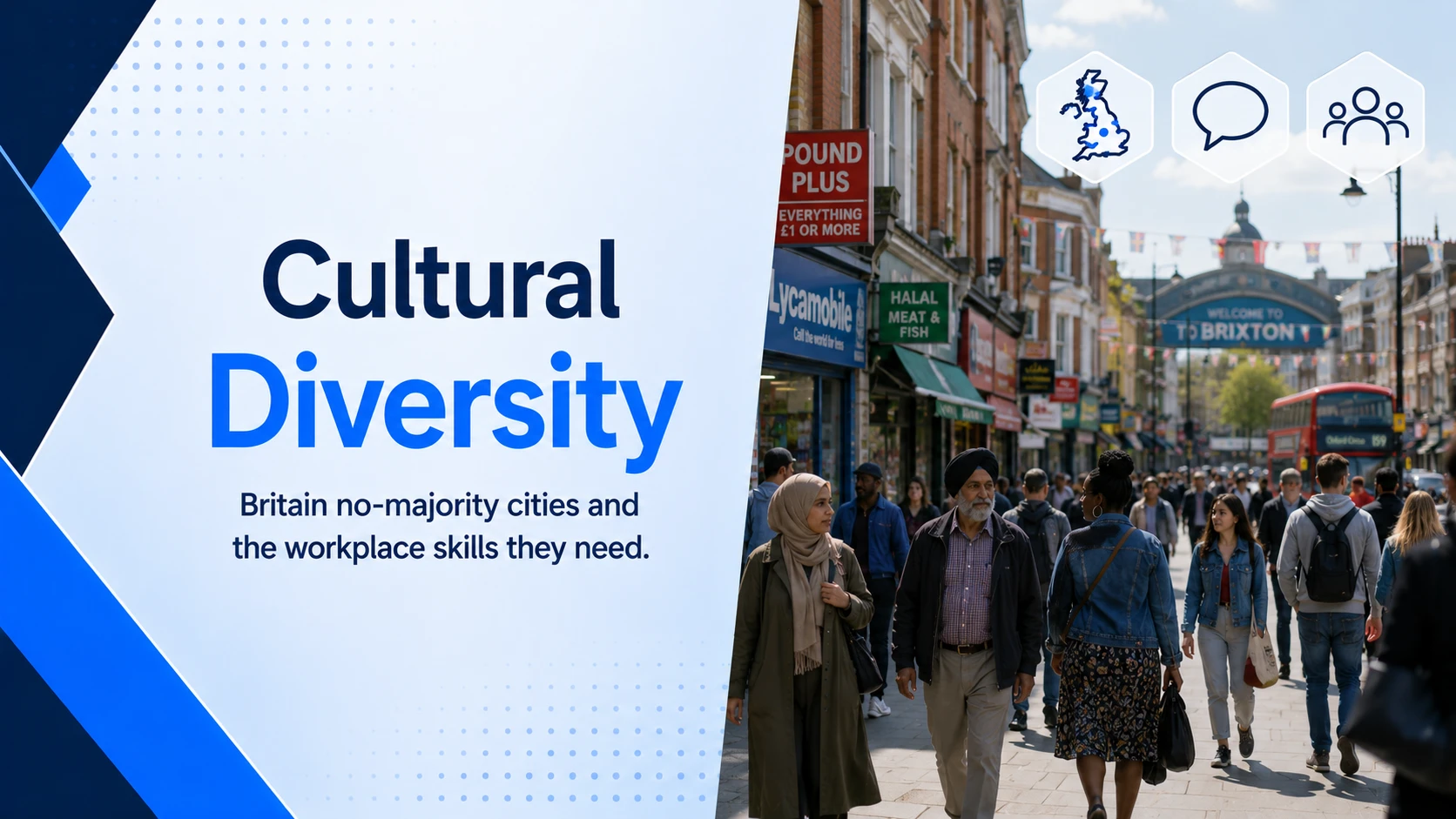
Cultural diversity is the presence of different cultural, ethnic, national and religious backgrounds within a society or organisation. It's a more specific concept than diversity in general — focused on culture as a distinguishing dimension — and it carries particular weight in the UK because Britain has become substantially more culturally diverse over the last two generations, and because that change is uneven across regions, cities and institutions.
This guide sets out what cultural diversity actually means, the current demographic picture from the 2021 Census, what cultural diversity looks like at work and in public services, the legal framework that governs it, and current thinking on language, terminology and cultural competence.
What cultural diversity means
Culture is the shared patterns of belief, behaviour, language, custom, food, dress and tradition that mark a group as distinct. Cultural diversity is the presence of more than one such pattern within a population. It overlaps with — but isn't identical to — ethnicity, nationality, race and religion. A British-born Sikh and a Punjabi-born Sikh share religious heritage but different national experiences. Two people of Irish descent might share ethnicity but practise different faiths, or none. A White British person and a White Polish migrant share visible ethnicity in narrow terms but bring different cultural reference points to a workplace.
Working with cultural diversity well means avoiding two opposite errors. The first is treating people as wholly defined by their cultural background — assuming, for example, that every Muslim observes Ramadan in the same way, or that every Black British employee thinks the same way about anything. The second is pretending culture doesn't matter — treating cultural difference as a private hobby that has no implications for how people work, communicate, eat, worship, mourn or organise their lives.
The useful framing sits between these: people are individuals first, but their cultural backgrounds are real factors that often shape how they engage with work, services and public life. A workplace, school or care home that handles this well takes individual difference seriously without making cultural background invisible.
The demographic picture in modern Britain
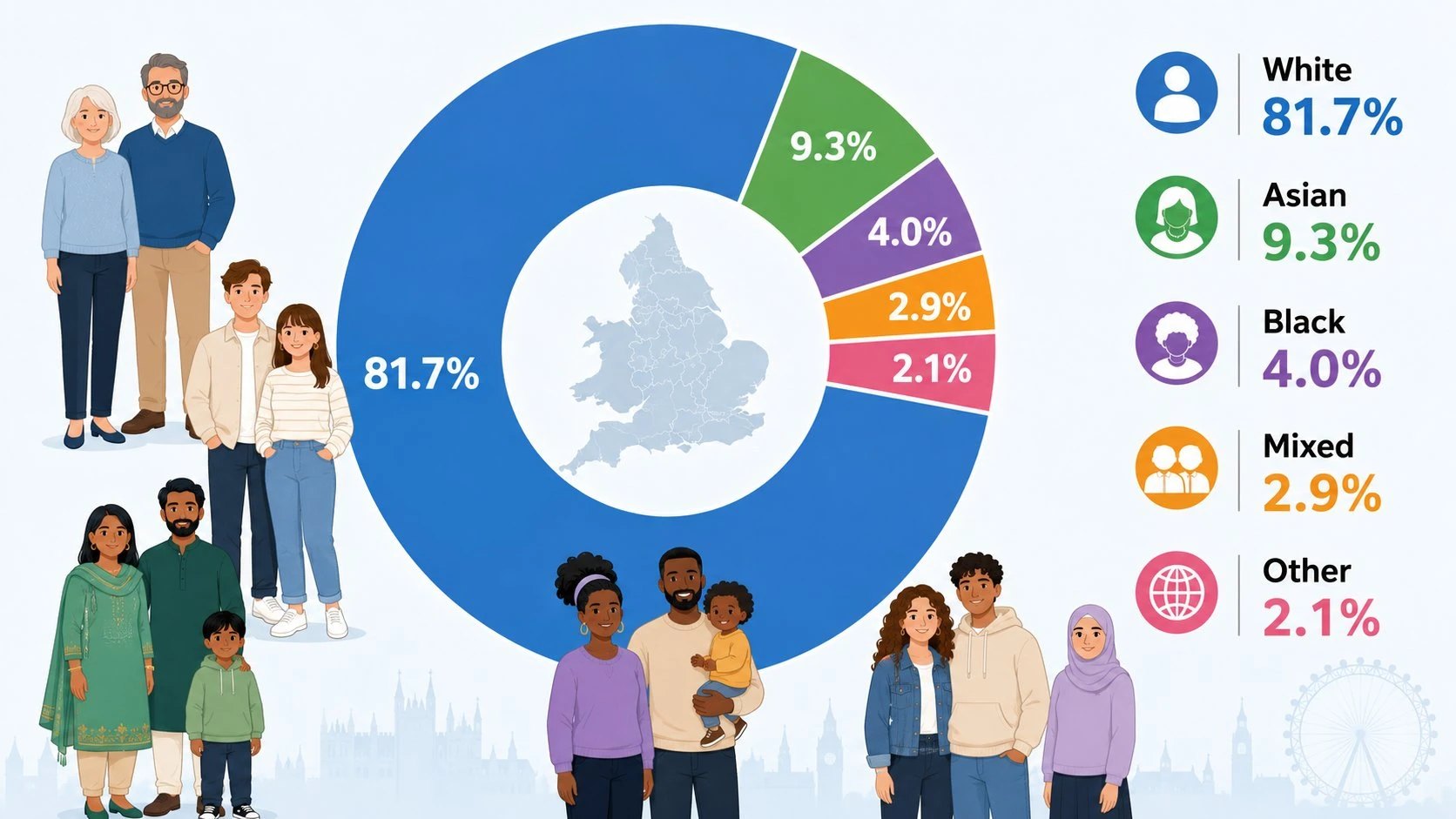
The 2021 Census, conducted by the Office for National Statistics, gives the most current authoritative snapshot of cultural diversity in England and Wales. The headline figures from the Ethnicity Facts and Figures service are these: 81.7% of the population identified as White, 9.3% as Asian, 4.0% as Black, 2.9% as Mixed or multiple ethnic groups, and 2.1% as Other ethnic groups.
The aggregate hides substantial variation by region.
London is the most culturally diverse part of the UK. Only around 37% of Londoners identify as White British. The capital has substantial populations from across the Indian subcontinent, West and East Africa, the Caribbean, Eastern Europe, the Middle East and East Asia.
Other major English cities — Birmingham, Leicester, Manchester, Bradford, Coventry, Slough, Luton — are now 'no majority' cities, where no single ethnic group accounts for more than half the population. The pattern is concentrated in urban areas with industrial or post-industrial economies that drew migrant labour from the 1950s onwards.
Wales is around 94% White, with a more concentrated minority ethnic population in Cardiff and Newport. Scotland, which conducted its census separately in 2022, shows a similar pattern with diversity concentrated in Glasgow and Edinburgh. Northern Ireland has a smaller minority ethnic population at around 3.4%.
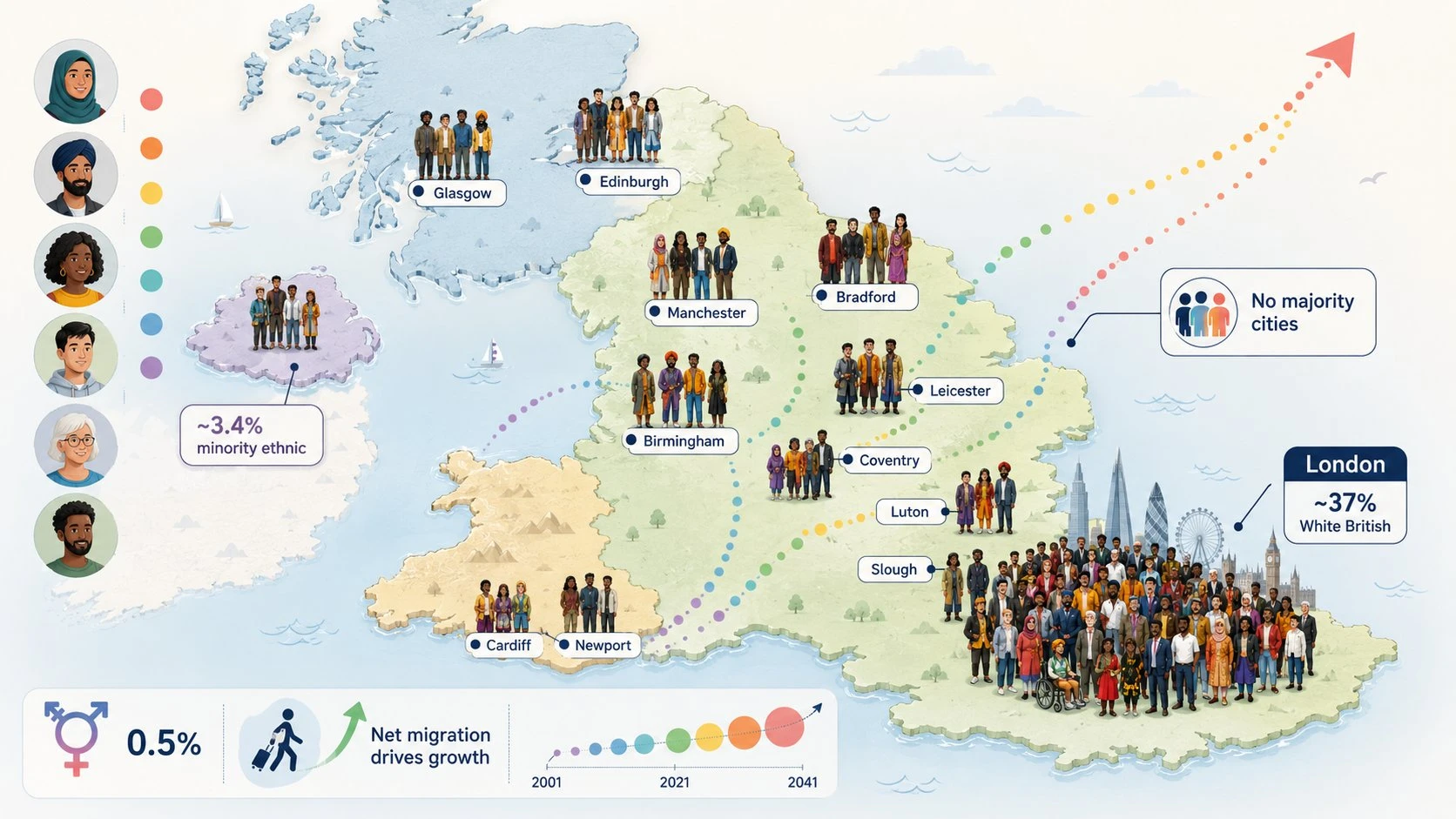
The Census also added a question on gender identity for the first time. About 0.5% of the population in England and Wales — around 262,000 people — reported a gender identity different from their sex registered at birth. The Census included a question on sexual orientation alongside, also for the first time.
The Office for National Statistics' 2024-based national population projections, published in 2026, anticipate that net migration will continue to be the principal driver of UK population growth over the next twenty-five years. The trajectory is towards more cultural diversity, not less, with the rate of change varying considerably between regions.
Cultural diversity at work
A culturally diverse workplace shows up in concrete operational decisions, not in framed posters.
Religious observance
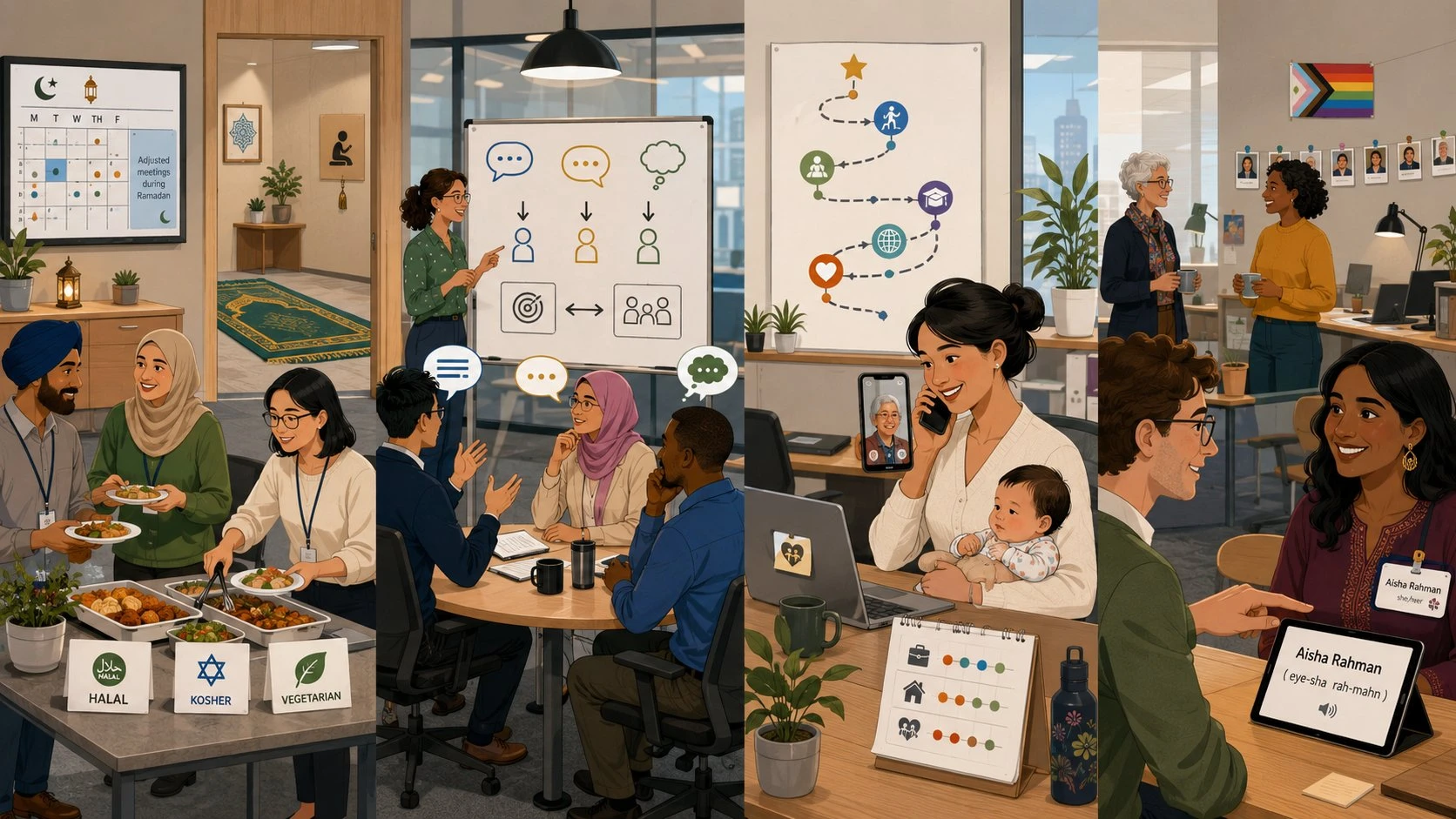
Different faiths have different practical requirements: daily prayer times, fasting periods (Ramadan for Muslims, various fasts in the Orthodox Christian and Jewish calendars), Sabbath observance, religious holidays. A workplace that takes this seriously builds in flexibility — prayer space, adjusted meeting schedules during fasting periods, fair allocation of religious holidays, food options that meet halal, kosher and vegetarian requirements at events.
Communication norms
Cultural backgrounds shape how people give and receive feedback, raise concerns, manage hierarchy, and approach disagreement. Direct, low-hierarchy communication that some British workplaces prize can feel rude to colleagues from cultures where indirect language signals respect. Decisions about whether to flag a problem early or to wait until it's solved can follow cultural patterns. Effective teams don't impose a single style — they make the implicit rules explicit and adjust where needed.
Career patterns
The expectation that careers progress in a straight line is itself a cultural assumption. People with strong extended family obligations, with parents who emigrated and need support, with caring responsibilities for community members beyond the immediate family, may take career routes that look discontinuous to someone applying a different template. Hiring and promotion processes that punish discontinuity can systematically disadvantage workers from particular cultural backgrounds.
Names, pronunciation and identity
Getting someone's name right matters. Refusing to learn pronunciations, anglicising names without consent, repeatedly misspelling, or asking 'what should I call you for short?' all send signals. It costs nothing to learn how to pronounce a colleague's name correctly; it costs a lot to make a colleague feel their identity is too much trouble.
These aren't dramatic accommodations. They're the texture of how a workplace functions when it actually accommodates the variety of people in it.
The legal framework
UK law approaches cultural diversity through two of the protected characteristics in the Equality Act 2010: race and religion or belief.
Race under the Act covers colour, nationality, and ethnic or national origins. The protection is broad. It includes recognised ethnic groups (Sikhs, Jews and Roma have all been treated as ethnic groups by the courts), nationalities, and broader racial categories. It applies to direct discrimination (less favourable treatment because of race), indirect discrimination (a policy that disadvantages a racial group without justification), harassment, and victimisation.
Religion or belief covers any religion or any religious or philosophical belief, and also the lack of any such belief. The 'belief' limb is wider than is sometimes appreciated and has been extended to cover ethical veganism, gender-critical beliefs, and various philosophical positions, where they meet the legal threshold (cogent, serious, worthy of respect in a democratic society, not in conflict with the fundamental rights of others).
Public authorities have additional duties under the Public Sector Equality Duty, including a duty to foster good relations between people of different racial groups and different religious or belief backgrounds.
The full treatment of these characteristics is in our guide to the nine protected characteristics.
Cultural competence and cultural intelligence
Two related concepts are useful for thinking about how organisations and individuals can engage with cultural diversity effectively.
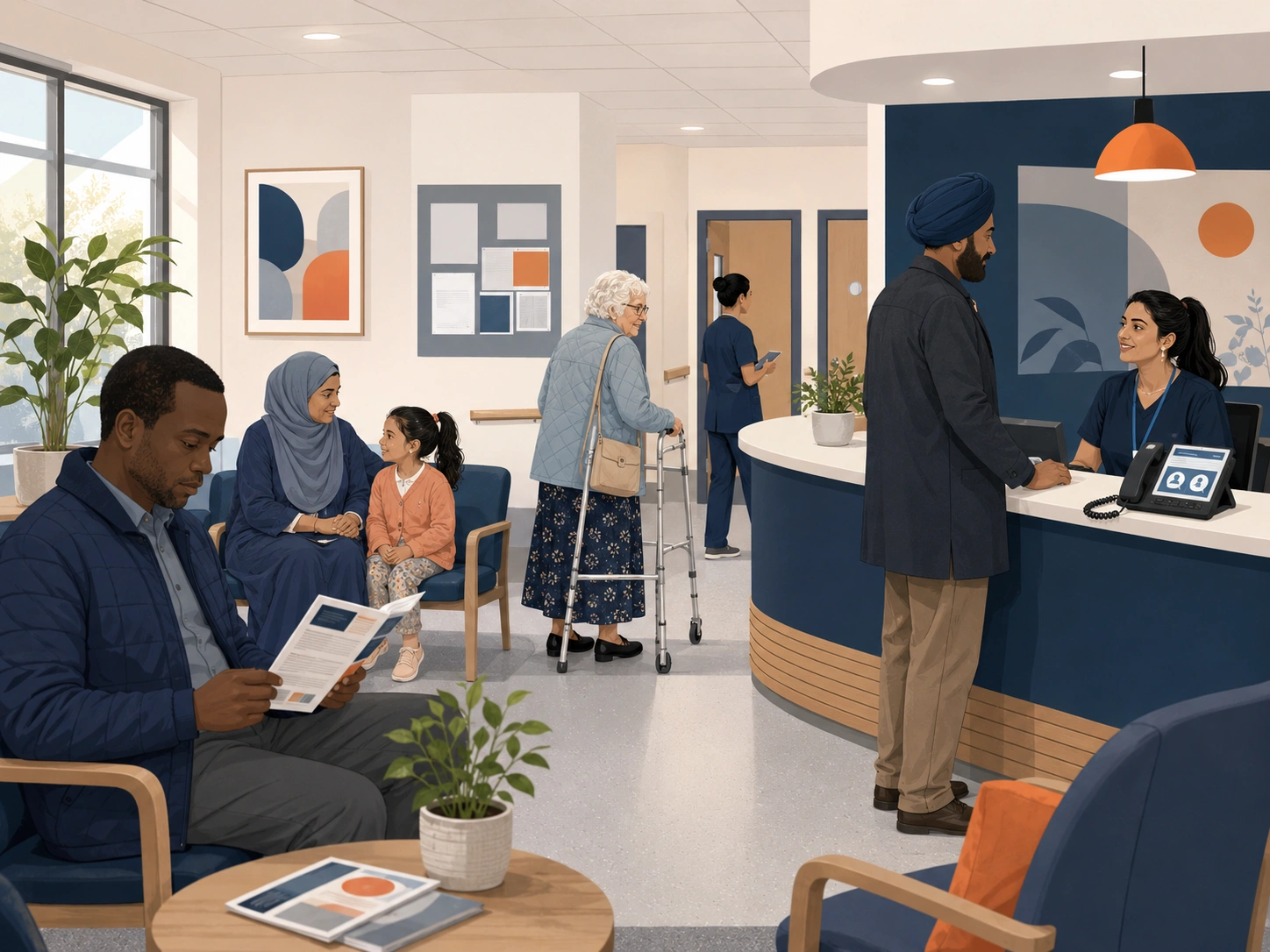
Cultural competence is the ability to interact effectively with people from cultures different from one's own. It's been a standard concept in health, social work and education for several decades. The competence has several layers: awareness (of one's own cultural assumptions), knowledge (of other cultural patterns), attitudes (openness, respect, willingness to learn), and skills (practical ability to communicate, adapt, and work effectively across difference).
Cultural competence as a concept has limitations. The most-cited criticism is that 'competence' suggests a destination — a point at which one has finished learning — rather than an ongoing practice. Another is that it can encourage stereotyping: learning 'about' a culture as if it were a static set of rules, rather than engaging with individuals who happen to share a cultural background.
Cultural intelligence (sometimes abbreviated CQ) is a related concept that has emerged more recently, with origins in business and organisational psychology. It's defined as the capability to function effectively across cultures, and is usually broken into four components: cognitive (knowledge of cultures and cultural systems), motivational (interest and confidence), behavioural (adaptive action), and meta-cognitive (awareness of one's own cultural reasoning in the moment). CQ frames cultural competence as a dynamic capability rather than a body of knowledge.
In practical terms, both concepts point in the same direction: organisations and individuals work better with cultural diversity when they (a) know their own cultural assumptions, (b) are genuinely curious about others', (c) develop a working knowledge of the relevant differences, and (d) adjust their behaviour accordingly.
Cultural diversity in schools and public services
Outside the workplace, cultural diversity shapes how schools, the NHS and other public services are delivered.
In schools, cultural diversity affects everything from school dinners (vegetarian, halal, kosher provision) to dress codes (compatibility with religious dress), to the curriculum (whose history is taught, whose literature is read), to the calendar (religious holidays, term dates). A school that gets this right doesn't treat any one culture as the default; one that gets it wrong can systematically disadvantage pupils from particular backgrounds.
In the NHS, cultural diversity shapes how patients access services, communicate symptoms, take medical advice, observe end-of-life practices and engage with mental health support. Interpreter services, accessible information, culturally appropriate care plans and awareness of varying health beliefs are all part of equitable provision.
In adult social care, cultural diversity is one of the core themes of Care Certificate Standard 4. We cover it in detail in our guide to equality and diversity in health and social care.
Language and terminology
UK terminology in this area has shifted in recent years and continues to shift. A few practical notes.
'BAME' — Black, Asian and Minority Ethnic — was widely used as a catch-all term until around 2021. The Commission on Race and Ethnic Disparities recommended moving away from the acronym, on the grounds that it grouped together very different communities whose experiences are not interchangeable and that it centred 'minority' status rather than specific identities. UK Government usage has since shifted towards more specific naming where the data allows (Black African, British Indian, Pakistani, Chinese) and to 'ethnic minority' or 'minority ethnic' as a general term. Workplace usage is moving the same way, though more slowly.
'People of colour' is more common in American usage than British. UK practice tends to retain 'ethnic minority' for general reference.
'Black, Asian and Other ethnic minority groups' is sometimes used as a more specific alternative to BAME where a general reference is unavoidable.
Naming conventions
When in doubt, ask people what term they use for themselves and follow their lead. Self-description is generally the safest practice in mixed-audience contexts.
'Diverse' as a description of an individual is technically a category error — an individual person isn't diverse, a group is. 'A diverse candidate' is widely used but increasingly flagged as imprecise. 'A candidate from an under-represented background' or simply naming the relevant characteristic is more accurate.
Common mistakes
Three patterns come up often enough to flag.
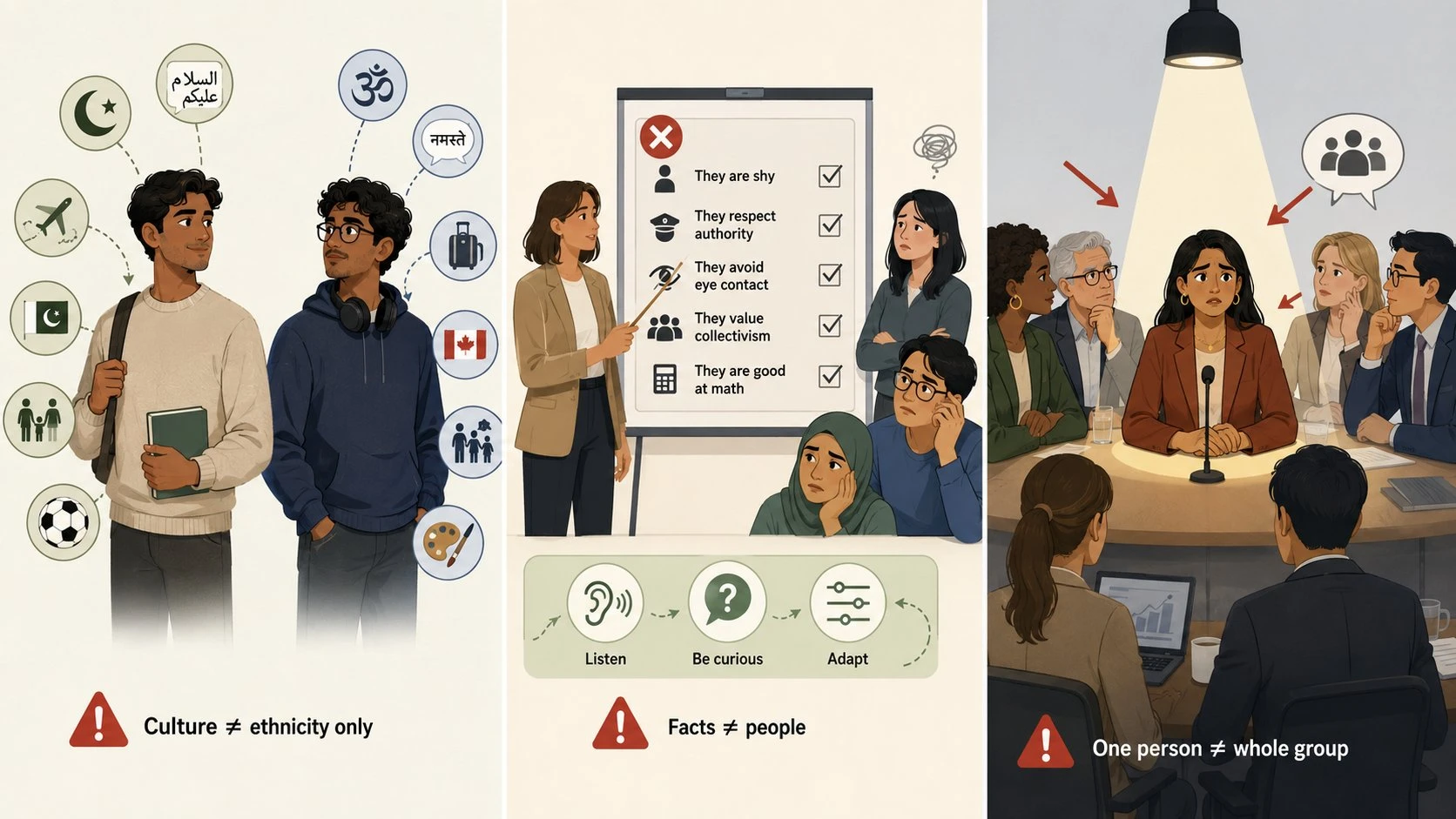
Treating cultural diversity as ethnic diversity only
Ethnicity is one dimension of culture, but national origin, religion, language and migration history all matter as well. Two people of the same ethnic background can have very different cultural reference points.
Designing 'cultural awareness' training as a fixed list of facts about other cultures
This produces stereotyped knowledge that can be worse than ignorance — people who 'know' that all members of a culture do X will fit individuals who don't into their preconception. Better training builds skills in curiosity, listening and adjustment.
Tokenistic representation
Putting a person from an ethnic minority on a panel, then asking them to speak 'as a representative' of that group, places a burden on individuals that they didn't sign up to carry and tends to reinforce the stereotyping it's intended to challenge.
Frequently asked questions
What is cultural diversity?
The presence of different cultural, ethnic, national and religious backgrounds within a society or organisation. It overlaps with diversity in general, but focuses specifically on culture as a distinguishing dimension.
Is the UK culturally diverse?
Yes, increasingly so, with substantial variation by region. The 2021 Census recorded that 81.7% of the population in England and Wales identified as White, with the remainder spread across Asian, Black, Mixed and Other ethnic groups. London, Birmingham, Leicester and Manchester are now 'no majority' cities; Wales, Scotland and Northern Ireland are less ethnically diverse on aggregate but with concentrated diversity in their major cities.
What is cultural competence?
The ability to work effectively with people from cultures different from one's own. It includes awareness of one's own cultural assumptions, knowledge of other cultural patterns, openness and respect, and the practical skills to adapt.
Why is cultural diversity important?
It reflects the actual population that organisations serve, draws on a wider talent pool, brings different perspectives to decision-making, and is required by UK law through the race and religion-or-belief provisions of the Equality Act 2010.
What is the difference between cultural diversity and multiculturalism?
Cultural diversity is the descriptive fact that different cultures are present. Multiculturalism is a particular policy approach to that fact — broadly, one that emphasises preserving and valuing distinct cultural identities rather than assimilating them into a single national culture. Multiculturalism is contested politically; cultural diversity is just a description.
Should I still use 'BAME' as a term?
Increasingly, no. UK Government usage has shifted away from BAME towards more specific naming where possible and 'ethnic minority' as a general term. The shift reflects concerns that BAME groups very different communities and centres minority status over specific identity. Workplace usage is moving in the same direction.
Cultural diversity is one of several specific dimensions of diversity recognised in UK practice. The underlying legal framework is the Equality Act 2010, particularly the race and religion-or-belief provisions in the nine protected characteristics. For sector-specific guidance on cultural diversity in care, see our piece on equality and diversity in health and social care. To turn the principles into competent practice across your team, our Equality, Diversity & Inclusion Training course delivers the framework as a workable programme.
Related guides
- Equality and Diversity in Health and Social Care: A UK Guide
- Equality Act 2010: The Complete UK Guide
- The Nine Protected Characteristics Under the Equality Act 2010
Turn these principles into competent everyday practice across your whole team.
Explore the Equality, Diversity & Inclusion Training course →
Mark writes about equality, diversity and inclusion, workplace compliance and accredited online training for Equality, Diversity & Inclusion Training, part of Online CPD Academy.