
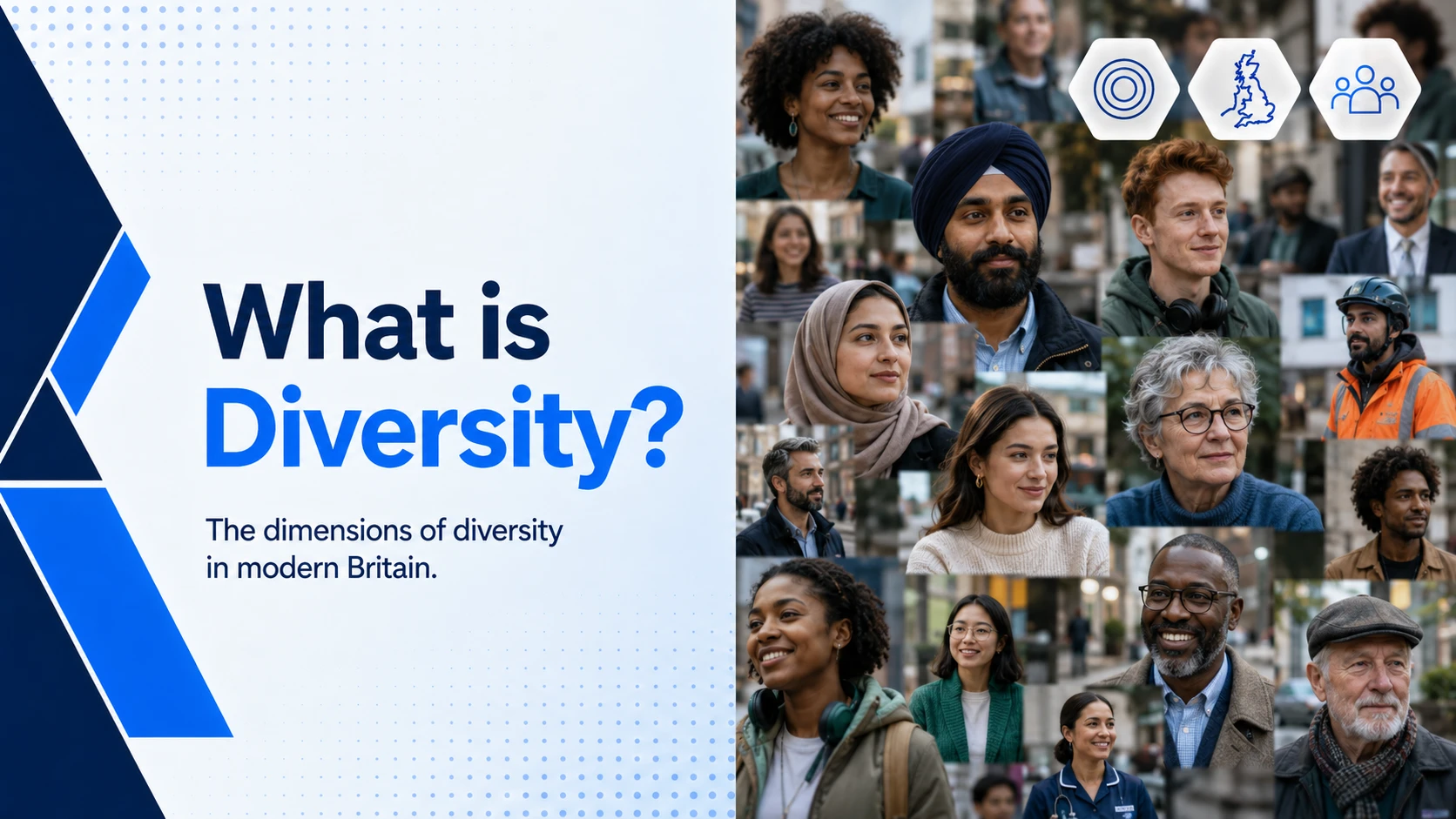
Diversity is one of those words that gets used so widely it can lose its edge. It’s on company posters and in council strategies, in HR policies and in NHS induction packs. The result is that ‘diversity’ often gets reduced to a feeling — we should have more of it — without much clarity about what it actually is or what kinds of difference count.
This guide sets out a working definition, the main dimensions of diversity used in UK practice, the demographic picture in modern Britain, and what diversity means in a workplace context. It also covers the line between diversity and the related-but-distinct idea of inclusion.
A working definition
Diversity is the presence and value of difference within a group. That difference can be visible — ethnicity, gender, age, disability — or invisible — religion or belief, sexual orientation, socio-economic background, neurodivergence, ways of thinking. Diversity exists in any group that contains more than one person; the question is whether that difference is recognised, valued and able to contribute, or whether it’s flattened out by an assumption of similarity.
A more usable definition for organisational practice: diversity is the breadth of identities, backgrounds, experiences and perspectives present in a workforce, a service user base, or a population — and the active recognition that this breadth is real and consequential.
Two things this definition is not. It isn’t only about visible characteristics — a team that’s visibly varied but built entirely from people with the same education, the same class background and the same outlook isn’t as diverse as it looks. And it isn’t synonymous with inclusion. Diversity is about who is there; inclusion is about whether they can contribute fully once they’re there.
The main dimensions of diversity
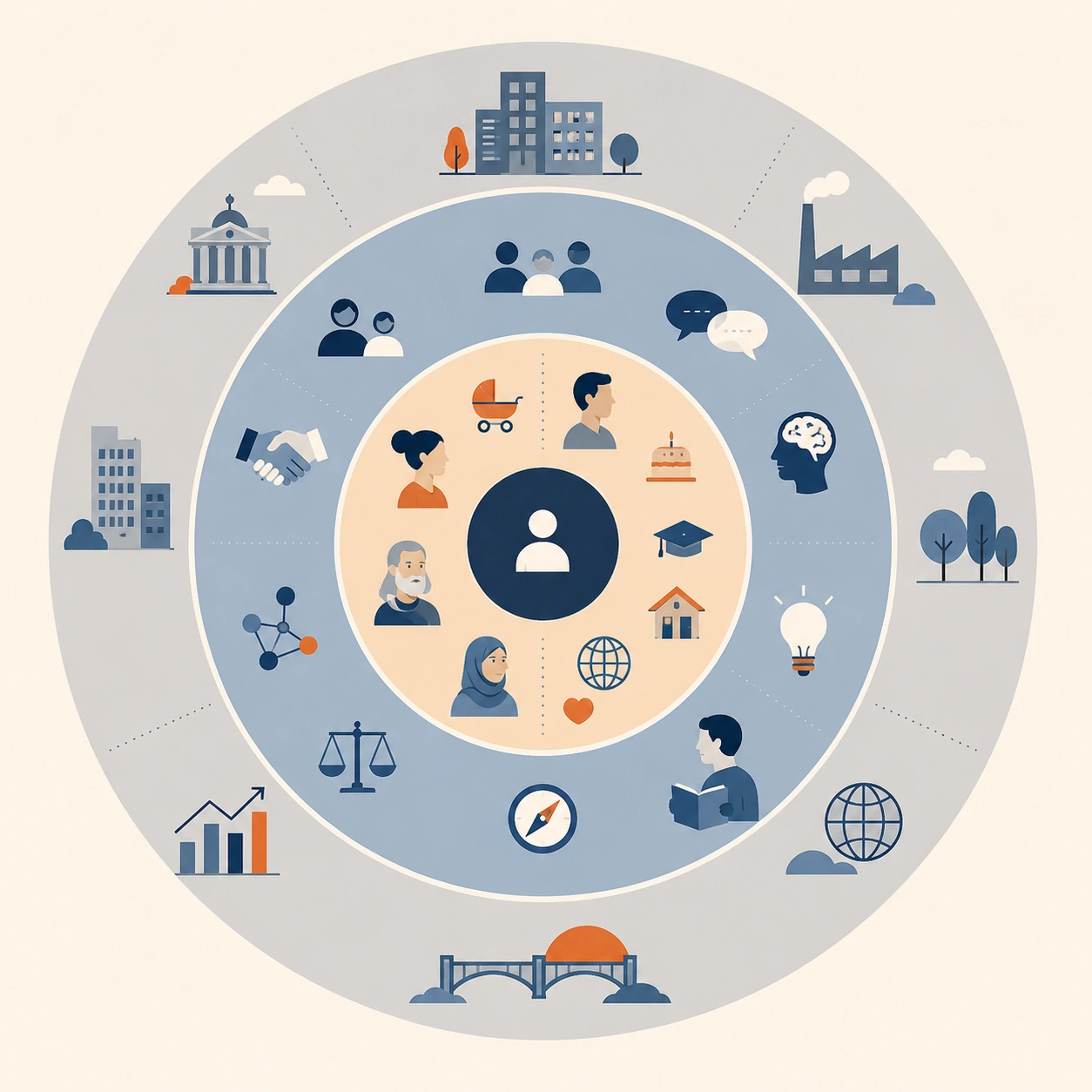
UK practice usually treats diversity as multi-dimensional rather than reducible to one or two categories.
Demographic dimensions
The most legally protected and the most measurable. The Equality Act 2010 protects nine characteristics: age, disability, gender reassignment, marriage and civil partnership, pregnancy and maternity, race, religion or belief, sex, and sexual orientation. These are the dimensions where discrimination law applies; they’re also the dimensions most organisations monitor.
Visible vs invisible
Some differences are immediately observable — ethnicity, gender presentation, age, some disabilities. Others are not — neurodivergence, sexual orientation, religion, mental health conditions, socio-economic background, caring responsibilities. A diversity programme that addresses only the visible dimensions misses much of what actually shapes how people experience work.
Cognitive and experiential diversity
Different ways of thinking, problem-solving, processing information and approaching tasks. Neurodivergent thinking — autistic, ADHD, dyslexic, dyspraxic patterns — is one example; so are differences arising from career path, sector experience and educational background. Cognitive diversity is what most of the ‘better decisions’ arguments for diversity actually rest on, and it’s the dimension most often left out of organisational thinking.
Socio-economic background
Not currently a protected characteristic under the Equality Act (although section 1 of the Act, if commenced, would create a duty to consider socio-economic disadvantage in strategic decisions; it has never been brought into force in England). Increasingly captured by employers anyway because the data shows it shapes career outcomes alongside the protected characteristics.
Intersectionality
A way of seeing that combines several of the dimensions above. A Black woman is not just a Black person and a woman separately; her experience of work and life is shaped by both characteristics together, and might be different from what a Black man or a White woman would experience. UK employers increasingly look at intersectional patterns in their data rather than reporting on each protected characteristic in isolation.
Examples of diversity at work
A more concrete sense of what diversity actually looks like in a UK workplace.
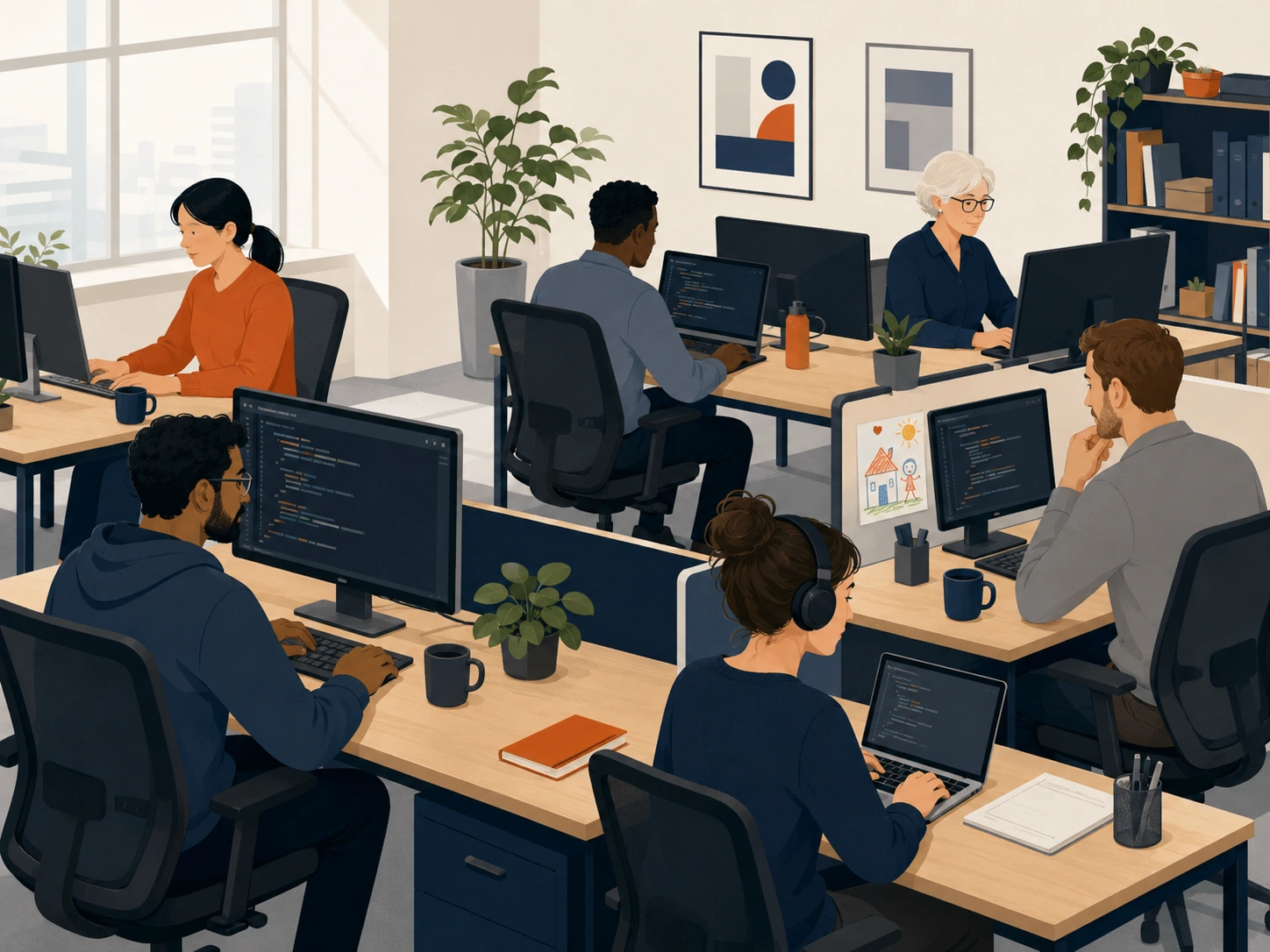
A software team in Manchester. The team has six developers. Two are British Asian, three are White British, one is Polish. Two are women. One has ADHD and works most productively in 90-minute focused blocks. One is a single parent who needs to leave by 5pm. Two are in their mid-twenties, two are in their thirties, one is in his early fifties, one is approaching retirement. The team’s visible diversity is real but partial; the more interesting diversity is in working styles, career stages and life situations, all of which affect how the team operates.
A community library in a market town. The staff team is six women — five White British, one Filipino — and one British Asian man. The library serves a town of 18,000 people whose population profile is more varied than the staff team. The diversity question for the library isn’t only ‘who works here’ but ‘who feels welcome, whose needs are reflected in the stock, who comes in and uses the service’.
A care home. The residents include people from a range of backgrounds: an elderly Jewish couple who keep kosher; a former merchant seaman from Trinidad who arrived in the UK in 1962; a woman with early-onset dementia who is a practising Muslim; a retired teacher who is openly gay and lost a partner two years ago. The staff team is largely Filipino and Romanian, with one British-born manager. Diversity here is about how the home accommodates dietary, religious, linguistic and identity-based needs at the same time as building a coherent staff team across different cultural backgrounds.

These examples are deliberately ordinary. They aren’t dramatic illustrations of difference — they’re the texture of how real UK organisations actually work.
Diversity and inclusion
The two terms are often paired but they’re not the same thing. Diversity is about presence; inclusion is about experience. A team can be diverse in composition and exclusionary in culture, and several of them are. Diversity without inclusion produces high turnover, low engagement and a workplace where some people quietly stop putting themselves forward for opportunities because they’ve learned the unwritten rules don’t favour them.
UK workplaces have largely moved from talking about ‘equality and diversity’ to talking about ‘equality, diversity and inclusion’ for this reason. Our guide to equality, diversity and inclusion covers the EDI framing in detail, including how it differs from the American ‘DEI’.
Diversity in modern Britain
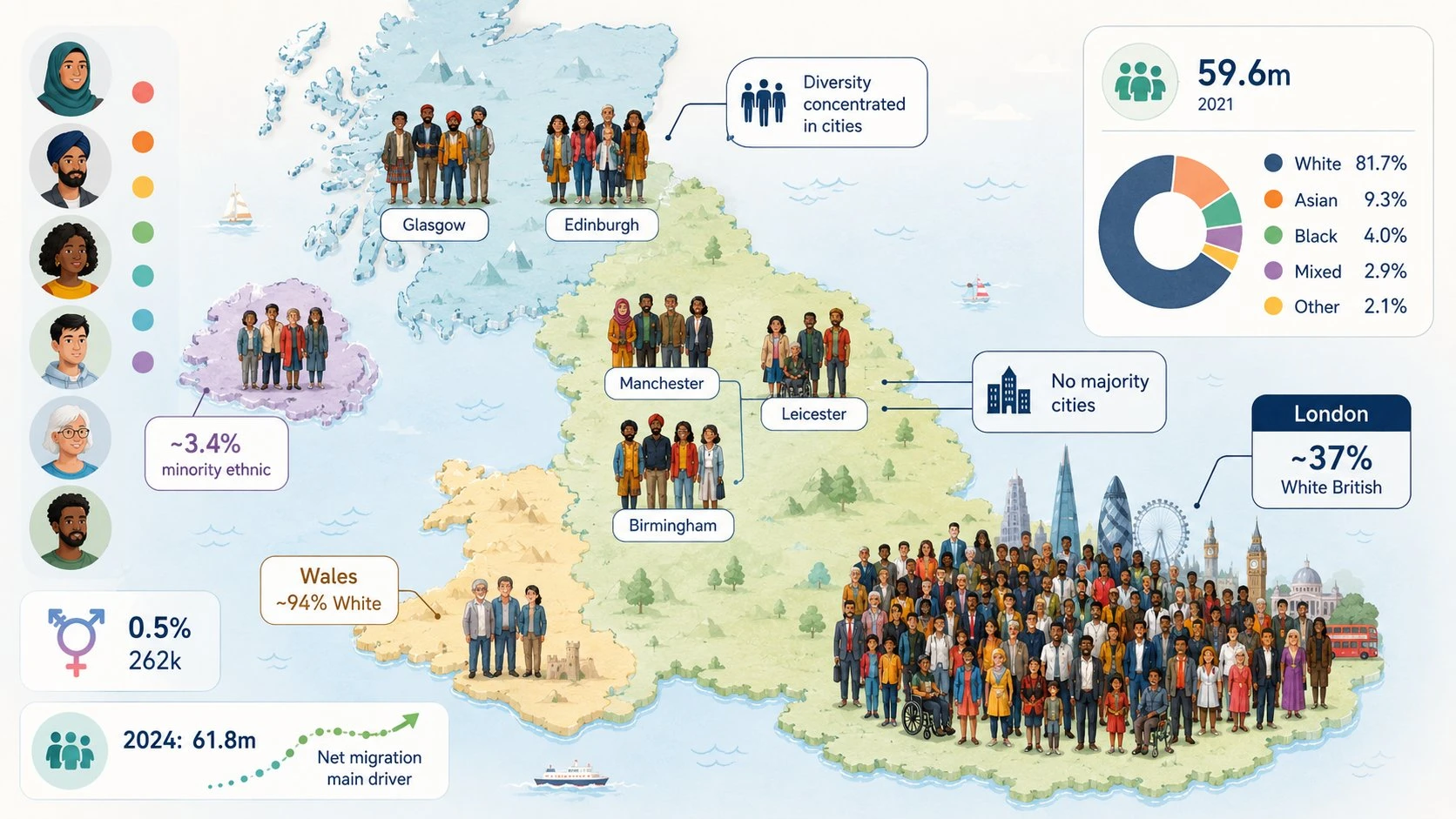
The 2021 Census, conducted by the Office for National Statistics, recorded an England and Wales population of around 59.6 million. Of that population, 81.7% identified as White, 9.3% as Asian, 4.0% as Black, 2.9% as Mixed, and 2.1% as Other ethnic groups. London is more diverse than the country as a whole — only about 37% of Londoners identify as White British. Birmingham, Leicester and Manchester are now ‘no majority’ cities in the same sense, where no single ethnic group accounts for more than half the population.
Wales is more uniformly White, at around 94%. Scotland conducted its census separately in 2022 and shows a similar pattern with more variation between Edinburgh, Glasgow and the rest. Northern Ireland’s minority ethnic population is around 3.4%.
The 2021 Census also captured information on gender identity for the first time. 262,000 people in England and Wales, or 0.5% of the population, reported a gender identity different from their sex registered at birth. The 2021 Census added a question on sexual orientation in addition.
ONS mid-year population estimates for 2024, published in 2025, put the England and Wales population at 61.8 million, an increase of 1.2% on the previous year. The 2024-based national population projections released in 2026 anticipate that net migration will continue to be the principal driver of UK population growth over the next twenty-five years.
Why diversity matters
Briefly, because it’s covered in detail elsewhere: the strongest reasons are the moral and legal cases. Diversity matters because people deserve fair treatment and access, and because UK law makes discrimination unlawful. The business and societal cases are also real: diverse teams attract a wider talent pool, organisations that reflect the population they serve tend to make better decisions about that population, and societies that waste talent through systematic exclusion of capable people are poorer than societies that don’t. Our piece on why diversity matters covers all four cases including an honest account of where the business-case evidence is contested.
Specific forms of diversity
Two specific dimensions deserve a brief mention here because they’re large topics in their own right.
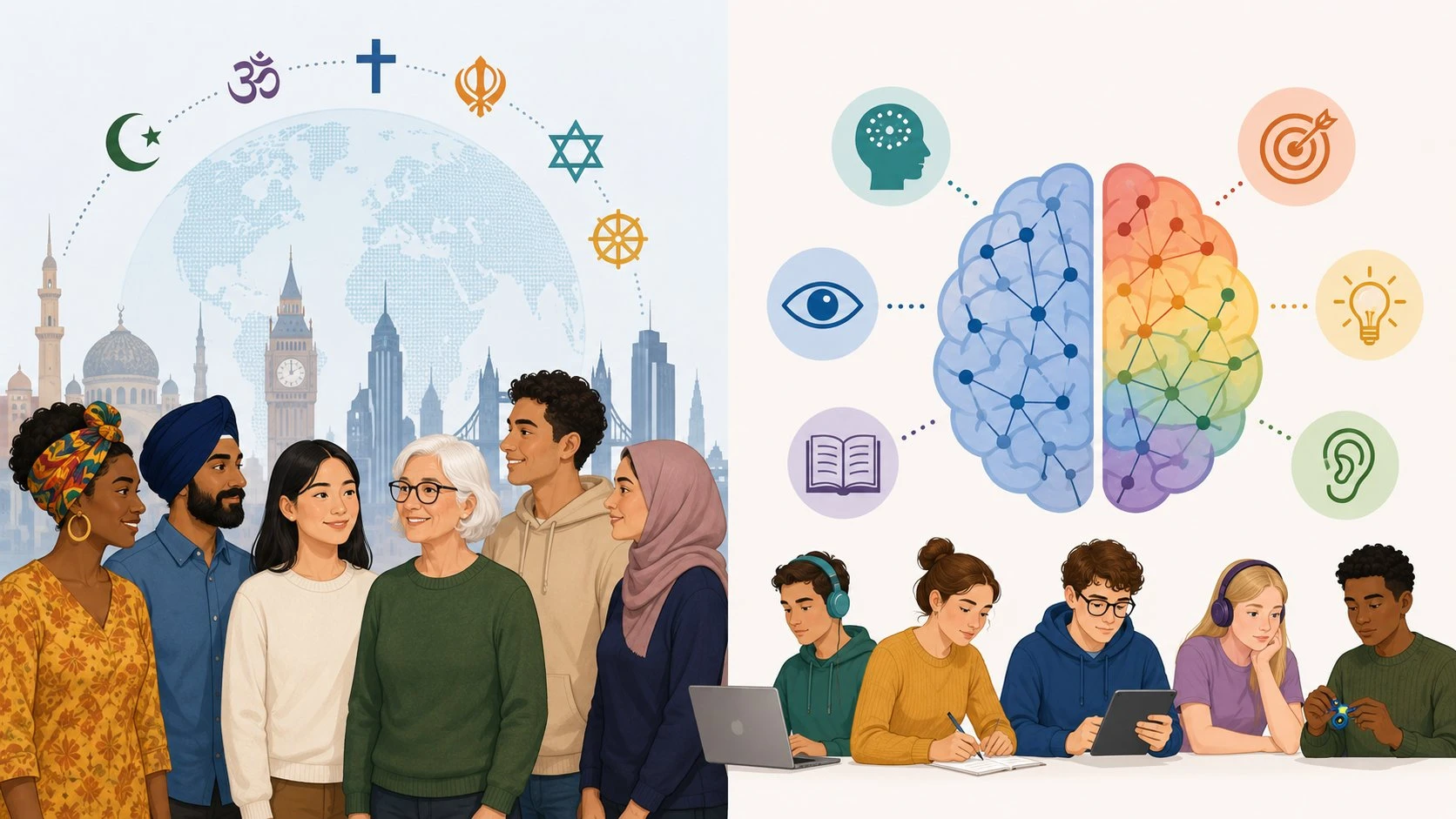
Cultural diversity — the presence of different cultural, ethnic and national backgrounds — is the most demographically visible form of diversity in modern Britain. The protected characteristics of race and of religion or belief sit underneath it. We cover this in cultural diversity in the UK.
Neurodiversity — the natural variation in how human brains work, including autistic, ADHD, dyslexic and dyspraxic patterns — is increasingly recognised as a workplace issue. NHS Employers estimates that around one in seven people in the UK are neurodivergent. We cover this in neurodiversity in the workplace.
Terminology notes
A few language notes that come up repeatedly.
‘BAME’ (Black, Asian and Minority Ethnic) was widely used as a default term until around 2021, when the UK Government’s Race Disparity Audit and subsequent reports recommended moving away from the acronym. Government usage now favours more specific naming (‘Black African’, ‘British Indian’, ‘Chinese’) where data allows, with ‘ethnic minority’ or ‘minority ethnic’ as a general term. Workplace usage is moving in the same direction, though more slowly. The term BAME is increasingly seen as flattening important differences between groups.
‘People of colour’ is more common in American usage than British. UK practice tends to retain ‘ethnic minority’ for general reference and to use specific terms where possible.
‘Diverse’ describing an individual is technically a category error — an individual person isn’t diverse, a group is. The usage ‘a diverse candidate’ is widespread but increasingly flagged as imprecise. Better phrasing is ‘a candidate from an under-represented background’ or simply naming the specific characteristic.
Frequently asked questions
What is diversity?
Diversity is the presence and value of difference within a group — including ethnicity, gender, age, disability, sexual orientation, religion, neurodivergence, socio-economic background, and life experience. In UK practice it covers both visible and invisible characteristics.
What are the main types of diversity?
The main dimensions are demographic (the protected characteristics in the Equality Act), visible vs invisible, cognitive and experiential, and socio-economic. Intersectionality is the recognition that these dimensions combine in individual lives rather than acting independently.
What is diversity in the workplace?
The mix of identities, backgrounds, experiences and perspectives present in the workforce, and the active recognition that this mix shapes how the organisation operates, recruits, retains people, and serves customers.
What is the difference between diversity and inclusion?
Diversity is about presence — who is in the room. Inclusion is about experience — whether the people in the room can contribute fully, speak freely, disagree without penalty and progress without unspoken barriers. Diversity without inclusion produces turnover and disengagement.
Why is diversity important in the UK?
For moral, legal, talent and societal reasons. UK demographics have changed substantially over the last twenty years and continue to change; institutions that don’t reflect the population they serve lose legitimacy over time. The Equality Act makes discrimination unlawful, and individual organisations benefit from wider talent access and broader perspectives when making decisions.
Diversity is one half of the standard UK workplace framing. The other half is equality, and the relationship between them is set out in our equality and diversity guide. To turn the principles into practice, our Equality, Diversity & Inclusion Training course delivers a programme suitable for staff at any level.
Related guides
- Equality and Diversity in Health and Social Care: A UK Guide
- Equality Act 2010: The Complete UK Guide
- The Nine Protected Characteristics Under the Equality Act 2010
Give your team the understanding to support a fair, inclusive workplace.
Explore the Equality, Diversity & Inclusion Training course →
Mark writes about equality, diversity and inclusion, UK equality law and accredited online training for Equality, Diversity & Inclusion Training, part of Online CPD Academy.