
Around one in seven people in the UK is neurodivergent, according to estimates published by NHS Employers. That’s a substantial proportion of any workforce — often substantially more than employers realise, because many neurodivergent employees never formally disclose. Most of those people are doing their jobs well; some of them are doing their jobs while spending considerable energy masking their neurodivergence to fit a workplace that wasn’t designed with them in mind.
This guide explains what neurodiversity actually is, the most common conditions, the legal framework that applies, what good workplace support looks like, and the practical changes that make the biggest difference for neurodivergent employees and the organisations that employ them.
What neurodiversity means
The term was coined by Australian sociologist Judy Singer in 1998 to describe the natural variation in how human brains work — the way some people process information, focus, communicate, learn and respond to sensory input differently from what’s been treated as the typical pattern.
Neurodiversity is the diversity in brain functioning itself; it’s a characteristic of the human population, not of any individual. A particular person isn’t neurodiverse; they’re either neurodivergent (with a brain that works differently from what’s been considered typical) or neurotypical (with a brain pattern closer to the conventional norm). A team or organisation can be neurodiverse — containing both neurodivergent and neurotypical people — and the more neurodivergent people there are in it, the more neurodiverse it becomes.
The ‘neurodiversity paradigm’ that Singer’s term gave rise to treats neurodivergent ways of thinking as natural variation rather than as deficits to be fixed. This doesn’t mean ignoring the real difficulties some neurodivergent people face, particularly in workplaces designed without them in mind. It means framing those difficulties as a mismatch between person and environment, rather than as something wrong with the person.
Common neurodivergent conditions
Several conditions sit under the neurodivergence umbrella. They’re related in that they all involve brain functioning that differs from the assumed norm, and many people have more than one — what’s sometimes called ‘co-occurring conditions’.
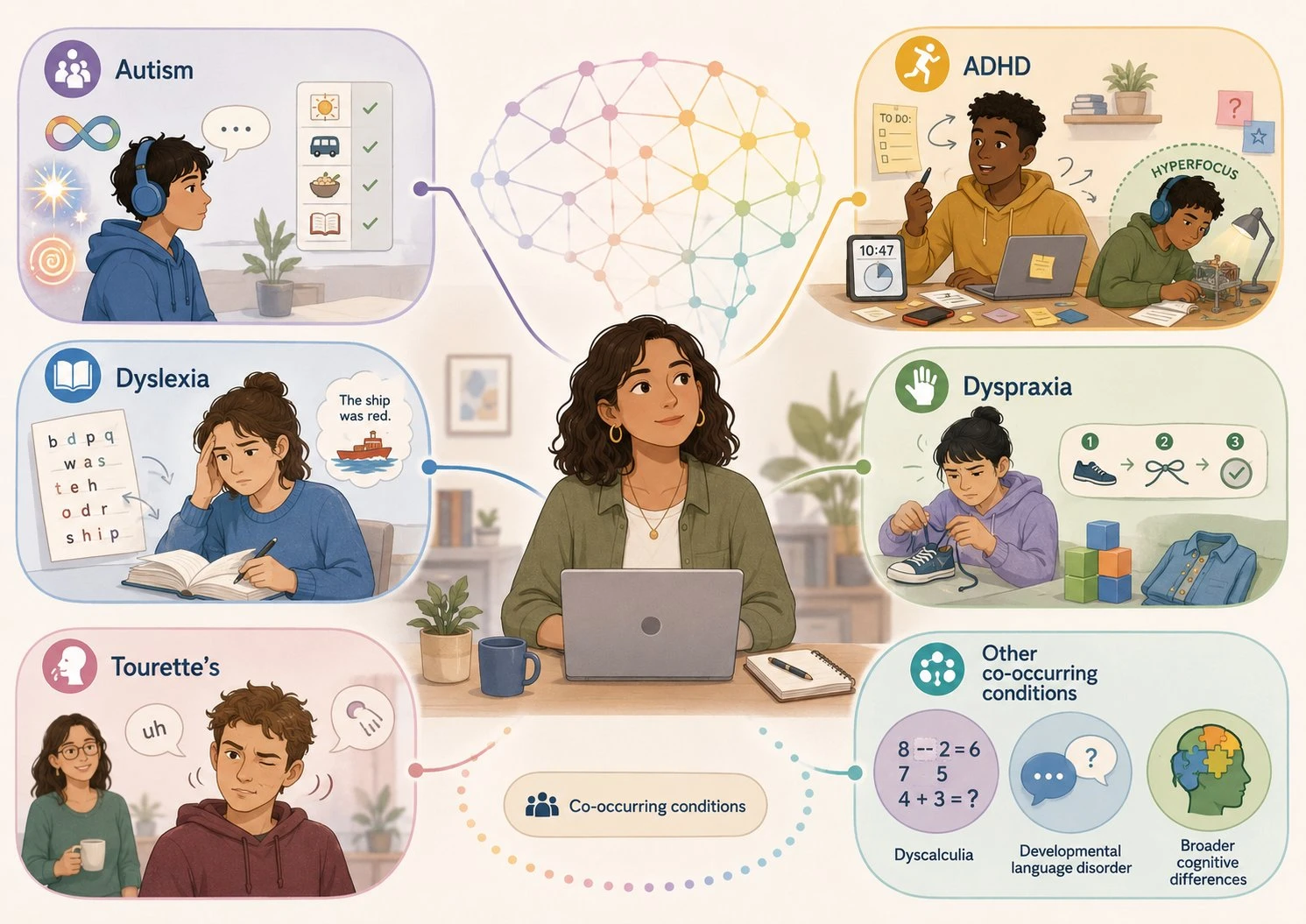
Autism, or autism spectrum condition, involves differences in social communication, sensory processing and patterns of interest and behaviour. Autistic people may find unstructured social situations difficult, prefer routines, find direct communication clearer than implied or hinted communication, and have specific sensory sensitivities (or sensory-seeking patterns) that affect how they experience environments. Autism is lifelong; it’s not an illness.
ADHD — attention deficit hyperactivity disorder — involves differences in attention, impulse control and activity levels. People with ADHD may struggle with tasks that require sustained attention to material they don’t find engaging, have difficulty starting tasks they know they need to do, hyperfocus intensely on tasks that interest them, lose track of time, and find externalising thoughts (talking, moving, writing) easier than holding them internally.
Dyslexia involves differences in how the brain processes written language. Reading, spelling and written expression can take more time and effort than for neurotypical peers, even where comprehension and verbal expression are unaffected.
Dyspraxia, also known as developmental coordination disorder, involves differences in motor coordination, organisation and sequencing. Tasks that involve fine motor control, spatial reasoning or following multi-step physical processes can be more demanding than for neurotypical peers.
Tourette’s syndrome involves tics — involuntary movements or vocalisations. Other related conditions include dyscalculia (mathematical processing differences), developmental language disorder, and conditions on the wider spectrum that affect specific cognitive functions.
The labels can be useful for accessing support but they aren’t the whole picture. Many people don’t fit a single diagnostic category, and many have one or more diagnosed conditions alongside undiagnosed neurodivergent traits. The most useful conversation in a workplace is usually about specific impacts and supports, not specific labels.
Neurodivergence and the Equality Act
Neurodivergence isn’t a separate protected characteristic under UK law. The relevant legal framework is disability, defined in section 6 of the Equality Act 2010 as a physical or mental impairment that has a substantial and long-term adverse effect on a person’s ability to carry out normal day-to-day activities.
Most neurodivergent conditions will meet that definition in most cases. Autism, ADHD, dyslexia, dyspraxia and Tourette’s are typically considered disabilities under the Act when they have substantial and long-term effects, which they usually do. This means the full range of disability protections apply: protection from direct and indirect discrimination, harassment and victimisation, plus — most importantly in practice — the duty on employers to make reasonable adjustments.
Two practical points matter here.
A diagnosis is not legally required
The ACAS guidance on neurodiversity at work makes this explicit, and the Equality Act itself doesn’t require diagnostic documentation. What matters is the practical effect on the person’s ability to carry out day-to-day activities. Many neurodivergent adults are undiagnosed — NHS waiting times for adult autism and ADHD assessments are long, and private diagnosis is expensive. An employer who refuses to consider adjustments without a formal diagnosis is on weak ground legally and is treating a substantial part of their potential workforce badly.
Many neurodivergent people don’t see themselves as disabled
This is fine personally, but the legal protections under the Act are accessed through the disability characteristic. People can be protected from disability discrimination without identifying as disabled in their own terms.
Our wider guide to the nine protected characteristics covers the disability definition and related case law in more depth.
Workplace barriers and what good support looks like

The same neurodivergent traits can be assets in one role and barriers in another. The barriers are usually about the environment and the way work is organised, rather than about the person.
Common workplace barriers include:
- Open-plan offices with unpredictable noise and movement, which are difficult for people with sensory sensitivities or attention differences.
- Unwritten social rules and ambiguous communication, which can be genuinely difficult for autistic employees to navigate.
- Performance criteria that reward visible activity rather than actual output, which can disadvantage employees whose work patterns are less continuous.
- Rapid context-switching and ‘just have a quick chat’ interruptions, which can be costly for employees who concentrate in deep blocks.
- Recruitment processes that test general aptitude in conditions that don’t reflect the job — high-pressure interviews, unstructured panel discussions, on-the-spot psychometrics.
Good support is rarely dramatic or expensive. The most common useful adjustments include:
- Written instructions following verbal ones, advance agendas for meetings, structured handover notes.
- Quieter spaces or noise-cancelling headphones for focused work.
- Flexibility about hours, breaks, and where the work is done.
- Predictable patterns — fixed meeting times, advance notice of changes, clarity about who reports to whom.
- Clear, direct feedback rather than implication and hint.
- Recognition that one-to-one or written communication often works better than meetings.
These adjustments help neurodivergent employees specifically, but they tend to help most other people too. The ‘curb-cut effect’ — adjustments designed for one group benefiting many — is consistent in neurodiversity support.
Recruitment, onboarding and progression
Recruitment is where the most talented neurodivergent candidates are most often filtered out. A few practical changes that make recruitment more equitable.
Job descriptions
Write them for the actual job. List the essential tasks and skills, separated from desirable extras. Avoid catch-all phrases like ‘excellent communication skills’ or ‘thrives under pressure’ that screen out candidates without testing the underlying ability.
Application processes
Be explicit about what’s needed. If you require a CV and a cover letter, say so. If you’re using an assessment platform, say what the assessment will involve. Vagueness disproportionately affects candidates who would benefit from preparation.
Interviews
Send the questions, or at least the topics, in advance. Many autistic and ADHD candidates perform significantly better with preparation time. Use structured interviews with the same questions for every candidate. Avoid trick questions, sudden hypotheticals and high-pressure conditions that test nervous system response more than they test ability to do the job.
Adjustments at interview
Offer them proactively, and don’t ask candidates to justify what they need. A quiet waiting room, written prompts, breaks during a long interview, and the option to take an assessment at home rather than under timed conditions are all reasonable in most situations.
Onboarding
First days and first weeks are particularly demanding for neurodivergent employees. Written induction materials, a clear named contact, explicit guidance on what’s expected, and protected time to absorb new information all help. The ‘sink or swim’ approach is bad for everyone and particularly bad here.
Progression
Watch for patterns. If neurodivergent employees are well-represented at junior levels and absent at senior levels, the progression process is filtering them out. Common reasons include implicit expectations of self-promotion, social capital and visibility that don’t map cleanly onto how neurodivergent employees often work.
Language and etiquette
Language in this area is shifting and contested. A few practical points.
Identity-first language
Most current UK guidance — including ACAS — uses identity-first language: ‘an autistic person’, ‘a dyslexic colleague’, ‘an ADHD employee’. This reflects the position taken by many neurodivergent self-advocates, who see their neurodivergence as part of who they are rather than something they ‘have’. Person-first language (‘a person with autism’, ‘a person with dyslexia’) has historically been more common in medical contexts and is still preferred by some individuals. Where it matters, ask.
Avoid pathologising terms
‘Suffering from autism’, ‘afflicted with ADHD’, ‘symptoms of dyslexia’ all frame neurodivergence as illness. It isn’t. The neurodiversity paradigm treats these as natural variations, not diseases.
Be precise
‘Neurodivergent’ refers to individuals with a different neurological pattern. ‘Neurodiverse’ refers to a group containing such individuals. Calling an individual ‘neurodiverse’ is a category error that’s become widespread; saying ‘neurodivergent’ is more accurate.
Don’t assume
Neurodivergent traits vary enormously between people with the same diagnosis. Autistic people are not interchangeable; people with ADHD have different strengths and challenges. Adjustments and support should be specific to the individual.
Disclosure
Many neurodivergent employees don’t tell their employer. The reasons vary — concerns about stigma, uncertainty about whether disclosure would help, lack of confidence that the employer would respond well, sometimes uncertainty about their own neurodivergence.
A few points worth knowing.
Disclosure isn’t required for protection
The Equality Act protects against discrimination based on perceived disability as well as known disability. An employer who treats someone less favourably because they’re ‘difficult’ or ‘odd’ in ways that turn out to reflect undisclosed neurodivergence isn’t off the hook because the employee didn’t tell them.
The reasonable adjustments duty is triggered by knowledge or reasonable expectation of knowledge
If an employer has enough information to reasonably suspect that an employee might be disabled, the duty applies even without formal disclosure. Patterns of difficulty in particular environments, requests for adjustments, occupational health referrals or sickness absence patterns can all give rise to that reasonable expectation.
Building a culture where disclosure feels safer is better than waiting for individuals to take the risk
Visible neurodivergent role models, networks, training that treats neurodivergence as ordinary rather than exotic, and managers who respond well to early disclosures all help. The signal is the behaviour, not the policy statement.
Access to Work and other UK support
The UK government’s Access to Work scheme funds practical support for disabled and neurodivergent people in employment — including specialist equipment, software, support workers, coaching, communication support and travel costs. Applications are made by the disabled person themselves, with the employer’s involvement. Funding can substantially reduce the cost of adjustments for the employer.
Awareness of Access to Work is uneven, and waiting times can be long. Sensible employers signpost it actively rather than waiting for employees to find it on their own.
Other useful UK resources include the National Autistic Society for autism-specific guidance, ADHD UK and ADHD Aware for ADHD support, the British Dyslexia Association for dyslexia, and Autistica’s Neurodiversity Employers Index for benchmarking organisational practice.
Frequently asked questions
What does neurodivergent mean?
Having a brain that works differently from what’s been considered the typical pattern. Common neurodivergent conditions include autism, ADHD, dyslexia, dyspraxia and Tourette’s syndrome. The term applies to individuals; ‘neurodiverse’ applies to groups that contain both neurodivergent and neurotypical members.
Is neurodivergence a disability?
Most neurodivergent conditions meet the Equality Act 2010 definition of disability when they have substantial and long-term effects on day-to-day activities — which they usually do. This means the full range of disability protections apply, including the duty to make reasonable adjustments. Many neurodivergent people don’t personally identify as disabled, but the legal protections still apply.
Do I need a diagnosis to ask for adjustments?
No. ACAS guidance and the Equality Act are both clear that a formal diagnosis isn’t required. Employers should consider adjustments on the basis of the practical impact on the person’s ability to do the job. NHS waiting times for adult assessment are long and private diagnosis is expensive; requiring diagnosis as a precondition for adjustments excludes many people who’d benefit.
What is Access to Work?
A UK government scheme that funds practical support for disabled and neurodivergent people in employment, including specialist equipment, support workers, coaching and travel costs. Applications are made by the disabled person and can substantially reduce the cost of adjustments to the employer.
Should I disclose my neurodivergence at work?
It’s a personal choice. Disclosure can unlock formal adjustments and protection from misunderstanding, but it can also expose people to stigma in workplaces that aren’t well prepared. The employer can be on the hook for reasonable adjustments even without formal disclosure if they could reasonably have known. Cultures where disclosure feels safer tend to produce better outcomes for everyone.
What are reasonable adjustments for ADHD, autism or dyslexia?
The most useful adjustments tend to be about clarity, structure, sensory environment and flexibility — written instructions following verbal ones, advance agendas, quieter spaces or noise-cancelling headphones, flexible hours and breaks, predictable patterns, direct communication. Specific adjustments depend on the individual; the legal duty is to address substantial disadvantage, not to tick a list.
Neurodiversity sits within the broader framework of diversity recognised in UK workplaces, and within the legal framework of the Equality Act 2010 — specifically through the disability characteristic and the duty to make reasonable adjustments. To equip your managers to support neurodivergent employees confidently and lawfully, our Equality, Diversity & Inclusion Training course covers the framework in detail with practical worked examples.
Related guides
- Equality and Diversity in Health and Social Care: A UK Guide
- Equality Act 2010: The Complete UK Guide
- The Nine Protected Characteristics Under the Equality Act 2010
Equip your managers to support neurodivergent colleagues confidently and lawfully.
Explore the Equality, Diversity & Inclusion Training course →
Mark writes about equality, diversity and inclusion, workplace compliance and accredited online training for Equality, Diversity & Inclusion Training, part of Online CPD Academy.