
Equality means treating people fairly. That sounds simple until you try to apply it. Does treating people fairly mean giving them the same things, or giving them what they each need? Does it mean ignoring difference, or recognising it? Is equality a matter of starting points or end results? UK law and everyday practice answer those questions differently in different contexts, and getting them right is the difference between a fair workplace and a tribunal claim.
This guide sets out what equality actually means, the main types it takes, how UK law treats it, and the misconception that trips up most people who try to apply it.
A working definition
Equality is the principle that people should be treated fairly, without unjustified disadvantage because of who they are. In UK law this principle is expressed through the Equality Act 2010, which protects nine specific characteristics — age, disability, gender reassignment, marriage and civil partnership, pregnancy and maternity, race, religion or belief, sex, and sexual orientation — from discrimination, harassment and victimisation.
Notice what equality is not. It isn't sameness — people are different and treating them as identical can itself be unfair. It isn't an end state — equality is something you work towards through decisions, processes and culture, not something you achieve once and forget. And it isn't a matter of intention. The Act treats discrimination as unlawful whether the discriminator meant to discriminate or not.
A more workable definition: equality is the active practice of removing unjustified barriers and disadvantages, so that what differs between people's outcomes is what they choose, contribute and achieve — not who they are.
The main types of equality
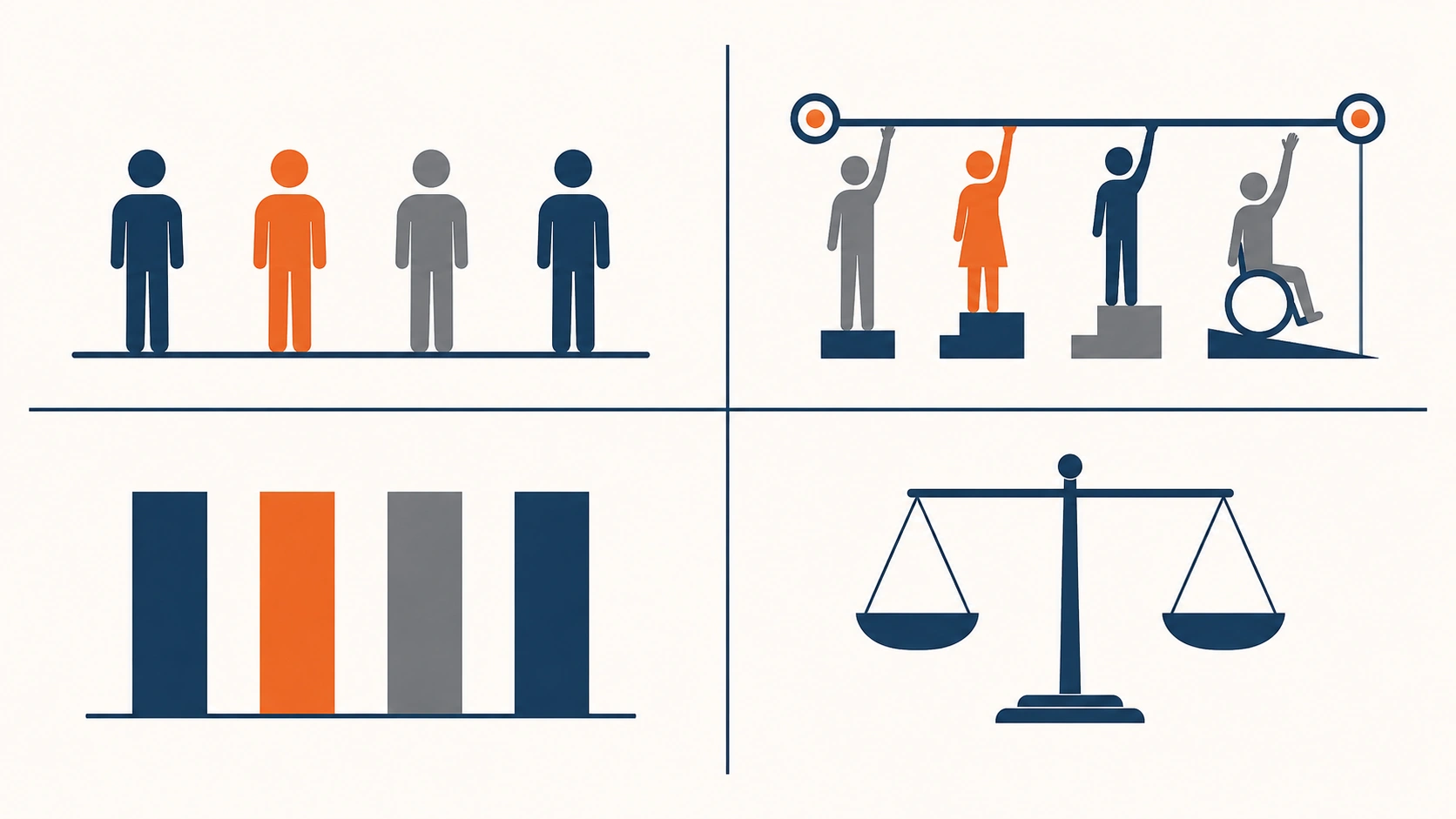
Four distinctions come up repeatedly in UK practice. They aren't competing definitions; they're different aspects of the same idea.
Formal equality
The principle that the same rules apply to everyone. This is the bedrock and it sounds uncontroversial, but it can produce unfair results when the rules themselves were designed without certain groups in mind. A job advert that says 'must have driving licence' is formally equal because it applies to all applicants. It is also indirectly discriminatory against disabled people who can't drive, unless driving is actually essential to the role.
Equality of opportunity
The principle that the chance to apply, compete and progress is genuinely open. This goes beyond formal equality by asking whether the rules in practice give everyone a real chance. A recruitment process that's open to everyone but advertised only on LinkedIn provides formal equality of access while excluding everyone without a LinkedIn account.
Equality of outcome
Looking at the actual results, not just the rules. Equality of outcome doesn't usually mean producing identical outcomes — that would be impossible and undesirable. It means watching for systematic differences that suggest the rules are working better for some groups than others. The gender pay gap, the ethnicity pay gap, the disability employment gap and the under-representation of women in senior roles are all equality-of-outcome questions.
Equality before the law
The principle that everyone is subject to the same law and protected equally by it. Article 14 of the European Convention on Human Rights, incorporated into UK law by the Human Rights Act 1998, expresses this in the language of rights: the rights guaranteed by the Convention must be secured 'without discrimination on any ground'.
In practice most equality conversations move between these four levels. A policy might pass the formal test, fail the opportunity test, show up as unequal outcomes, and trigger a Human Rights Act issue all at once.
Equality is not the same as equity
The two terms are increasingly used interchangeably, often by people who mean well but have absorbed the confusion from elsewhere. They are not the same.
Equality, broadly, is about giving people the same starting point. Equity is about giving people what they each need to reach a comparable outcome. A workplace lift is an equity intervention — it gives wheelchair users a way to reach the upper floor that the rest of the workforce reach by the stairs. The two people end up at the same floor, but they didn't get there in the same way.
UK law uses the term 'equality' rather than 'equity', but the Equality Act builds in equity-style interventions: the duty to make reasonable adjustments for disabled people, the protection of pregnancy and maternity, and the lawful 'positive action' provisions under sections 158 and 159 that allow employers to take proportionate steps to enable underrepresented groups to overcome disadvantage. We unpack this further in equality vs equity.
Equality in UK law
The Equality Act 2010 is the principal statute. It came into force on 1 October 2010 and consolidated more than a hundred earlier pieces of law into a single framework. It prohibits four main types of discrimination: direct (treating someone less favourably because of a protected characteristic), indirect (a policy that applies to everyone but disadvantages a particular group without justification), harassment (unwanted conduct related to a protected characteristic), and victimisation (treating someone badly because they've made a complaint or supported one).
The Act applies in England, Scotland and Wales. Northern Ireland has its own separate equality framework, mainly under Section 75 of the Northern Ireland Act 1998 and a series of NI-specific anti-discrimination orders.
Public bodies have an additional duty under section 149 — the Public Sector Equality Duty — to have due regard to the need to eliminate discrimination, advance equality of opportunity and foster good relations. Private employers aren't subject to that duty, but they are still bound by the rest of the Act. The fuller treatment of the statute is in our guide to the Equality Act 2010.
Equality in everyday UK contexts
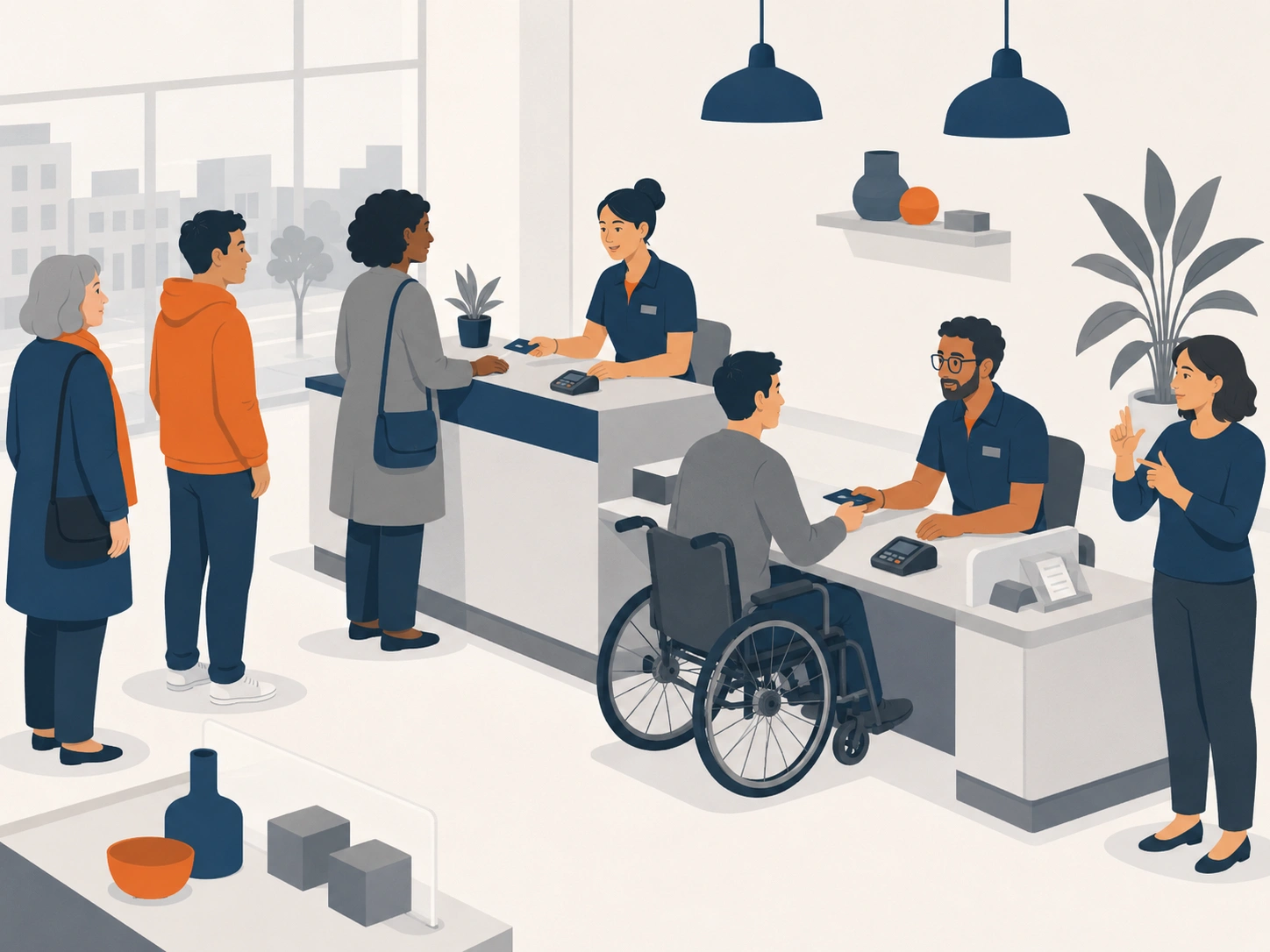
Equality looks different in different settings, although the underlying principle is constant.
At work
Equality means a fair recruitment process, equal pay for equal work, training and progression opportunities that aren't restricted by characteristics rather than capability, and a working environment free of harassment. The Worker Protection Act 2023, in force since October 2024, requires employers to take reasonable steps to prevent sexual harassment specifically.
In education
Schools, colleges and universities must not discriminate in admissions, in the provision of education or in exclusions. They must make reasonable adjustments for disabled pupils and students. They have specific duties under the Public Sector Equality Duty if they're publicly funded.
In healthcare and social care
Equality means equal access to services and adjustments where they're needed for someone to use those services. People can't be refused care because of any protected characteristic, and care plans should reflect individual needs including those connected to faith, culture, language and disability. We cover this in detail in equality and diversity in health and social care.
In public services more broadly
Councils, the police, transport, courts — equality means that the service is provided on the same terms to everyone, with adjustments where needed and with the public sector equality duty applied to significant decisions.
The most common misconception
The biggest misunderstanding about equality is the belief that it requires treating everyone identically. It doesn't, and the Equality Act explicitly accepts (and in some cases requires) treating people differently to achieve fair access.
The clearest example is the duty to make reasonable adjustments for disabled people. Under section 20 of the Equality Act, an employer must take reasonable steps to remove substantial disadvantage caused by a provision, criterion or practice, a physical feature, or the absence of an auxiliary aid. That's deliberately unequal treatment in the strict sense — the disabled employee is getting something the non-disabled employee isn't. It's the route to equal access.
Pregnancy and maternity protection works similarly. An employee on maternity leave gets time off and protections that her colleagues don't. The protections exist because pregnancy creates particular vulnerabilities that need particular safeguards.
Equality, properly understood, is the outcome — fair treatment, fair access, fair chances. It is not the procedure of giving everyone the same thing.
Frequently asked questions
What does equality mean in simple terms?
Equality means people are treated fairly, without unjustified disadvantage because of who they are. It doesn't always mean treating people identically — sometimes fairness requires adjustments to remove barriers that affect some people more than others.
What are the different types of equality?
The main types are formal equality (the same rules for everyone), equality of opportunity (a genuine chance to participate and progress), equality of outcome (watching for systematic differences in results), and equality before the law.
What is the difference between equality and equity?
Equality is about giving people the same starting point or the same rules. Equity is about giving people what they each need to reach a comparable outcome. UK law uses 'equality' as its primary term, but builds in equity-style interventions such as reasonable adjustments for disabled people.
Is equality the same as treating everyone the same?
No. Treating everyone identically often produces unequal outcomes because it ignores the different barriers people face. UK equality law explicitly allows and sometimes requires different treatment to achieve fair access — most clearly through the duty to make reasonable adjustments for disabled people.
Equality is one half of the standard UK workplace framing. The other half is diversity, and the relationship between them is covered in our equality and diversity guide. If you need this material delivered as training for your team or organisation, our Equality, Diversity & Inclusion Training course covers it in depth, with current treatment of the 2024 and 2026 legal changes.
Related guides
- Equality and Diversity in Health and Social Care: A UK Guide
- Equality Act 2010: The Complete UK Guide
- The Nine Protected Characteristics Under the Equality Act 2010
Looking for equality and diversity training? Get qualified fast with our CPD-accredited online course.
View course →
Mark writes about equality, diversity and inclusion, workplace compliance and accredited online training for Equality, Diversity & Inclusion Training, part of Online CPD Academy.