
'Equality and diversity' is one of those phrases that gets repeated until it loses its edge. It appears in HR handbooks, council strategies, NHS induction packs and almost every UK workplace policy. Yet ask ten people what it means and you'll get ten answers, most of them only half right. This guide separates the two ideas, places them in their UK legal context, and shows what the phrase actually involves in practice. It also covers what's changed since the Worker Protection Act of 2023 came into force and since the Supreme Court's April 2025 ruling on the meaning of sex.
What 'equality and diversity' means together
The phrase pairs two distinct ideas that work as a unit. Equality is about how people are treated — fairly, without unjustified disadvantage because of who they are. Diversity is about who is there in the first place — the mix of backgrounds, identities, experiences and perspectives present in a workplace, a school, a service, a society.
You need both, and they aren't interchangeable. A team can be perfectly equal in how it treats every member while being entirely uniform in who those members are. A team can be visibly diverse while treating some of its members worse than others. Equality without diversity is fairness in a monoculture; diversity without equality is representation without justice. The pair only works when both are present.
In UK practice the phrase has a particular legal shape, which the rest of this guide unpacks. It rests on the Equality Act 2010, the statute that brought together more than a hundred earlier pieces of equality law and now governs how people are protected from discrimination at work, in services, in education and in public functions.
What 'equality' means
Equality means treating people fairly so that no one is disadvantaged because of who they are. In UK law and practice it does not mean treating everyone identically. A wheelchair user and a colleague who runs marathons both need to reach the second floor — equality is about both being able to, not about both using the stairs.
Several types of equality matter at work. Equality of opportunity is the most familiar: the chance to apply, compete, progress and contribute is open on the same terms to everyone. Equality of outcome looks at whether actual results — pay, promotion, retention — show patterns that suggest some groups are losing ground. Equality before the law is the bedrock principle: the same rules apply to everyone.
For a deeper treatment, including the four main types of equality and what each looks like in practice, see our guide to what equality actually means.
What 'diversity' means
Diversity is the presence and value of difference within a group. The visible dimensions — ethnicity, gender, age, disability — are part of it. The less visible dimensions — neurodivergence, sexual orientation, religion or belief, socio-economic background, lived experience, ways of thinking — matter just as much. A diverse team isn't only one that looks varied in a group photograph. It's one whose members bring meaningfully different perspectives to the work.
That distinction matters in recruitment. Many UK employers have made their applicant pools look more diverse without changing how those candidates are then assessed, supported or promoted. The result is representation at the door without representation in the rooms where decisions get made.
For more, including the main dimensions of diversity and what they look like in UK workplaces, see what we mean by diversity.
The difference between equality and diversity
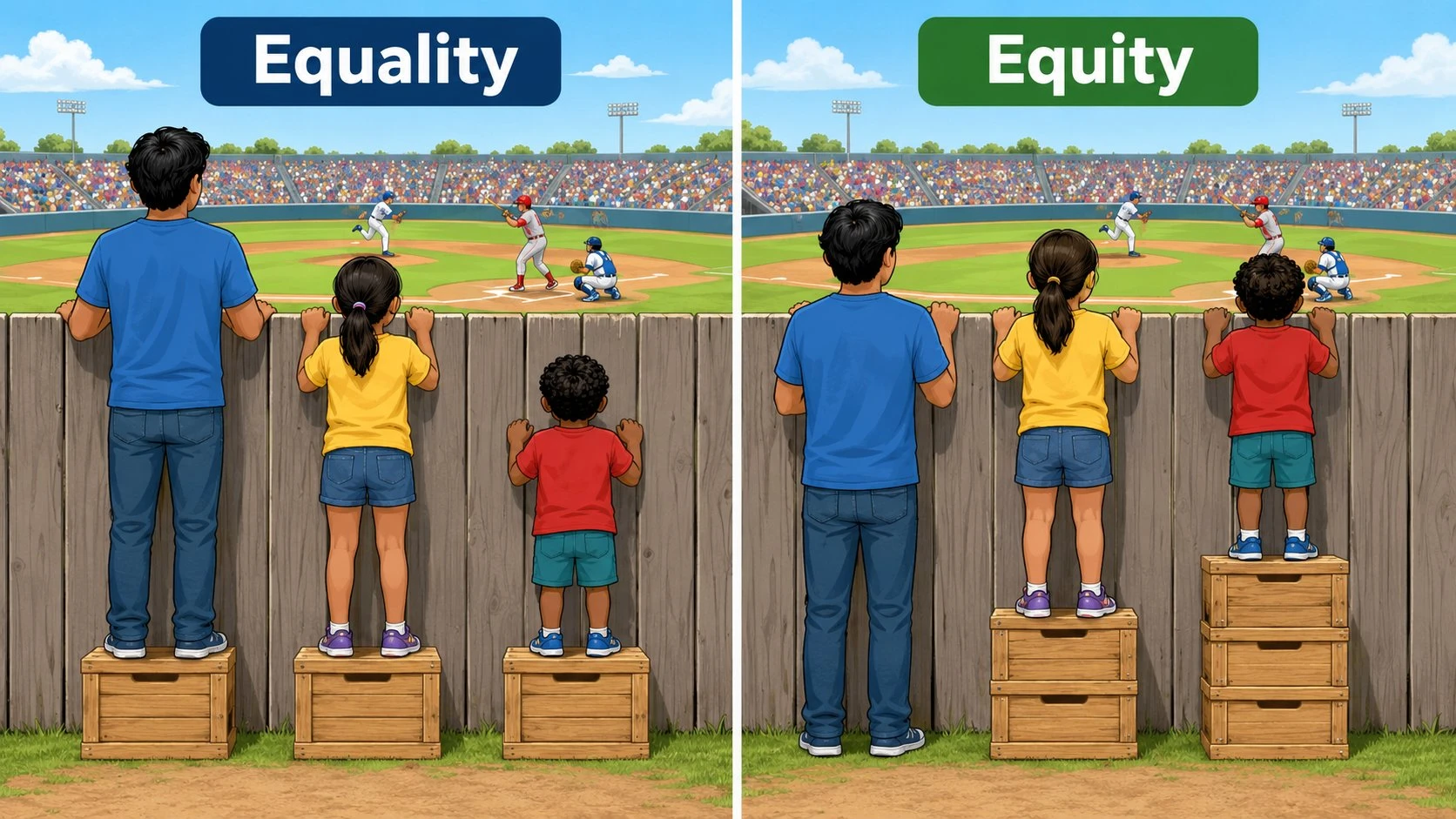
The clearest way to hold the two apart is to ask different questions.
Equality asks: Is this person being treated fairly? Are they getting the same access, the same chances, the same protections from harm? It's a question about treatment. The Equality Act answers it by listing nine protected characteristics and prohibiting four kinds of discrimination on those grounds.
Diversity asks: Who is here? Whose perspectives are in the room? Whose lives are reflected in how the service is designed? It's a question about composition.
The two interact. You can't deliver equality if you don't know who you're serving, which is why monitoring matters. You can't sustain diversity if some of the people you bring in are then treated badly, which is why inclusion matters. A good policy treats them as two halves of one job: fix the composition, fix the treatment, hold them in balance.
There's a related but distinct distinction — equality versus equity — which often gets confused with this one. Equity is about giving people what they specifically need to reach a comparable outcome; equality is about giving them the same starting point. We unpack that in equality vs equity.
How inclusion fits
Modern UK workplaces have largely moved from 'equality and diversity' to 'equality, diversity and inclusion' — usually shortened to EDI. The addition of 'inclusion' is meaningful. Inclusion is what happens when someone is in the room and also able to contribute fully: to speak, be heard, disagree without penalty, and develop without hitting an unspoken ceiling. It's the experience of belonging, not just the fact of attendance.
You can be diverse and not inclusive — many organisations are. Diverse hiring, then the new starters drift out because the culture wasn't built for them. You can also be inclusive within a narrow group — close, warm, supportive — without being diverse, because the people who'd find the culture awkward never joined in the first place. The three concepts are stacked: equality is the floor, diversity is the state, inclusion is what makes the state stable.
For the workplace framing in full, including how EDI differs from the American 'DEI' and where the newer 'EDIB' (with 'belonging') fits, see our guide to equality, diversity and inclusion in the UK workplace.
The UK legal context
The Equality Act 2010 is the central statute. It came into force on 1 October 2010 and replaced or consolidated more than 116 pieces of earlier legislation, including the Sex Discrimination Act 1975, the Race Relations Act 1976 and the Disability Discrimination Act 1995. The Act applies in England, Scotland and Wales; Northern Ireland has its own separate equality framework.
The Act protects nine characteristics: age, disability, gender reassignment, marriage and civil partnership, pregnancy and maternity, race, religion or belief, sex, and sexual orientation. It prohibits four main types of discrimination on those grounds — direct, indirect, harassment and victimisation — plus discrimination arising from disability and failure to make reasonable adjustments. The Equality and Human Rights Commission is the statutory regulator.
Public bodies have an additional duty — the Public Sector Equality Duty under section 149 — to have 'due regard' to the need to eliminate discrimination, advance equality of opportunity and foster good relations. Private employers and service providers aren't subject to that duty, but they are bound by the same prohibitions on discrimination and the same obligation to make reasonable adjustments for disabled people.
The Act has been amended twice in the last three years. The Worker Protection (Amendment of Equality Act 2010) Act 2023 came into force on 26 October 2024, creating an active duty on employers to take reasonable steps to prevent sexual harassment. The Employment Rights Act 2025 makes further changes that take effect in October 2026, including raising that standard to 'all' reasonable steps and reintroducing employer liability for third-party harassment across all protected characteristics. We cover the Act in full in our guide to the Equality Act 2010.
What this looks like in a UK workplace
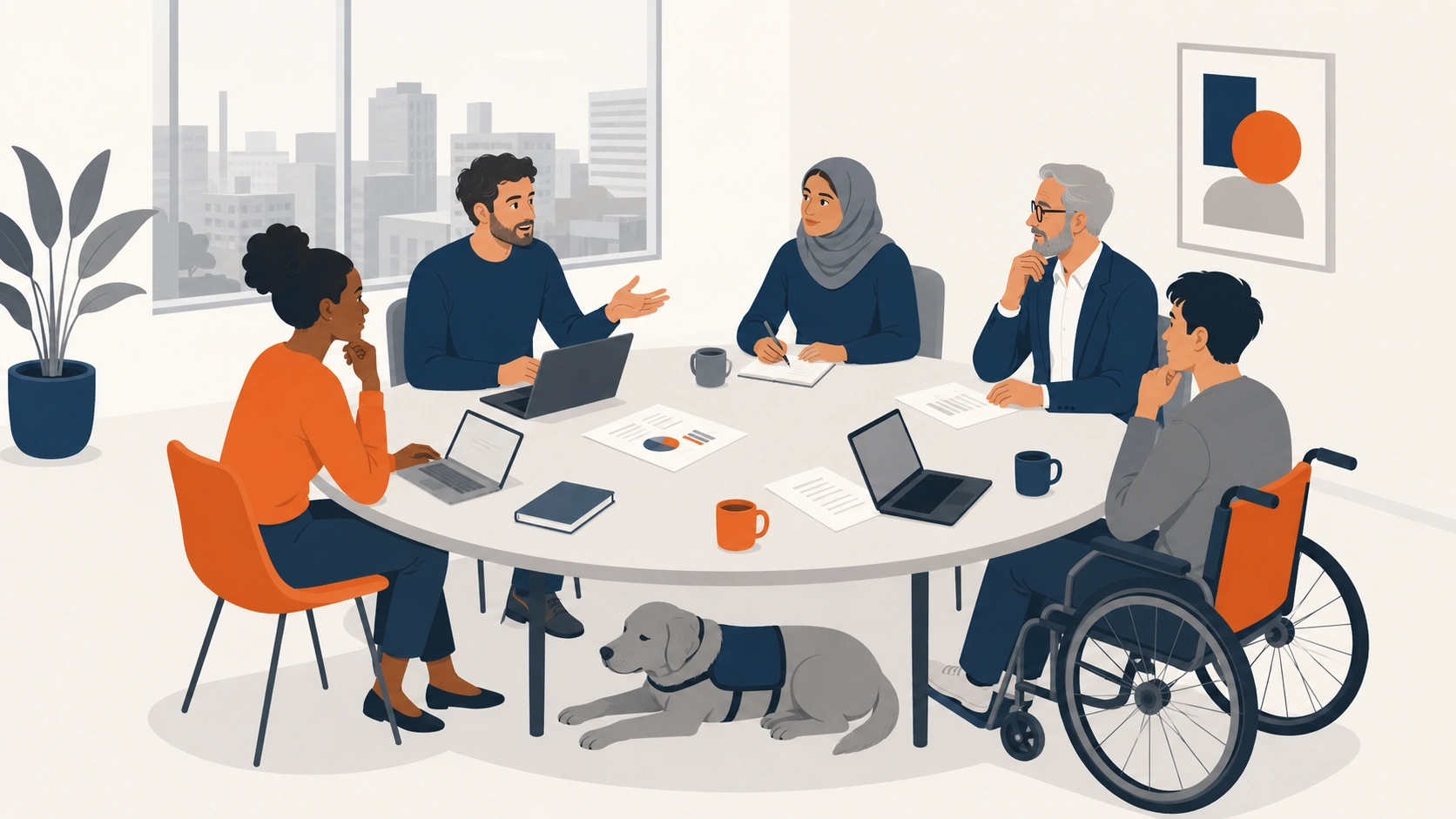
Equality and diversity show up in concrete decisions, not in framed statements on a wall. A few practical examples:
A recruitment manager redesigns the job application for a customer service role. The previous version asked for 'excellent communication skills' and three years of experience. The new version specifies the actual tasks (handling around 40 customer calls a day, resolving billing queries, escalating safeguarding concerns) and removes the experience requirement, on the grounds that it screened out younger and career-changing candidates without predicting performance.
A care home manager learns that one of the residents observes Ramadan. The kitchen rota is changed so that suhur and iftar meals are prepared at the right times, the night staff are briefed, and the resident's medication schedule is adjusted in consultation with the GP.
A team leader notices that the same two voices dominate every meeting, both from people with longer tenure. She introduces a five-minute structured round at the start of agenda discussions, where each person speaks once before anyone speaks twice. The team's quieter members start contributing more. The discussions get longer; the decisions get better.
A school's SENCo identifies that a Year 9 pupil with ADHD is being marked down for late homework. The reasonable adjustment is to allow submission by Friday rather than Monday, and to provide a written task summary at the end of each class so the pupil isn't relying on memory.
None of these are dramatic. They are the small accumulated decisions that make a workplace, a school or a care setting actually work for the range of people it serves.
Why it matters
The reasons are stacked rather than competing. The moral case is the strongest one and the one most people start with: treating people fairly because they are people is its own justification. The legal case is the most concrete: the Equality Act is enforceable through Employment Tribunals and through the EHRC's regulatory powers, and getting it wrong is expensive in time, money and reputation.
The business case is the most contested. Companies with more diverse leadership teams have been linked in various studies to better financial performance, but the underlying evidence is more mixed than the headline numbers suggest, and the direction of causation isn't always clear. What's more reliably true is that organisations that take equality and diversity seriously tend to attract a wider talent pool, retain people for longer, and make decisions that are tested against a wider range of viewpoints — all of which are valuable in their own right. Our page on why diversity matters sets out the evidence and the disputes honestly.
Specific sectors
Some sectors carry additional duties. Public sector employers are bound by the Public Sector Equality Duty and often by published equality objectives; many will conduct equality impact assessments before significant policy changes. Health and social care is governed by Care Certificate Standard 4 alongside the Equality Act, the Care Act 2014 and the Human Rights Act 1998 — covered in our guide to equality and diversity in health and social care. Education has its own statutory framework. The general principles are the same; the specific duties differ.
What's changed recently
Three developments are reshaping UK equality practice and any current policy needs to reflect them.
The Worker Protection Act 2023 has been in force since October 2024. Employers now have an active duty to take reasonable steps to prevent sexual harassment of their workers. Tribunals can uplift discrimination compensation by up to 25% where the duty hasn't been met. The bar rises again in October 2026 under the Employment Rights Act 2025, when the standard becomes 'all reasonable steps' and the duty extends to harassment by third parties — customers, contractors, members of the public — for every protected characteristic, not just sex.
The Supreme Court ruled in For Women Scotland Ltd v The Scottish Ministers on 16 April 2025 that the terms 'sex', 'man' and 'woman' in the Equality Act mean biological sex. A Gender Recognition Certificate does not change a person's legal sex for the purposes of the Act. Transgender people retain protection through the separate characteristic of gender reassignment. Any equality policy or training material drafted before that date needs revisiting.
Frequently asked questions
What is equality and diversity in simple terms?
Equality is the fair treatment of people, regardless of who they are. Diversity is the mix of people present in a workplace or service. Together they describe both how people are treated and who is there to be treated.
What is the difference between equality and diversity?
Equality is about treatment — fair access, opportunity and protection. Diversity is about composition — who is in the room. You can have one without the other, which is why both need active attention.
What are the nine protected characteristics under the Equality Act?
Age, disability, gender reassignment, marriage and civil partnership, pregnancy and maternity, race, religion or belief, sex, and sexual orientation. These are set out in section 4 of the Act.
Is equality and diversity training legally required in the UK?
Training itself is not directly required by statute. However, employers have legal duties to prevent discrimination and harassment, and providing appropriate training is one of the principal ways tribunals expect those duties to be met — particularly under the sexual harassment prevention duty introduced in October 2024.
What is the difference between EDI and DEI?
EDI (equality, diversity and inclusion) is the standard UK framing. DEI (diversity, equity and inclusion) is the more common American framing, substituting equity for equality and putting diversity first. The concepts overlap heavily but the emphasis and legal context differ.
Equality and diversity is a wide topic and this guide is the gateway to the rest of our writing on it. If you'd like the same ground covered as training for your team or organisation, our Equality, Diversity & Inclusion Training course brings it together in a single programme suitable for staff at any level, with up-to-date coverage of the 2024 and 2026 legal changes.
Related guides
- What is equality? The four types explained
- What is diversity? Dimensions and meaning
- Equality Act 2010: the complete UK guide
Get the same ground covered as accredited training for your team or organisation.
Explore the Equality, Diversity & Inclusion Training course →
Mark writes about workplace equality, diversity and inclusion and accredited online training for Equality, Diversity & Inclusion Training, part of Online CPD Academy.