
Flexible working is now the default expectation of the UK labour market rather than the exception, but the headline picture hides sharp divides by income, qualification and disability. This page compiles the key UK working-pattern numbers in one fully cited reference, drawing on the Office for National Statistics (ONS) analysis of who has access to hybrid working, the CIPD’s annual Flexible and hybrid working practices report, Labour Force Survey contract data published via Statista, and GOV.UK and Acas material on the day-one right to request flexible working that took effect on 6 April 2024. It covers hybrid uptake, flexi-time contracts and how requests are handled; because flexible working is the single adjustment carers, disabled and menopausal staff most often ask for, it also frames who relies on flexibility most as an equality issue.
Key facts and figures
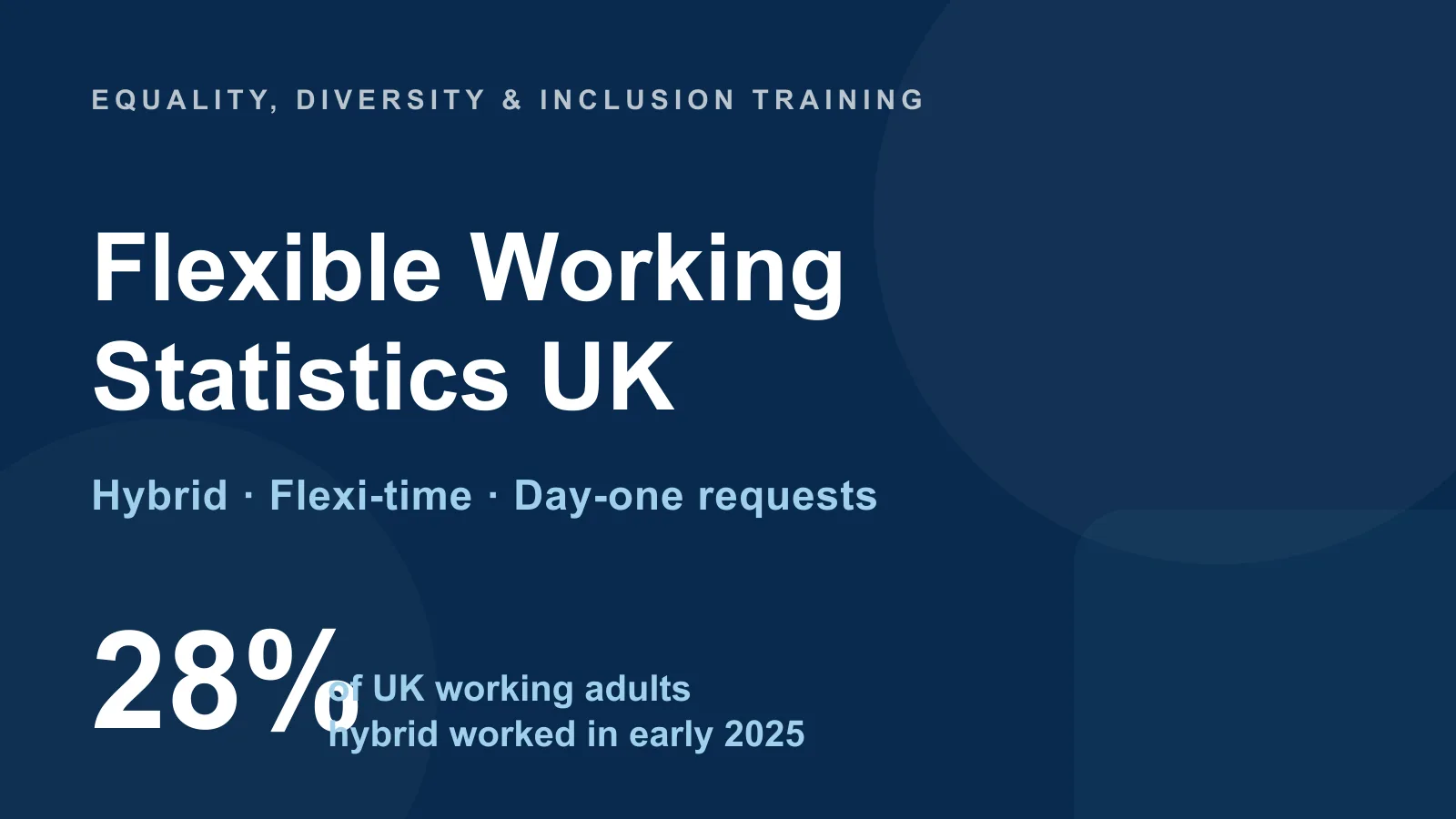
- 28% of working adults in Great Britain were hybrid workers between January and March 2025 (ONS, June 2025).
- 91% of employers offer some form of flexible working arrangement, and 74% say they have hybrid working in place — down from 84% in 2023 (CIPD, July 2025).
- Around 4.4 million UK employees held flexi-time contracts in 2025 — the most common flexible arrangement, up from 3.22 million in 2013 (ONS Labour Force Survey via Statista, 2025).
- 10 times — degree-holders were about ten times more likely to hybrid work (41%) than those with no qualifications (4%) in Jan–Mar 2025 (ONS, June 2025).
- 45% vs 8% — hybrid working among those earning over £50,000 versus under £20,000 (Jan–Mar 2025, ONS).
- 2.2 million more employees were brought into scope of the right to request flexible working by the 6 April 2024 day-one reform (GOV.UK, 2024).
- 18% of employers saw an increase in flexible working requests after the day-one right took effect (CIPD, July 2025).
- Around 1.1 million workers (3% of employees) left a job in the past year because of a lack of flexibility — down from about 2 million (6%) the year before (CIPD, July 2025).
These figures are the latest available as of July 2026. The main refresh points are the ONS “who has access to hybrid working” analysis (roughly annual/mid-year; the current release covers Jan–Mar 2025 and was published 11 June 2025), the CIPD Flexible and hybrid working practices report each July, and the flexi-time contract count as new Labour Force Survey annual data flows through.
What percentage of UK workers work flexibly or hybrid?
28% of working adults in Great Britain were hybrid workers between January and March 2025, according to the ONS analysis Who has access to hybrid working in Great Britain? (published 11 June 2025). Hybrid working — splitting time between home and a workplace — has settled into a stable share of the workforce after the sharp swings of the pandemic years, rather than continuing to climb.
Flexibility is much broader than hybrid, though. On the employer side, the CIPD’s July 2025 report finds 91% of organisations offer some form of flexible working arrangement — a category that spans flexi-time, part-time hours, compressed weeks, job shares, staggered hours and term-time working, not just home-based days. Hybrid specifically is offered by 74% of organisations, down from 84% in 2023, the first clear sign of a partial pull-back from the post-pandemic peak. So while hybrid access has plateaued or dipped, the wider promise of “some flexibility” is now near-universal in principle, even where it is not always used in practice.
How many people have flexi-time contracts?
Around 4.4 million UK employees held flexi-time contracts in 2025, making flexi-time the single most common formal flexible-working arrangement, according to Labour Force Survey data published via Statista (ONS underlying, 2025). That is up from 3.22 million in 2013 — a long, steady climb rather than a pandemic spike, since flexi-time is about when hours are worked rather than where.
Flexi-time (variable start and finish times around core hours) sits alongside other contractual arrangements — annualised hours, term-time-only working, job sharing and zero-hours contracts — but is consistently the largest of the “positive” flexible categories in the series. The table below sets the flexi-time figure against the broader employer and worker picture.
| Measure | Figure | Period / source |
|---|---|---|
| Employees with flexi-time contracts | ~4.4 million | 2025; up from 3.22m in 2013 (LFS via Statista) |
| Working adults hybrid working | 28% | Jan–Mar 2025 (ONS) |
| Employers offering some flexible working | 91% | 2025 (CIPD) |
| Employers with hybrid working in place | 74% (was 84% in 2023) | 2025 (CIPD) |
| Employers requiring minimum office days | 65% | 2025 (CIPD) |
Source: ONS Labour Force Survey via Statista (2025); ONS hybrid-working analysis (June 2025); CIPD Flexible and hybrid working practices in 2025 (July 2025). Treat all three series as annual.
Which workers actually get to work hybrid?
Degree-holders were around ten times more likely to hybrid work (41%) than those with no qualifications (4%) in January to March 2025 (ONS, June 2025). The same analysis shows the hybrid workforce is heavily concentrated among higher earners and professional occupations — flexibility is not distributed evenly across the labour market, and that is exactly where it becomes an equality question rather than a perk.
The income gradient is just as steep. 45% of workers earning over £50,000 hybrid worked, against just 8% of those earning under £20,000 (Jan–Mar 2025, ONS). Hybrid working clusters in office-based, degree-level, higher-paid roles; front-line, manual and lower-paid jobs — retail, care, hospitality, warehousing — are largely place-bound and see little of it.
Disability adds another layer. Disabled workers were slightly less likely to hybrid work (24%) than non-disabled workers (29%) in Jan–Mar 2025 (ONS, June 2025) — a notable gap given that flexible and home-based working is one of the most frequently requested reasonable adjustments under the Equality Act 2010. Part of the explanation is occupational: disabled people are over-represented in the kinds of roles where hybrid is not on offer at all, which means the groups who might benefit most from flexibility are not always the ones getting it. For the wider picture of disabled people’s access to work, see our disability employment gap statistics.
| Group | Hybrid working rate, Jan–Mar 2025 |
|---|---|
| Workers with a degree | 41% |
| Workers with no qualifications | 4% |
| Earning over £50,000 | 45% |
| Earning under £20,000 | 8% |
| Non-disabled workers | 29% |
| Disabled workers | 24% |
Source: ONS, Who has access to hybrid working in Great Britain? (11 June 2025), covering January to March 2025.
Who has the legal right to request flexible working?
Every employee has had a day-one right to request flexible working since 6 April 2024, a reform GOV.UK estimated would bring an additional 2.2 million employees into scope of the entitlement (GOV.UK, 2024). Before that date, the Employment Relations (Flexible Working) Act 2023 required 26 weeks’ continuous service before a request could be made; the reform removed the qualifying period entirely.
The same package of changes let employees make two requests in any 12-month period (up from one), removed the requirement to explain the business impact of the request, and required employers to consult before refusing and to respond within two months (down from three). Employers can still refuse on one of eight statutory business grounds. A statutory right to request is not a right to be granted flexibility — but the day-one change materially widened who can ask, especially newer starters, carers and disabled employees who previously had to wait half a year.
The reform sits inside the Equality Act framework: refusing flexible working can amount to indirect sex discrimination where it disproportionately disadvantages women with caring responsibilities, or a failure to make reasonable adjustments where it relates to disability. For the underlying law, see our guide to the Equality Act 2010 and the nine protected characteristics.
How have flexible working requests changed since the day-one right?
18% of employers reported an increase in flexible working requests since the day-one right took effect, according to the CIPD’s Flexible and hybrid working practices in 2025 report (July 2025). The response has been evolutionary rather than a surge — most employers already handled informal flexibility, so the day-one right formalised existing behaviour more than it unleashed a wave of new demand.
Awareness was a real problem at the outset. Acas found that around the April 2024 changes, 43% of employers and 70% of employees were unaware of the new flexible-working rules (Acas, 2024), which published a new statutory Code of Practice on handling requests to coincide with the reform. Low initial awareness is one reason the measured rise in requests has been modest so far.
There is also a confidence gap on the employee side. The CIPD found 30% of employees would not feel comfortable making a formal flexible working request, and 31% said the same about asking informally (July 2025). A legal right to request only translates into take-up if workers feel able to use it without penalty — and for a substantial minority, that comfort is missing.
Are employers pulling back to the office?
65% of organisations require employees to be in the workplace a minimum number of days per week or month, and 14% of hybrid-allowing employers plan to introduce or increase mandatory office days (CIPD, July 2025). Alongside the fall in employers reporting hybrid working in place — from 84% in 2023 to 74% in 2025 — this is the clearest evidence of a partial return-to-office tightening, even as overall flexible-working provision stays high.
The market cost of getting this wrong is measurable. The CIPD estimates around 1.1 million workers (3% of employees) left a job in the past year because of a lack of flexible working — though notably that is down from about 2 million (6%) the year before, suggesting either that provision has caught up with expectations or that a cooler labour market has made workers less willing to walk. Either way, flexibility remains a live retention lever, not just a compliance obligation.
How many jobs are advertised as flexible?
Just 31% of UK job adverts overtly offered flexible working in 2023, up only one percentage point on 2022 (30%), after analysis of 5.7 million vacancies in the Timewise Flexible Jobs Index (2023, 9th edition). The gap between the near-universal offer of flexibility inside organisations (91% per CIPD) and the fewer than one in three vacancies that mention it up front is one of the most persistent findings in the field.
That gap matters for equality of access. Candidates who need flexibility from day one — carers, disabled applicants, parents, people managing health conditions — cannot tell from most adverts whether a role will accommodate them, so many self-select out before applying. Making flexibility explicit at the advertising stage is widely argued to widen the applicant pool; the Timewise series shows the advertised share has barely moved despite that argument being made for years. (Timewise has not published a complete new edition since 2023, so the 31% figure remains the most recent full-index number.)
Which groups most rely on flexible working?
Flexible working is the single most-valued support measure among women experiencing menopause — cited by 48% of respondents — yet only 26% of organisations offer planned flexibility for that purpose (CIPD menopause report, 2023). That mismatch captures the equality argument for flexibility in one line: it is the top-requested adjustment for a group that faces real barriers to staying and progressing at work, but provision lags demand.
The same pattern recurs across the groups covered elsewhere in this cluster. Flexible and home-based working is one of the most common reasonable adjustments requested by disabled employees; it is the lever carers use to combine work with unpaid care; and it is central to how parents share caring after a birth. In other words, the equality significance of flexible working is less about the average worker and more about the specific groups for whom it is the difference between staying in work and dropping out. For the connected topics, see our statistics pages on the disability employment gap, menopause in the workplace, women in leadership and shared parental leave.
Frequently asked questions
What percentage of UK workers work flexibly or hybrid?
28% of working adults in Great Britain were hybrid workers in January to March 2025 (ONS, June 2025). Flexibility is broader than hybrid: 91% of employers offer some form of flexible working, 74% have hybrid working in place, and around 4.4 million employees held flexi-time contracts in 2025.
How many flexible working requests have been made since the day-one right in 2024?
There is no single national count, but the CIPD found that 18% of employers reported an increase in flexible working requests since the day-one right took effect on 6 April 2024 (July 2025). Uptake has been modest partly because awareness was low at the start — Acas found 43% of employers and 70% of employees were unaware of the changes in 2024.
Who has the legal right to request flexible working in the UK?
Since 6 April 2024, every employee has had a day-one right to request flexible working, with no qualifying service period. GOV.UK estimated the reform brought an extra 2.2 million employees into scope. Employees can make two requests in any 12-month period, and employers must respond within two months and can only refuse on one of eight statutory business grounds.
Which groups most rely on flexible working?
Flexibility is used most by carers, disabled employees, parents and women managing menopause. It is the most-valued menopause support measure (48% of respondents, CIPD 2023) and one of the most common reasonable adjustments requested by disabled staff. Yet hybrid working itself skews to higher earners and degree-holders (45% of those earning over £50,000 versus 8% under £20,000).
How many people have flexi-time contracts in the UK?
Around 4.4 million UK employees held flexi-time contracts in 2025, up from 3.22 million in 2013, making flexi-time the most common formal flexible-working arrangement (ONS Labour Force Survey via Statista, 2025).
Are UK employers cutting back on hybrid working?
Partly. The share of employers with hybrid working in place fell from 84% in 2023 to 74% in 2025, 65% now require a minimum number of office days, and 14% of hybrid-allowing employers plan to introduce or increase mandatory office days (CIPD, July 2025). Overall flexible-working provision, however, remains near-universal at 91%.
Related guides
- Disability Employment Gap Statistics UK
- Menopause in the Workplace Statistics UK
- Shared Parental Leave & Paternity Statistics UK
- Reasonable Adjustments Under the Equality Act 2010
- Equality Act 2010: The Complete UK Guide
Sources & references
- Office for National Statistics — Who has access to hybrid working in Great Britain? (Jan–Mar 2025, published 11 June 2025)
- CIPD — Flexible and hybrid working practices in 2025 (published 15 July 2025)
- Statista — Number of employees on flexible-working contracts by type, UK (ONS Labour Force Survey underlying, 2025)
- Timewise — Flexible Jobs Index (2023, 9th edition; analysis of 5.7 million vacancies)
- GOV.UK — Millions to benefit from new flexible working measures (day-one right, in force 6 April 2024)
- Acas — Introducing the new Acas Code of Practice on requests for flexible working (April 2024)
- CIPD — Menopause in the workplace: employee experiences (October 2023)
Flexible working, reasonable adjustments and the right to request all sit within the Equality Act 2010 — make sure your managers and HR team handle requests fairly and confidently.
Explore the Equality, Diversity & Inclusion course →
Mark writes about equality, diversity and inclusion, UK workplace compliance and accredited online training for Equality, Diversity & Inclusion Training, part of Online CPD Academy.